Dispatch
How to Optimize Dumpster Dispatch Routes: A Practical Guide for Haulers
The nearest landfill and the cheapest landfill are usually different decisions once mileage, driver hours and the gate fee are counted. Here is how to sequence a real roll-off day.
By Daniel Teixeira Founder, Dumpster ControlsUpdated September 28, 2026 3 min read
To optimize dumpster dispatch routes, treat the day as a cycle (empty truck, full can, empty can, landfill, yard) and sequence the cycle: group stops by zone, cluster deliveries next to pickups, plan around the landfill run and put fixed time windows first. Measure stops per driver per day. In Dumpster Controls the board, the live map and an AI route suggestion per driver ship on the free plan.
The short version
- A roll-off day is a cycle, not a list of stops. Empty truck, full can, empty can, landfill, back to the yard. Sequence the cycle and the miles fall out on their own.
- Four habits work at any size: zones, clustering, landfill-centric routing and time windows. None of them needs software; all of them get easier with it.
- Measure stops per driver per day. The FAQ below gives the working range. Everything else on this page exists to move that number.
- The tools are free. The board, the live map and AI route suggestions ship on the free plan of dumpster rental software from Dumpster Controls.
Dispatch efficiency decides whether a dumpster rental operation is profitable or merely busy. Two companies with the same trucks and the same drivers can finish very different days, and the difference is almost always the sequence of stops.
Why dumpster dispatch software decides your margin
In a roll-off operation every truck movement has a direct cost and an opportunity cost. A driver crossing town for one stop is not delivering a can, and the can that stays on the truck is not earning either.
Per mile
Fuel and wear
A roll-off truck burns fuel by the mile and the load. Fewer miles per job means less fuel and less maintenance per rental.
Per hour
Driver hours
Every wasted hour on the road is one fewer delivery or pickup that day. Driver time is the cost you cannot recover.
Windows
Customer promises
Tight routing lets you promise narrower delivery windows, which is what contractors remember and refer.
Utilization
Turn rate
A can picked up on a tight route is back on the next job sooner. Dispatch and utilization are the same problem seen from two sides.
In practice: Count miles per completed stop, not miles per day, and sequence around the landfill run, because that is the leg that repeats every day. Fix the sequence before buying a truck.
Dumpster route optimization: four strategies that work at any size
None of these require software. They are habits, and the best dispatchers run them from memory; software makes them repeatable when the owner is not the one dispatching.
1
Zone-based dispatching
Split the service area into a few zones by geography and demand. Give each driver a zone for the day, allow overflow only when a zone is empty, and rotate zones weekly.
2
Cluster scheduling
Batch deliveries and pickups that sit close to each other instead of alternating between distant addresses. The travel between stops is where the day leaks.
3
Landfill-centric routing
Every haul-off ends at a disposal site. Check the gate fee, because the closest site is often not the cheapest. Fees by facility: the open landfill database.
4
Time-window management
Put the stops with fixed windows first and fill the flexible ones around them. A route built the other way around gets rebuilt at ten in the morning.
Read it: In a market with several facilities, the difference in tipping fee can outweigh the difference in miles. The disposal choice belongs in the route plan, not after it.
Software-assisted dispatch: the board, the map and the suggestion
Manual dispatch works while the owner holds the whole day in their head. It stops working the day a second person has to hold it too, and dumpster dispatch software makes the day visible to everyone at once.
Drag-and-drop board
One lane per driver, one card per task. Drag a delivery onto a lane and it is assigned; reorder stops inside the lane with the same motion.
Live map with truck states
The map draws each leg by type and each line solid or dashed depending on whether the truck carries a can. Impossible sequences get a warning.
Next-delivery suggestion
When a truck frees up with an empty can of a matching size, the board suggests the next delivery for it at the top. One click assigns it.
AI route suggestion
AI Routes reorders one driver's remaining stops for the shortest day, checked against the real truck cycle. Nothing moves until you click Apply.
Stops in progress or completed never move.
Same-day changes
Live driver positions let a dispatcher move a task to another lane when a job runs long, from the desk or from a phone.
Tresha, by voice
Ask which driver is closest or complete a landfill run from the chat, behind a confirmation card; reassigning a stop works through the MCP server in Claude. More: Tresha AI.
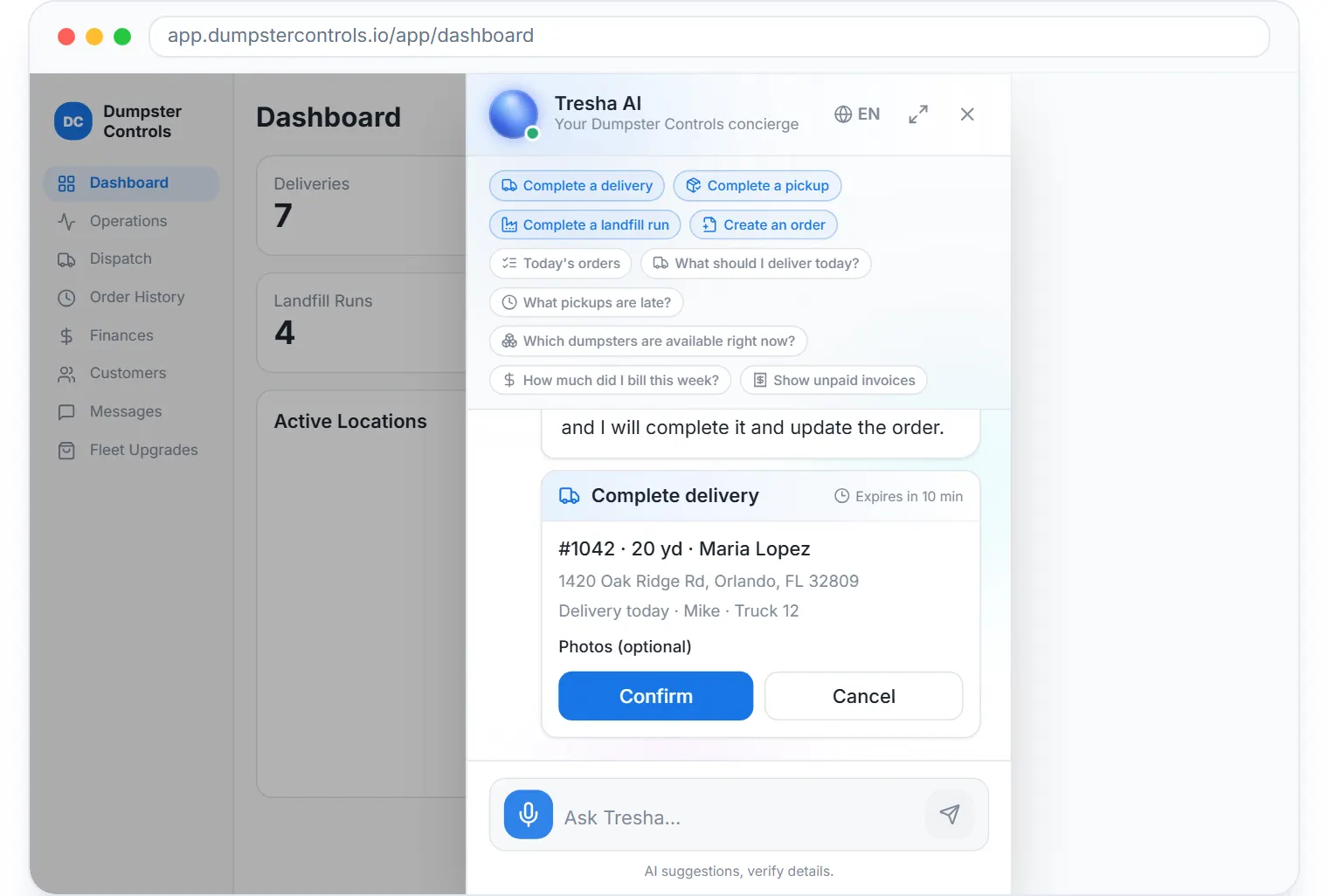
Tresha, the built-in assistant, by chat or voice: useful when the dispatcher is also the driver. Real screen, sample data.
AI route suggestion, step by step
The suggestion works on one driver's lane at a time, on today's board. It is a preview with a stated premise about the truck, and you decide.
1
Open the driver's route
Click the driver's block in the lane. The map panel opens on that driver's route.
2
Click AI Routes
The purple button, in the lane or at the top of the route panel. The panel enters preview mode.
3
Read the truck premise
"Truck starts empty" or "Truck starts with a full dumpster", and where that came from. If it says best guess, confirm it.
4
Read the proposed order
Purple arrows and renumbered pins on the map; the list shows moves like "5 → 1", with trips back to the yard as their own rows.
5
Check the estimated gain
A green banner with the approximate miles and minutes saved. Distances are straight-line estimates.
6
Apply order or Dismiss
Apply reorders the lane in one step; Undo stays available for 10 seconds. If the lane changed meanwhile, click Suggest again.
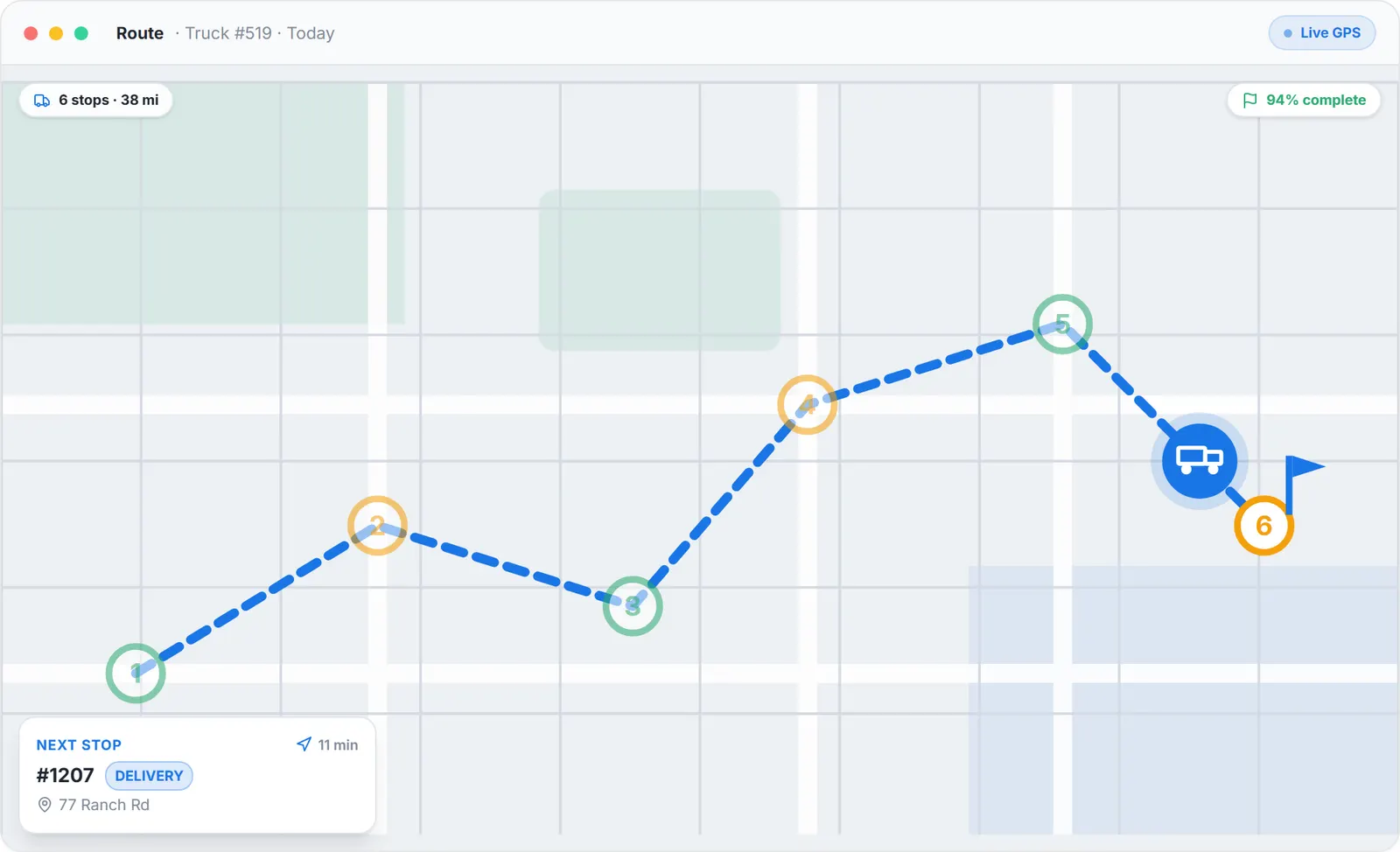
One driver's route with the stops in order, on the real dispatch map. Sample data.
In practice: If the suggestion says the route is already in great shape, that is a valid answer, not an error. The vendor list and what each charges for the same tools is on the dumpster rental software cost page.
How to measure dispatch efficiency
You cannot fix a sequence you do not measure. Six numbers, tracked weekly, tell you whether dispatch is improving.
Primary
Stops per driver per day
The main productivity number. The working range for urban and suburban roll-off is in the FAQ below.
Lower is better
Miles between stops
Track it per driver and per zone, and watch it rise when a zone gets diluted.
Promises
On-time rate
Deliveries made inside the promised window, as a share of all deliveries.
Waste
Empty return trips
Trips where the truck comes back to the yard with no can. Schedule pickups near deliveries to cut them.
Gate
Landfill wait time
Time at the gate and the scale. If one facility is always slow, the cheaper site down the road may be the faster one too.
The real test
Profit per order
Price minus landfill, fuel and driver time. See dumpster financial software.
Common dispatch mistakes, before and after
Most routing problems are not exotic. They are the same five habits, repeated because nobody wrote the alternative down.
Before
- Orders dispatched in the sequence they were received.
- A delivery on the east side followed by a pickup on the west side.
- Delivery windows promised before the route exists.
- A haul-off scheduled as the nearest landfill is closing.
- Everything in the dispatcher's head, past the point where one head can hold it.
After
- Orders grouped by zone and sequenced by geography.
- Pickups scheduled next to deliveries so the truck rarely runs empty.
- Windows promised from the plan, and kept.
- Landfill hours and fees in the plan, before the truck rolls.
- A board and a map that any dispatcher can read on a Monday.
The route is built before the trucks leave. The day happens after. Good dispatch software absorbs the second part without making you rebuild the first.
Scaling dispatch as you add trucks
Dispatch complexity does not grow in a straight line. Going from two drivers to four does not double the scheduling work; it multiplies the possible route combinations.
1
A dedicated dispatcher
Separate dispatch from the owner's day once drivers outnumber what one person can hold while also selling and invoicing.
2
Standard plays
Write down the repeatable scenarios: same-day delivery, next-day pickup, swap requests. New dispatchers run the play instead of improvising.
3
Drivers see the whole day
A driver app with the full schedule lets drivers manage timing between stops instead of calling the office. See the dumpster driver app.
4
Plan in the afternoon
Build tomorrow's routes today. The morning is for the changes that always come.
For the wider picture, including hiring order and pricing, read how to scale a dumpster rental business. For the disposal side of routing, the dumpster route optimization page goes deeper.
Dumpster dispatch routes: frequently asked questions
What is dumpster dispatch optimization?
Dispatch optimization is the process of assigning drivers to jobs and sequencing stops in a way that minimizes travel time, fuel costs, and idle periods while maximizing the number of completed tasks per day.
How many stops can a roll-off driver complete per day?
A well-routed driver in an urban or suburban area can typically complete 6 to 10 stops per day, depending on haul distances and landfill wait times. Without optimization, this often drops to 4 to 6 stops.
Does AI improve dispatch efficiency?
It helps with the sequence. In Dumpster Controls, AI Routes reorders one driver's remaining stops on today's board for the shortest day, checked against the real roll-off truck cycle, and shows the estimated gain before anything changes. You review the preview and apply it or dismiss it; stops in progress or completed never move.
What is zone-based dispatching?
Zone-based dispatching assigns drivers to specific geographic areas, reducing cross-town travel and improving response times. It works best in markets with concentrated demand in distinct neighborhoods or zip codes.
How do landfill locations affect routing?
Landfill proximity is a major routing factor. Each haul-off requires a round trip to the landfill, so operators positioned closer to disposal sites have a structural cost and time advantage.