Product Updated 2026-09-27 9 min read
The AI That Completes Your Orders: Running a Dumpster Business From a Chat
DC
Dumpster Controls Team
Editorial team, reviewed against the shipped product
On August 21, 2026, a real pickup, on a real order, at a real Jacksonville job site, was completed without anyone opening a dispatch screen. The dispatcher typed one sentence to Tresha, our built-in AI, and tapped one confirmation card.
The order advanced, the customer was notified, the photos attached, the books updated. The screens did not disappear. They just stopped being required.
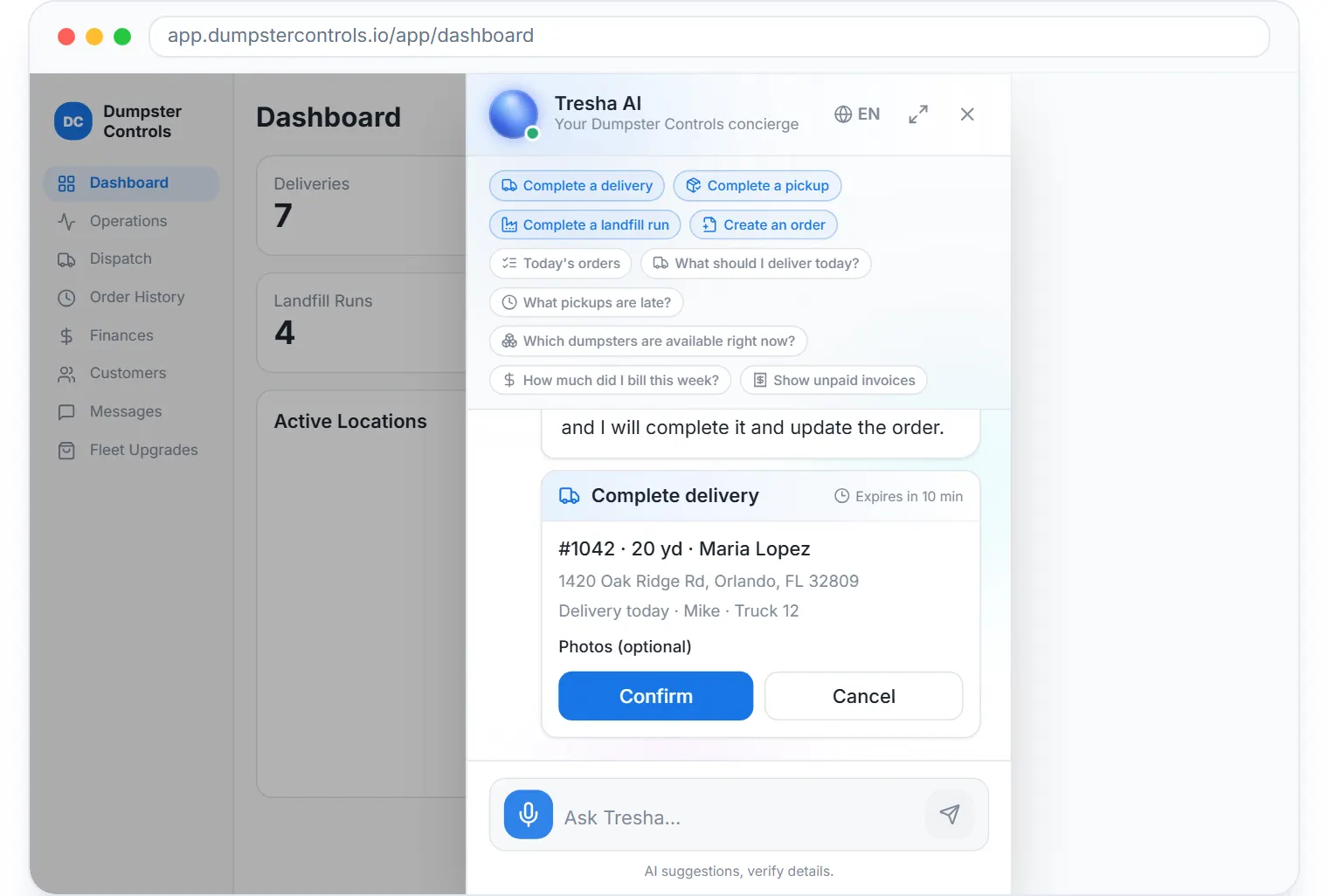
Tresha, the built-in assistant, by chat or voice, sample data.
The moment dumpster software stopped needing screens
Every field-service platform, ours included, has spent a decade building screens: boards, forms, drawers, tabs. Screens are how software asks you to translate your intent ("that pickup is done") into its language: find the order, open the task, scroll, tap, tap, confirm.
The translation is the friction. A dispatcher juggling phones does it dozens of times a day; a driver wearing gloves in the rain does it on a 6-inch screen.
Chat flips the direction. You say what happened in your own words, and the software does the finding, the opening and the tapping. Tresha has answered questions this way since early 2026, and now she executes: completing deliveries, pickups and landfill runs from the chat, live for every company on dumpster rental software from Dumpster Controls, including the free plan.
See it: a pickup completed by chat
This is the real flow, recreated with sample data. The dispatcher does not know the order number, only the address, and that is enough.
Step 1: say it in your own words. Tresha finds the real task and proposes, never executes.
The card is the contract. It shows the real order number, customer, container size, address and date pulled from the live database, and it expires after 10 minutes.
Photos are optional, exactly like the app, taken right on the card with the same GPS and date stamp the driver app applies. Confirm with no photo and Tresha asks "Complete without any photo?" first.
Nothing executes until the Confirm button is physically tapped: not from text, not from voice, not from the AI deciding on its own.
Step 2: one tap. The same server functions the app buttons call do the work.
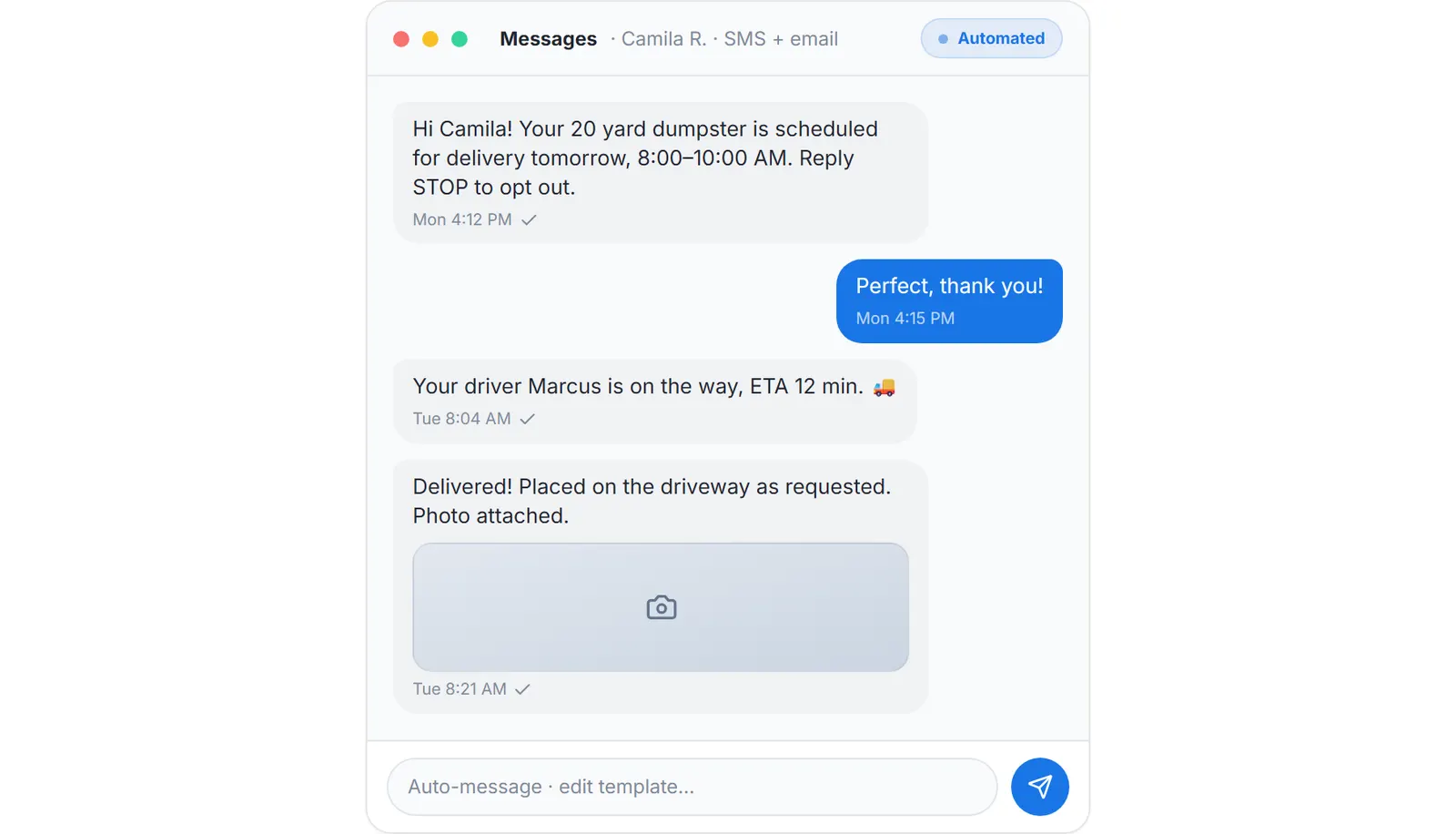
The customer gets the same text they would get from the app button. Sample data.
The dump ticket reads itself
The landfill run is where the chat flow gets almost unfair. Completing it collects the two numbers that decide whether the job made money: net weight and cost. In the app, someone types them; in the chat, attach the scale ticket photo and Tresha reads them.
Attach the ticket photo; AI vision extracts the net tons and the cost. You check, you confirm.
The reading handles the messy reality of scale tickets. Weights printed in pounds get converted to tons, tickets that only show gross and tare get their net computed, and anything the AI cannot read with confidence comes back blank for manual entry instead of a guess.
The ticket photo, the tons and the cost are saved on the order the same way the driver app saves them, so your per-order profit numbers stay complete.
Why it is safe to let AI touch your orders
"AI that executes" is easy to demo and hard to trust. We built the trust layer first, because it is the difference between a feature and a liability.
Propose, never act
The AI's only writing power is a proposal a human confirms by tap. The proposal is validated server-side and expires in 10 minutes.
Your identity, not the AI's
Confirmed actions run under your own account through the same server functions the app buttons call. A driver can only complete their own stops.
Same rules as the app
Only tasks scheduled up to today. Landfill runs always collect weight and cost. Skipping the ticket photo takes an explicit extra confirmation.
Money is excluded
No refunds, no charges, no price changes from the chat. Those keep their dedicated screens.
Everything is audited
Every conversation, tool call and executed action leaves an audit trail marked as coming through Tresha.
Feedback is one tap away
Every completed or failed card carries a Report a problem button that opens a pre-filled support ticket, answered within 24 hours on every plan.
Why chat-first is the future of dumpster dispatch software
The dumpster business happens in trucks, at job sites, at the scale house. The screens were always a compromise: the work is spoken ("the can at Collins Road is gone, close it out"), and the software wanted clicks.
Voice input, an AI that understands your operation, and a tap-to-confirm card close that gap with the safety intact. One sentence replaces six taps; the confirmation tap keeps the human in charge of every consequence.
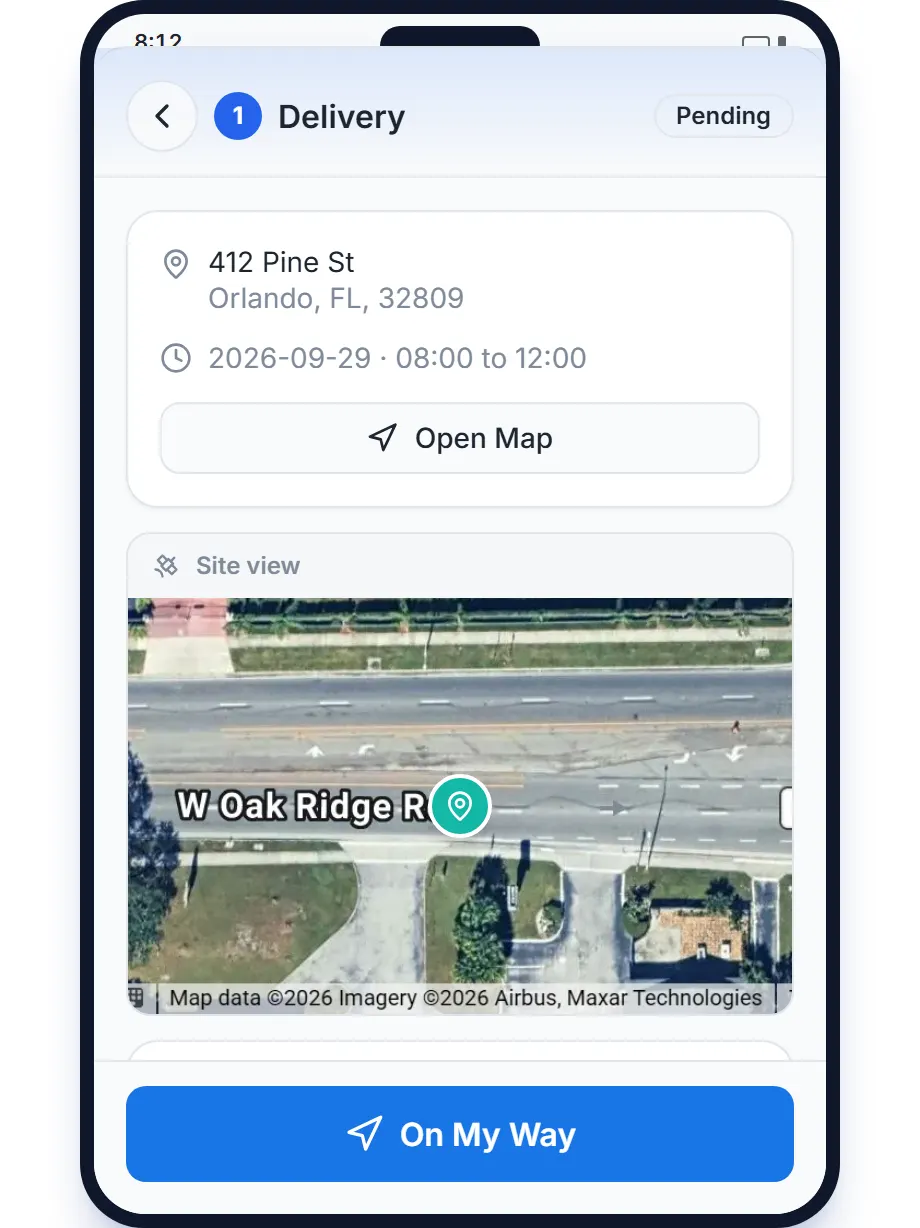
Drivers get the same assistant in the app, for their own stops, by voice. Sample data.
We think every operational surface ends up here: you will always be able to use the board, and you will need it less every month. Assigning drivers, rescheduling and applying AI route suggestions from the chat are next, in the order published on the Tresha fact page's public roadmap, shipped the same way: behind confirmation cards, only claimed once they are live.
She creates complete orders too
Since late August 2026 the chat also creates delivery orders end to end. Say "create an order for John Smith, 20 yard, delivery tomorrow" and Tresha chains her own tools in a single turn.
- Finds the customer, with numbered matches you can answer with just "two" while driving, or a quick-create if they are new.
- Lists your inventory sizes with their default prices and pulls the address on file.
- Asks only what is missing: tax, fuel surcharge, dates, driver notes.
- Offers a payment link only when your Stripe is connected, and never accepts a card number in chat; digits are masked before they touch anything.
The confirmation card shows the complete order: price breakdown, dates, address, notes. One tap on Create order and it lands on the dispatch board with its delivery task and invoice, flowing to QuickBooks if connected.
Junk removal companies get the same flow shaped for junk: load fraction with your template prices, job date with morning or afternoon windows, what is being removed, and collect on site or a payment link.
What it does today, with its guardrails
In the spirit of every claim on this site being checkable: the chat completes deliveries, pickups, landfill runs and order-linked special stops, and creates delivery orders and junk removal jobs, all tested in production on real orders.
Every action waits for your tap on a confirmation card, and it never moves money. Voice can dictate the request; only the tap confirms it.
The full step-by-step, including every guardrail, lives in the public manual: Complete deliveries, pickups and landfill runs from the chat. How the assistant fits the dispatch day is at dumpster rental AI dispatcher.
The Free Forever Promise
Free means free. Forever.
We are the only full dumpster software in North America that is free for every company size. Not a trial. Not a feature-gated freemium. Not a free plan capped at one truck. The entire app, unlimited orders and unlimited users, on the house.
$0
Monthly fee
Ever. No surprise charges.
$0
Setup fee
No onboarding cost.
$0
Per-user fee
Unlimited admins, drivers, dispatchers.
$0
Annual contract
Cancel anytime. We never auto-charge.
How we make money: only when you opt in, and the numbers are public. The software is free with unlimited orders and no per-order software fee. If you choose to collect a customer’s card payment through Dumpster Controls, the processing fee is 2.99% + $3.99 per card transaction on the free plan, or 2.99% + $0.30 (the standard Stripe rate) on the optional $169/month lower card rate plan. Take payment by cash, check, Zelle or any other way and you pay nothing at all. Beyond that, our revenue comes from the optional lower card rate plan and from equipment partners and sponsors advertising in the app and on our public directory; our marketplace, the Dumpster Net Hub, charges zero marketplace fees. Run your own business your way and you never pay to use the software. It’s the only model that lets a 1-truck owner-operator run on the same software as a 50-truck fleet.
FAQ
Explore the platform
- Dumpster Rental Software: the complete platform overview
- Software for Dumpster Companies: built for roll-off haulers
- Dispatch Software: drag-and-drop dispatch board
- Booking Software: online booking widget
- Driver App: free iOS & Android
- Free Plan: Free, no credit card
- Help Center: 421 step-by-step guides to every module