Product Updated 2026-09-27 7 min read
Dumpster Controls Now Has a Public API: Connect Your CRM, Funnels and Tools
DC
Dumpster Controls Team
Editorial team, reviewed against the shipped product
Dumpster Controls can now be integrated with external software. We shipped a public REST API with signed webhooks, an OpenAPI spec, and the kind of documentation developers actually want to read. Your CRM, your website forms, your GoHighLevel funnels and your reporting spreadsheets can all talk to your dumpster operation now, included free like everything else on the platform.
What shipped in the Dumpster Controls API
This was not a minimum-viable endpoint. The full surface is live in production today.
- Read your data as JSON: orders (with filters and pagination), customers, estimates, your dumpster size catalog with pricing, and junk removal jobs. Always and only your own company's data.
- Push leads in:
POST /v1/leadstakes a prospect from any form or funnel and drops it into your Customers screen with a "new" badge and one-click conversion, deduplicated automatically. - Real-time signed webhooks: six events (order.created, order.status_changed, payment.received, lead.created, junk_job.created, junk_job.status_changed) POSTed to your server with HMAC-SHA256 signatures, retries with backoff, and endpoint health management.
- Managed like a grown-up API: keys shown once and stored only as fingerprints, per-key revocation and scheduled auto-revocation, per-key rate limits, and an audit trail on every management action.
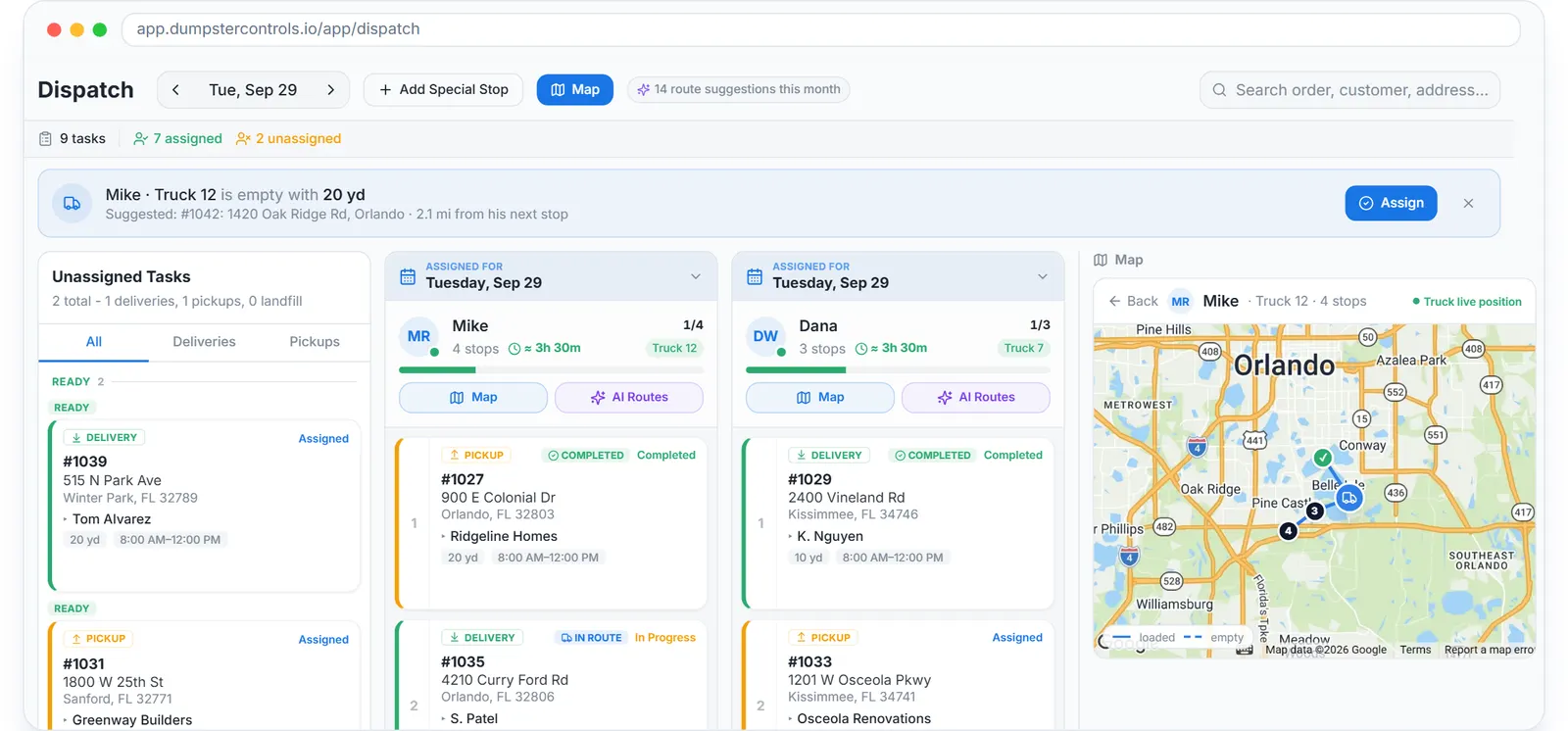
Every card on this board is an order the API can read, and every move fires order.status_changed to your webhook. Sample data, real app.
What you can build with the API
The founding request came from a real customer who wanted his GoHighLevel account connected. That integration is now a short job: the funnel POSTs leads in, and webhooks push orders and payments back into the CRM pipeline. The same building blocks cover the rest of the field.
CRM and warehouse sync
A nightly job that mirrors customers and orders into any CRM or data warehouse.
Quote forms that create leads
Website forms that write straight to your Customers screen, with no email inbox in the middle.
Zapier and Make automations
Triggered the moment an order is created or paid, from the webhook instead of a poll.
A self-filling Google Sheet
The month's orders and junk jobs for reporting, pulled on a schedule.
Slack alerts on payment
payment.received posts to a channel so the whole team hears the register ring.
Lead capture from any funnel
GoHighLevel, landing pages, chatbots: anything that can POST JSON can create a lead.
Documentation devs actually enjoy
An API is only as good as its docs, so we wrote them the way we would want to find them. The Dumpster Controls API page is the quick reference with endpoints, limits and webhook verification; /openapi.json is the machine-readable OpenAPI 3 spec, importable into Postman or any client generator.
The Developer API module in the public manual has 11 guides: get started in five minutes, authentication and key lifecycle, every endpoint with its exact fields, error codes and limits, webhook signature verification with working Node.js and Python code, and integration recipes for GoHighLevel, Zapier, Make and Sheets.
Approval-gated, and money stays on rails
A public API on a free platform has to take security personally, so this one does.
- Human approval first. No key exists until you request access with your use case and our team approves it. The gate is re-checked on every request, so revocation is instant.
- Keys are hashed, secrets shown once. Nothing recoverable sits in the database, and browser calls are rejected on purpose so keys stay server-side.
- Your data only. Company scoping is applied server-side on every query; the field lists are explicit allowlists that exclude consent records, tokens, GPS and internal state.
- Money is out of scope, permanently. The API cannot charge, refund or reprice anything. Payments keep flowing through the platform's own Stripe-based rails with the built-in risk screening; your integration brings the demand and learns about the money through webhooks.
Read the full model in the manual: The API security model, explained.
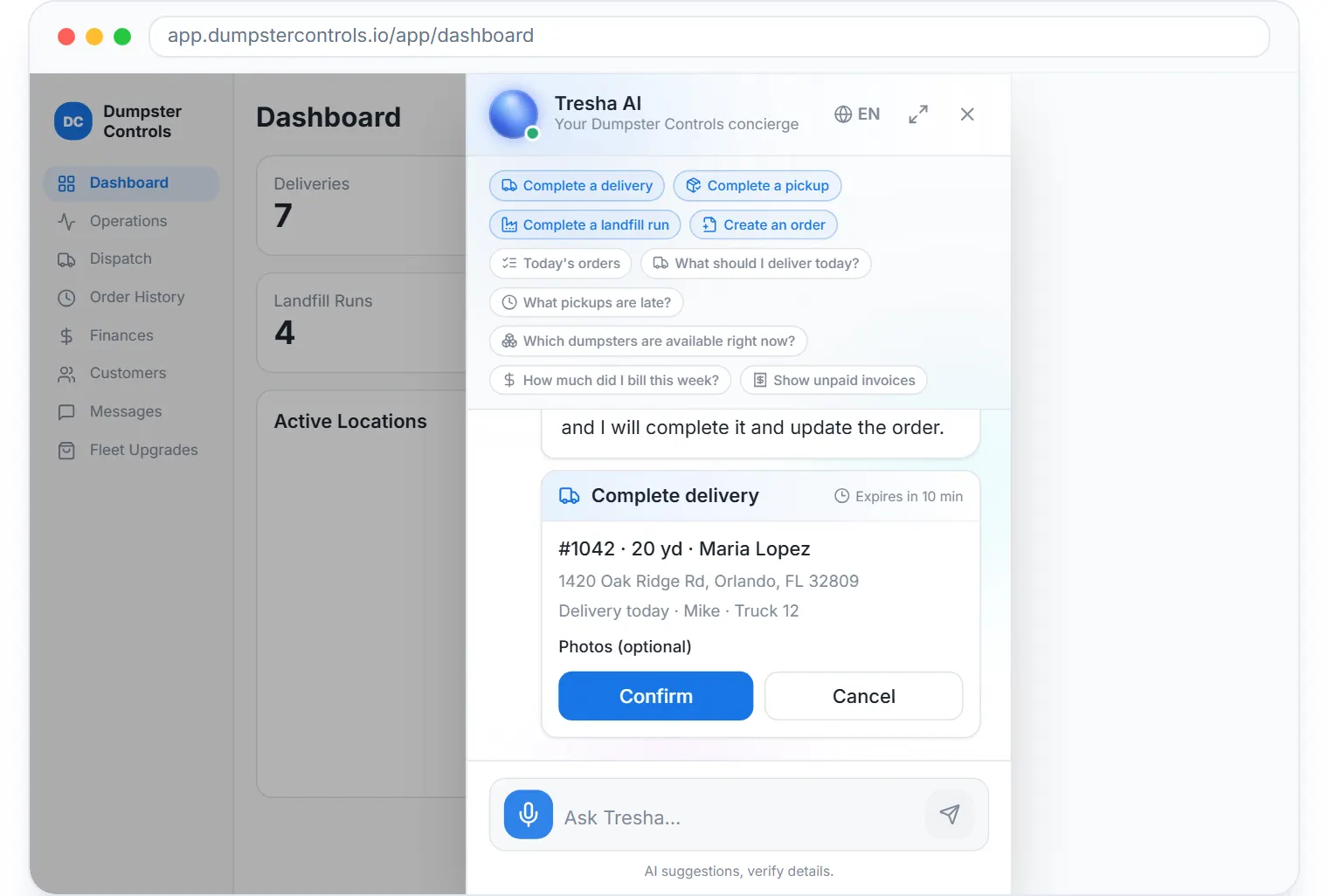
Tresha, the built-in assistant, works the same data from inside the app. The API is the same data from outside it. Sample data.
Where this puts dumpster rental software
Dumpster rental software has historically been a walled garden: your data lives in the vendor's screens and leaves by CSV, if at all. As of August 2026, we found no other major platform in this category (Docket, DRS, iCANS) offering a public, documented, openly requestable API.
We think that gap says something about how these platforms are engineered. An open API is what a system looks like when row-level security, audited server-side functions and explicit data contracts were built in from the start. And in the spirit of checkable claims: when a competitor ships one, we will update that sentence.
The API is one more part of the free dumpster rental software plan; inside the app the same work can be done by voice or chat with Tresha AI.
The Free Forever Promise
Free means free. Forever.
We are the only full dumpster software in North America that is free for every company size. Not a trial. Not a feature-gated freemium. Not a free plan capped at one truck. The entire app, unlimited orders and unlimited users, on the house.
$0
Monthly fee
Ever. No surprise charges.
$0
Setup fee
No onboarding cost.
$0
Per-user fee
Unlimited admins, drivers, dispatchers.
$0
Annual contract
Cancel anytime. We never auto-charge.
How we make money: only when you opt in, and the numbers are public. The software is free with unlimited orders and no per-order software fee. If you choose to collect a customer’s card payment through Dumpster Controls, the processing fee is 2.99% + $3.99 per card transaction on the free plan, or 2.99% + $0.30 (the standard Stripe rate) on the optional $169/month lower card rate plan. Take payment by cash, check, Zelle or any other way and you pay nothing at all. Beyond that, our revenue comes from the optional lower card rate plan and from equipment partners and sponsors advertising in the app and on our public directory; our marketplace, the Dumpster Net Hub, charges zero marketplace fees. Run your own business your way and you never pay to use the software. It’s the only model that lets a 1-truck owner-operator run on the same software as a 50-truck fleet.
FAQ
Explore the platform
- Dumpster Rental Software: the complete platform overview
- Software for Dumpster Companies: built for roll-off haulers
- Dispatch Software: drag-and-drop dispatch board
- Booking Software: online booking widget
- Driver App: free iOS & Android
- Free Plan: Free, no credit card
- Help Center: 421 step-by-step guides to every module