Operations Updated 2026-09-27 10 min read
The Triangulation Scam Hitting Dumpster Rental Companies (and How to Beat It)
DC
Dumpster Controls Team
Editorial team, reviewed against the shipped product
There is a scam working its way through the dumpster rental industry right now, and it is nasty precisely because everything about the job looks legitimate. The order is real, the delivery is real, and the customer at the address is real. The only fake thing is the credit card, and by the time anyone finds out, your dumpster has been rented, hauled and dumped, and the money claws its way back out of your account.
What the dumpster rental triangulation scam is
Triangulation fraud gets its name from the three corners involved: the scammer, a stolen credit card, and a legitimate business, yours. In the classic version the scammer adds a fourth corner: a real end customer who genuinely needs a dumpster.
The scammer advertises cheap rentals, collects cash or a transfer-app payment from that end customer, then books the rental from a real company, you, with the stolen card. Everyone gets what they wanted: the end customer gets a dumpster, the scammer pockets clean cash, and you get a booking that looks completely normal.
The person losing money at first is the cardholder, who never heard of your company. When they spot the charge they call their bank, the bank protects the cardholder, and the chargeback lands on you.
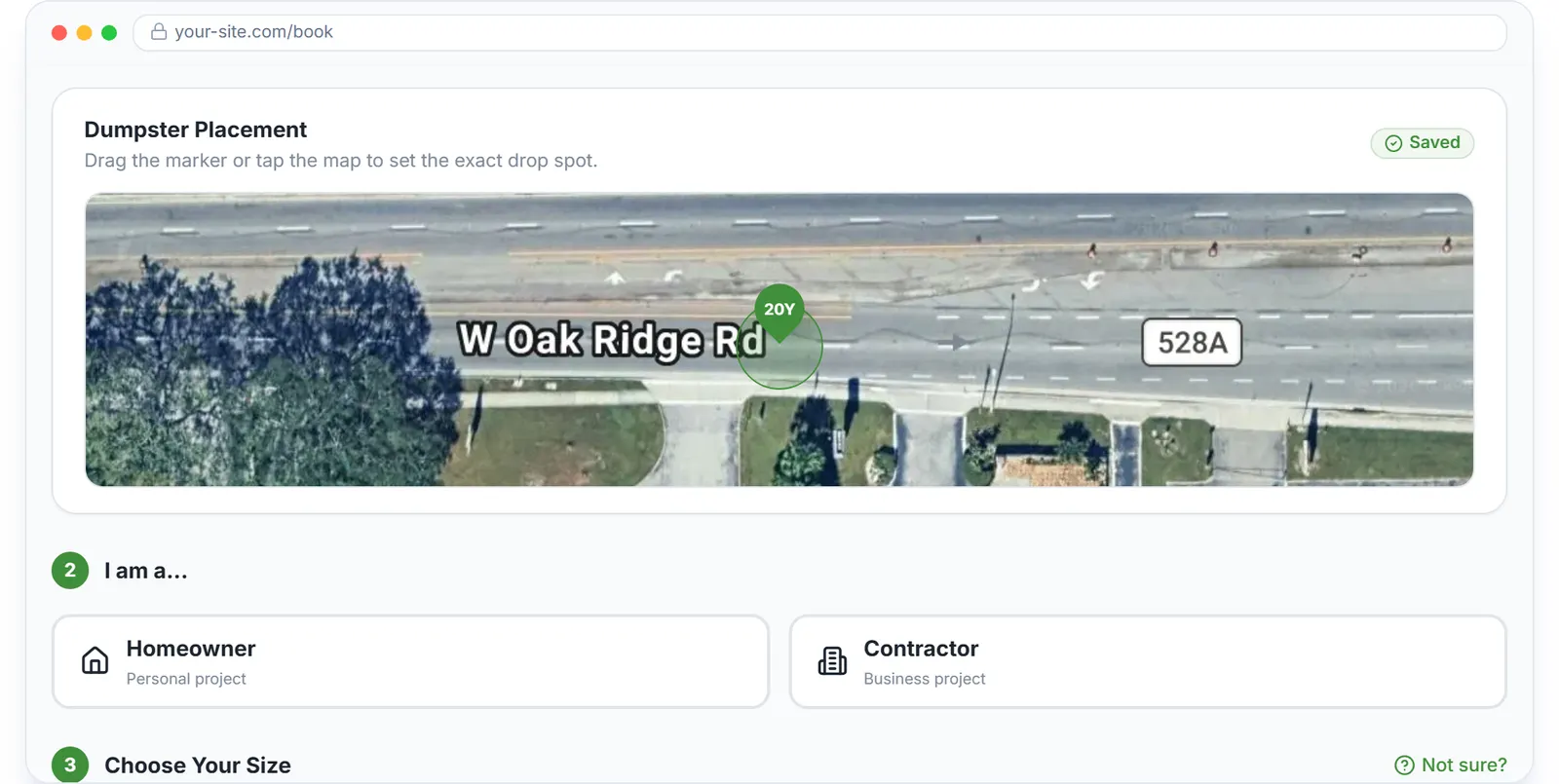
The booking page is where the scam enters and where the screening happens: every card payment is scored before capture. Sample data, real app.
Anatomy of a real case
This is a real timeline from a case handled on Dumpster Controls in the summer of 2026, with the company's details kept private. July 29: the dumpster is delivered, documented with GPS and date-stamped photos by the driver app.
July 30: the $656.49 card payment settles on the online booking, under a name that did not match the cardholder. Yes, the truck rolled a day before the card settled, a scheduling quirk of the real case that made everything look even more routine.
August 3: the container is picked up and dumped at a landfill, fully documented; that same day, Stripe issues an early fraud warning on the card. August 5: the real cardholder, a person entirely unrelated to the order, files a fraud dispute. The service was perfect, the paperwork was perfect, and the card was stolen.
Why banks side with the cardholder
It feels unjust: you delivered a real service in good faith and can prove it. But look at it from the card network's side. The cardholder never clicked buy, never met you, never authorized anything.
Card network rules exist to make people comfortable using cards at businesses they have never heard of, and that promise only works if stolen-card victims reliably get their money back. Delivery proof answers "did the service happen?" The dispute asks "did the cardholder authorize this?", and in a true stolen-card case the honest answer is no.
That is why the disputes are usually lost even with strong evidence, why we tell our companies the odds honestly, and why every layer of defense worth building sits before the truck leaves the yard.
The red flags, in order of loudness
Name and email do not match the card
The single loudest signal. In the real case above, the order name and the cardholder were entirely different people.
Rush pressure
The scammer wants the service completed before the cardholder notices the charge. Earliest delivery, minimal questions, no price sensitivity.
Text only, never a call
Phone calls break the triangle: the voice on the phone has to explain who is paying and why.
Billing far from the service address
A card whose billing region has nothing to do with the delivery area deserves a second look.
A customer at the site who paid someone else
If the person at the address says they paid a different company in cash, you are looking at the scam mid-flight.
What dumpster payment processing blocks automatically
After handling this scam in production, we built the defense into the platform as standard equipment, on every plan, including the free one.
- Risk screening before capture. Every online card payment is scored with Stripe Radar plus platform checks: IP distance to the service address, disposable email detection, card behavior. Payments are tiered.
- High risk is held, not delivered. Higher-risk orders are created as Under Review: the money is authorized but not captured, and no truck rolls until the Dumpster Controls risk team verifies and approves the payment. Extreme risk is canceled automatically.
- Early fraud warnings become instant alerts. When the card network flags a paid card as likely stolen, usually days before the dispute, the company gets a push notification: hold the delivery, review the order, refund proactively if service was not provided.
- Evidence builds itself. Drivers photograph deliveries, pickups and landfill receipts with GPS and date stamps as part of the normal workflow. When a dispute comes, the dossier already exists.
The full playbook, written for operators, lives in the manual: How to protect your company from the triangulation card scam. The payment rails themselves are described on the dumpster payment processing page.
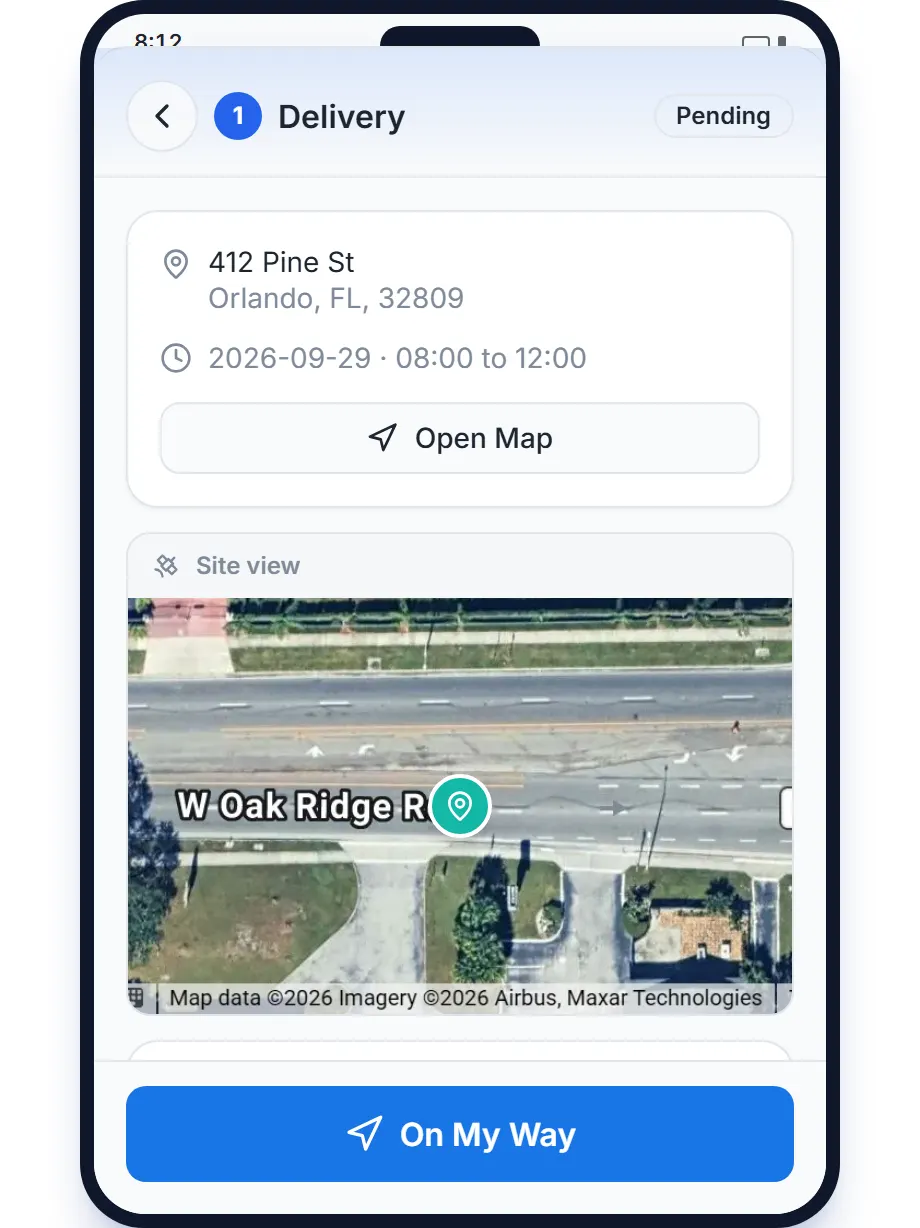
The photo step in the driver app. Delivery, pickup and landfill receipt are stamped with GPS and time as part of the normal day. Sample data.
When a dispute arrives: the honest process
Prevention fails sometimes. When a dispute lands, the process on Dumpster Controls is built on a simple idea: the company should never learn about any of it late, or by surprise.
- Visibility from the start. As soon as the dispute reaches the platform: a red alert in the app, a banner on the affected order, and a push notification if the payout is reversed.
- We fight it with you. Our team compiles the GPS-stamped photos, the task timeline and the payment verification data, and submits the response to the card network in the company's defense.
- You can add evidence, with a deadline. The order banner shows the evidence deadline and a button that opens a pre-filled support ticket for contracts, messages, anything that helps.
- Transparent money. The disputed payout is reversed while the case runs, labeled with the reason, and returned in full if the dispute is won.
- Honest odds. Stolen-card disputes are usually lost, because the bank is defending a real victim. We fight anyway, and every case sharpens the prevention for everyone.
The process is documented step by step in the manual: How card disputes are handled in Dumpster Controls.
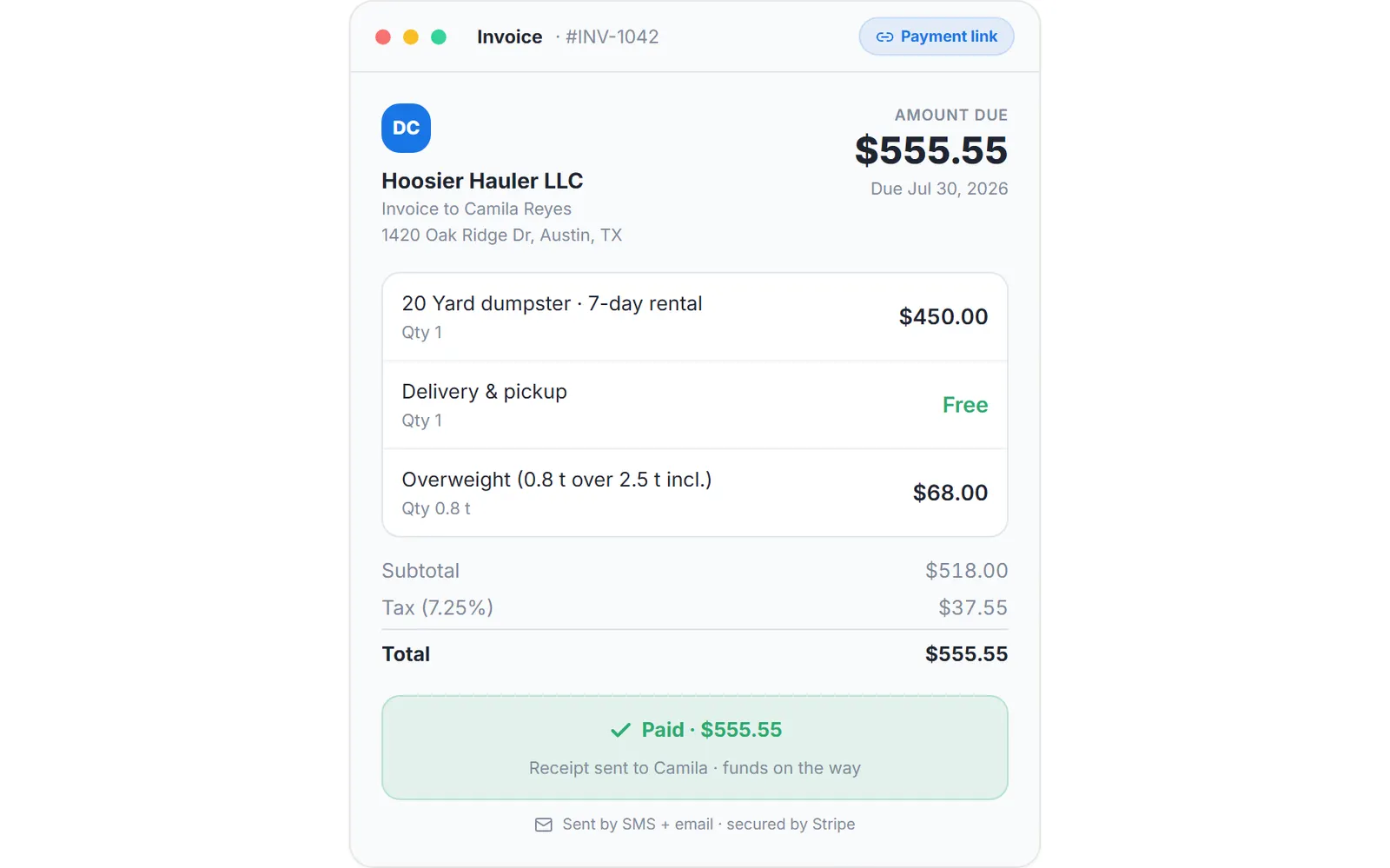
A payment taken inside the platform is screened, verified and documented. One taken outside it has none of that when the dispute comes. Sample data.
Your part: habits that break the scam
Software narrows the funnel; two human habits close it. First: before a first-time, high-value delivery, call the number on the order and confirm who is paying and with which card. Legitimate customers answer in seconds; scammers stall or push back to text.
Second: keep payments inside the platform, where they are screened and documented. A payment taken outside the booking page has no risk screening, no verification trail, and no dossier when a dispute comes.
Screening, holds and alerts ship on every plan of dumpster rental software from Dumpster Controls, and the booking page that carries them is described under dumpster booking software.
The Free Forever Promise
Free means free. Forever.
We are the only full dumpster software in North America that is free for every company size. Not a trial. Not a feature-gated freemium. Not a free plan capped at one truck. The entire app, unlimited orders and unlimited users, on the house.
$0
Monthly fee
Ever. No surprise charges.
$0
Setup fee
No onboarding cost.
$0
Per-user fee
Unlimited admins, drivers, dispatchers.
$0
Annual contract
Cancel anytime. We never auto-charge.
How we make money: only when you opt in, and the numbers are public. The software is free with unlimited orders and no per-order software fee. If you choose to collect a customer’s card payment through Dumpster Controls, the processing fee is 2.99% + $3.99 per card transaction on the free plan, or 2.99% + $0.30 (the standard Stripe rate) on the optional $169/month lower card rate plan. Take payment by cash, check, Zelle or any other way and you pay nothing at all. Beyond that, our revenue comes from the optional lower card rate plan and from equipment partners and sponsors advertising in the app and on our public directory; our marketplace, the Dumpster Net Hub, charges zero marketplace fees. Run your own business your way and you never pay to use the software. It’s the only model that lets a 1-truck owner-operator run on the same software as a 50-truck fleet.
FAQ
Explore the platform
- Dumpster Rental Software: the complete platform overview
- Software for Dumpster Companies: built for roll-off haulers
- Dispatch Software: drag-and-drop dispatch board
- Booking Software: online booking widget
- Driver App: free iOS & Android
- Free Plan: Free, no credit card
- Help Center: 421 step-by-step guides to every module