Broker Network & Growth Updated 2026-09-27 14 min read
How to Expand Your Dumpster Territory Using Partner Networks
DC
Dumpster Controls Team
Editorial team, reviewed against the shipped product
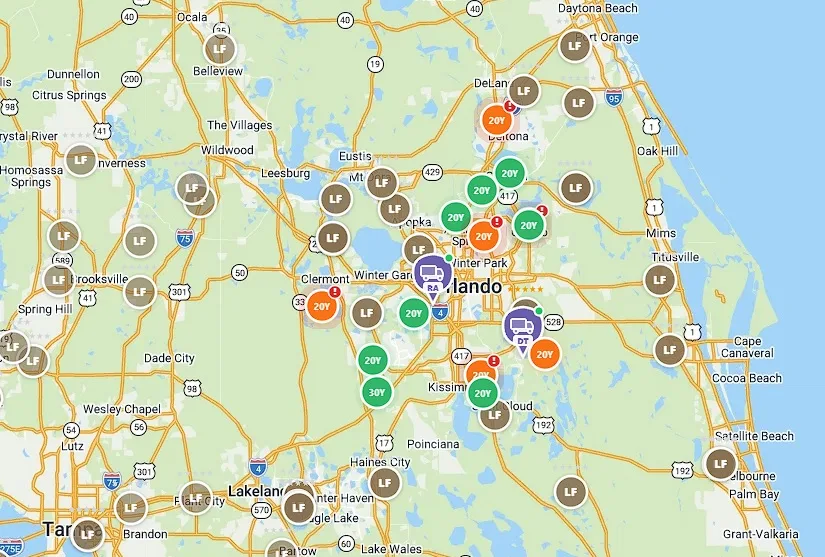
Every hauling company hits the point where the service area is the growth limit. You have trucks, drivers and capacity. The jobs are in the next county.
Opening there the old way means a yard, local advertising, name recognition and new landfill accounts. A partner network gets you the revenue first and lets you decide about the yard later.
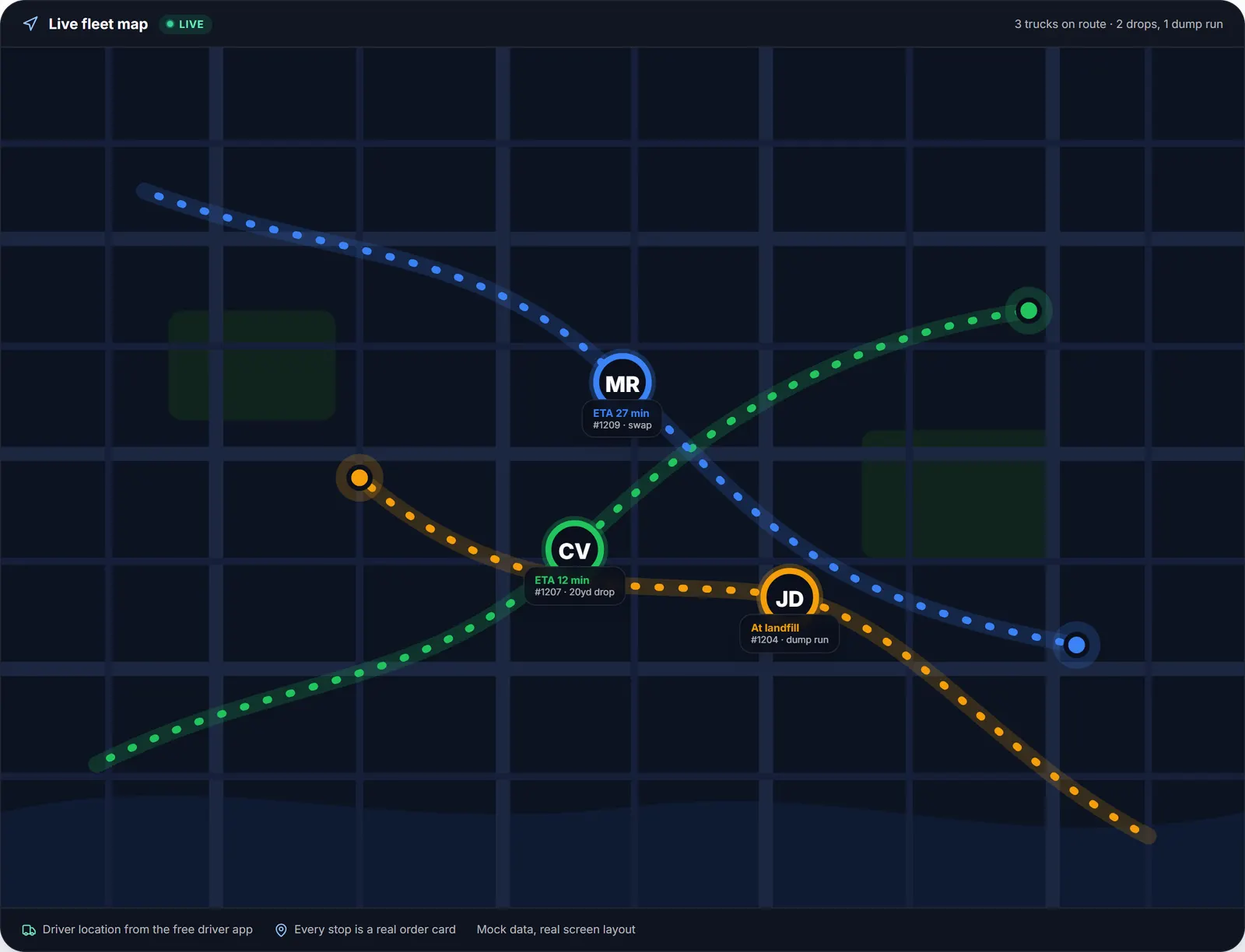
The live map is where the territory limit shows first: stops at the edge of the radius cost a truck most of a day. Sample data, real app.
The territory problem in a dumpster rental business
Most dumpster companies work inside a radius from the yard, and the radius exists for four practical reasons.
Drive time
Every mile to a job costs fuel and driver hours. Past a certain distance the trip stops paying for itself.
Disposal
A far-away job needs a landfill near the site, with an account and a known gate fee. New areas mean new facilities.
Customer expectations
Same-day or next-day delivery is hard to promise when the truck spends half the day getting there.
Competition
The operators already in that market have the reviews, the relationships and the pricing history.
What a partner network is
A partner network is a group of hauling companies that share work across territories. When one company gets an order outside its area, it passes the job to a partner who works there.
The originating company keeps its customer and a margin; the partner earns revenue it did not have to market for. Freight brokers and last-mile carriers have worked this way for decades, and digital platforms are bringing the same model to dumpsters.
How a partner network expands your territory
Accept work, not risk
Instead of investing in a second yard, you take the order and let a local partner deliver it. You keep the customer relationship and the price; the partner handles the physical work.
Test a market before committing
If orders keep arriving from the same zip codes, that is demand you can measure. Fulfill them through a partner first, then decide whether a physical presence is worth it.
Fill the soft spots
Most service areas have edges: zip codes you can reach but not profitably, or areas where you lack a landfill account. Partners cover those gaps without stretching your fleet's radius.
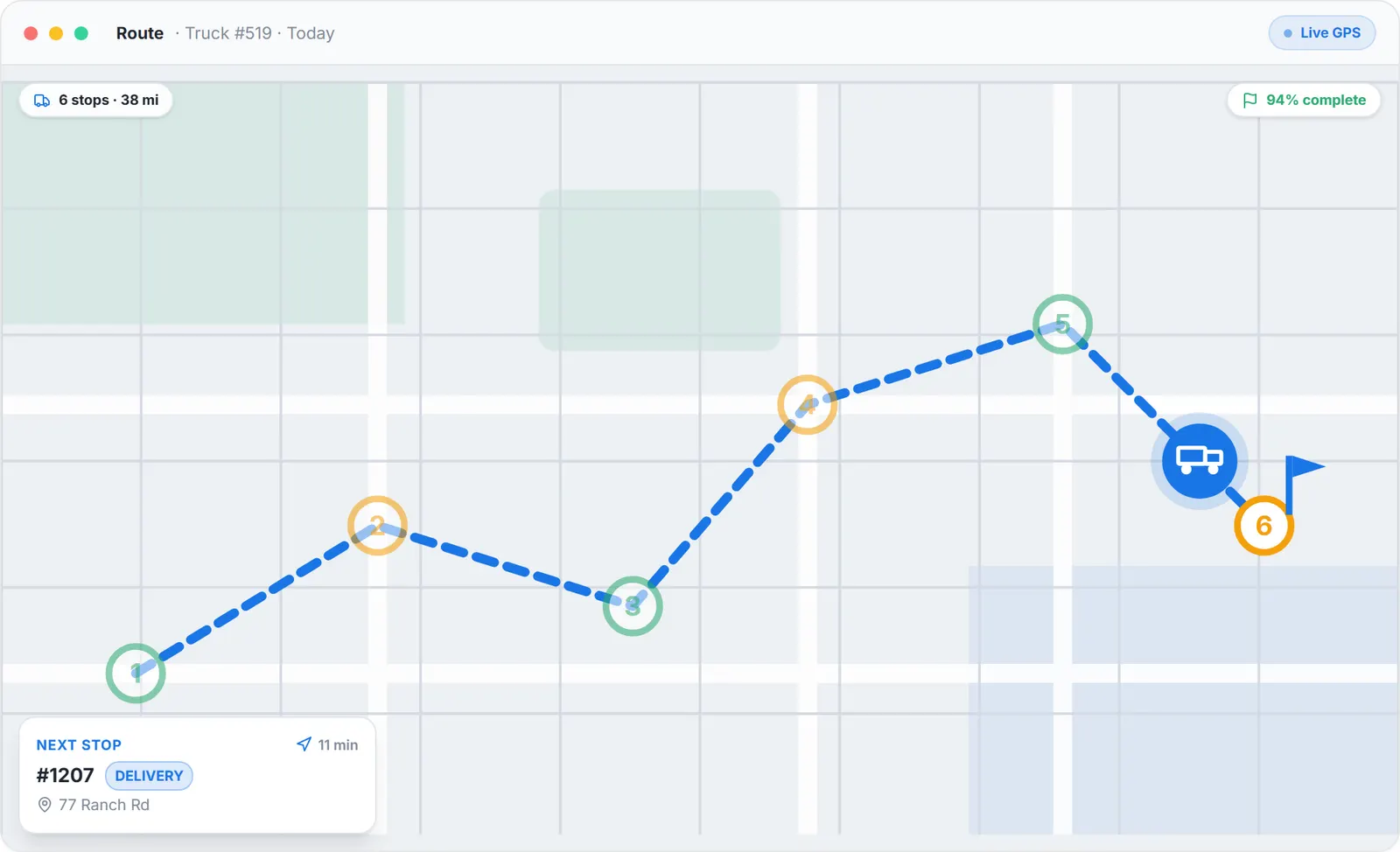
A driver's route for the day. The stop at the far edge of the radius is the one a partner in that zone would deliver for you. Sample data.
Grow revenue without growing the fleet
Growth used to mean more trucks, more drivers and more yard. With a network, your capacity is the network's capacity.
The math of network-based growth
Practical steps for using a partner network
- #### 01. Identify adjacent markets
Start with the places where you already get inquiries you turn down. Map those zip codes and add up the orders you declined last quarter. - #### 02. Find reliable partners
Look for operators with established operations in the target area, well-kept equipment, a record of keeping delivery windows and a habit of communicating early. The Dumpster Network HUB lists authorized companies so the search starts on a board, not in a phone book. - #### 03. Establish clear terms
Pricing by size and waste type, delivery and pickup timelines, photo documentation, who to call when something slips, and how and when the partner is paid. - #### 04. Start small and build
One adjacent market, one reliable partner, then volume. Five new markets at once is how a reputation gets spread thin. - #### 05. Monitor quality
Track customer satisfaction on partner-fulfilled orders separately from your own. Replace a partner who keeps missing before it reaches your reviews.
What a partner job earns on the Hub
On the Dumpster Net Hub the math is on the listing. You set the asking price the executor will receive; the executor gets that full amount and the Hub charges no marketplace fee. Your margin is whatever your customer paid above the asking price.
The money is held in escrow and released when the executor confirms delivery with a photo. If nobody takes the listing before the timer you chose, the order returns to your account.
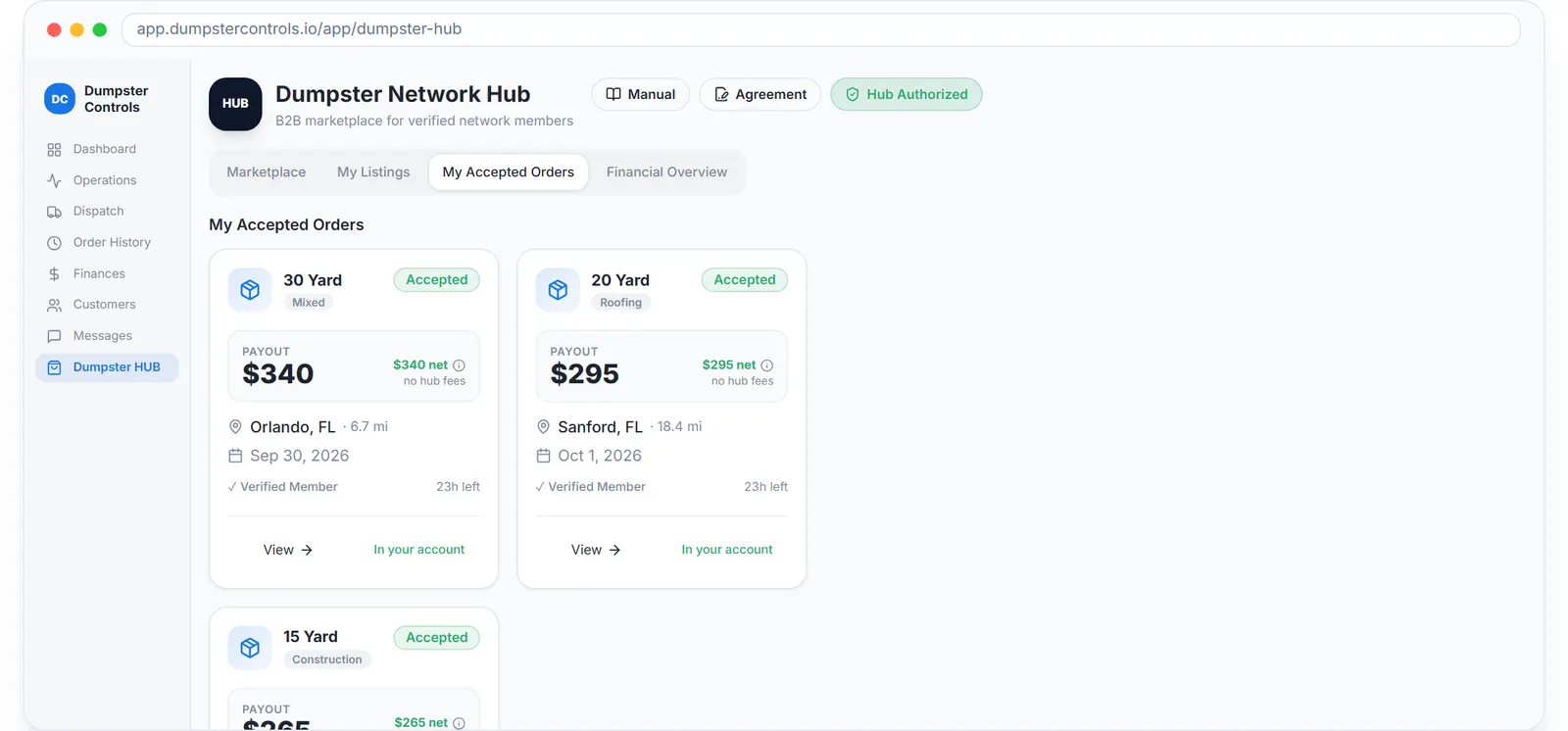
List an out-of-area order with your asking price, or take one from a company that cannot reach your zone. Sample data.
When to move from partner to direct
A network is not a permanent substitute for presence. When one market keeps producing orders month after month, a truck and a driver there may pay better than the margin you leave with partners. By then the network has done its job: it proved the market and built the customer list.
The Dumpster Network HUB is the ready-made partner network inside dumpster rental software from Dumpster Controls; the feature is described on the dumpster broker software page. For the routing side of a wider territory, see dumpster dispatch software.
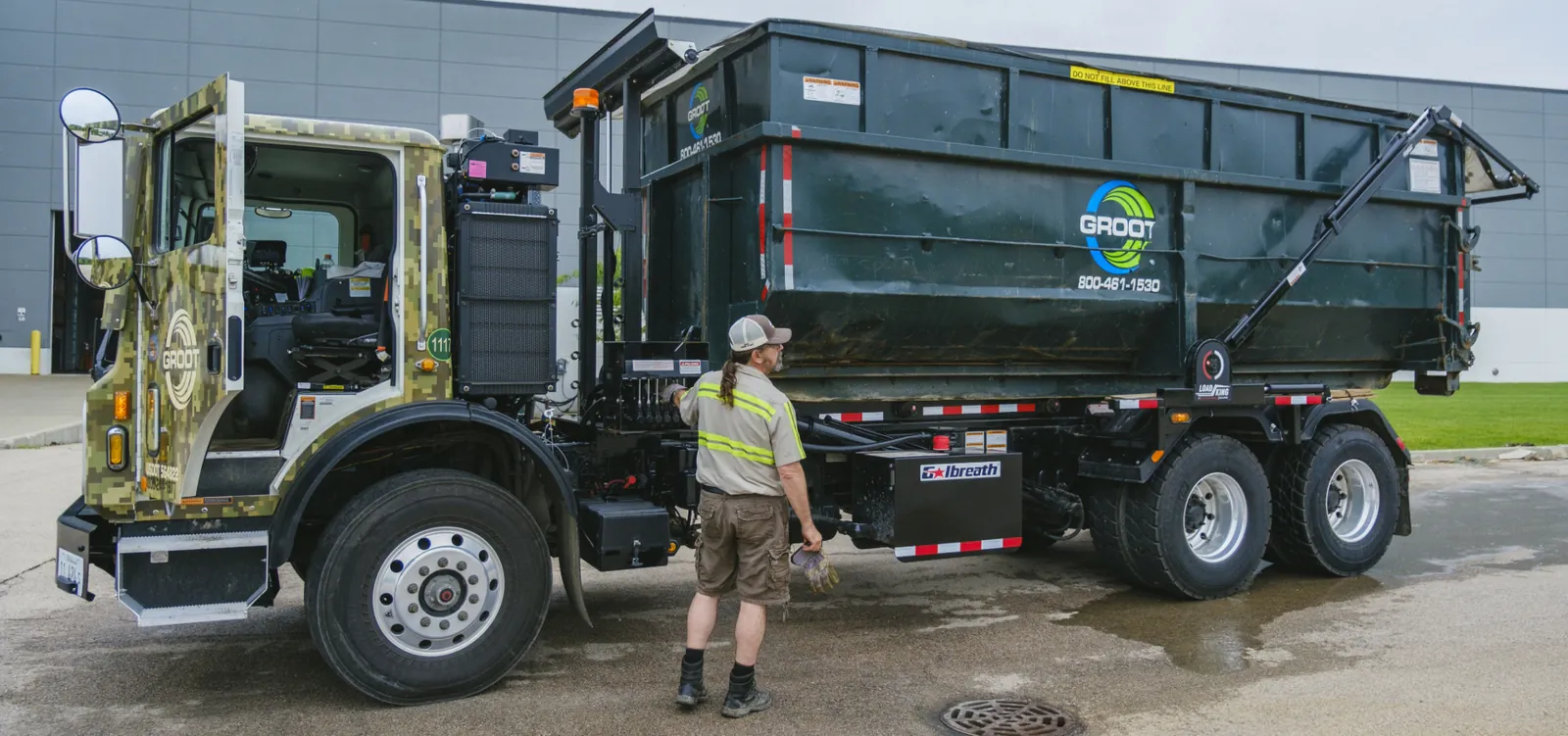
Groot expanded coverage across Illinois through partner relationships. Photo courtesy of Groot , Illinois800-461-1530Used with permission.
Explore the platform
- Dumpster Rental Software: the complete platform overview
- Software for Dumpster Companies: built for roll-off haulers
- Dispatch Software: drag-and-drop dispatch board
- Booking Software: online booking widget
- Driver App: free iOS & Android
- Free Plan: Free, no credit card
- Help Center: 421 step-by-step guides to every module
← PreviousHow Roll-Off Brokers Operate: The Complete BreakdownNext → Dumpster Broker Work vs. Direct Sales: Finding the Right Mix
Frequently asked questions
Is Dumpster Controls really free?
Yes. The entire app is free for any company at any fleet size: dispatch, online booking, the driver app, invoicing, the Tresha AI assistant and every other feature, with no monthly fee, no trial period and no credit card to sign up. The only cost on the free plan is optional card processing when a customer pays by card through the platform: 2.99% plus $3.99 per transaction on the free plan. The entire app is free; an optional $169 per month plan lowers that to 2.99% plus $0.30 and adds a Sponsored spotlight in the public company directory. Prices as published on dumpstercontrols.io/pricing on 2026-09-23.
Do you charge per driver, per truck or per order?
No. There is no per-driver, per-truck, per-user or per-order fee, and no order limit. A company with one truck and a company with twenty pay the same for the software: nothing.
Is there a contract?
No. There is no contract, no minimum term and no setup fee. You create the account yourself, and on the free plan there is nothing to cancel because nothing is billed. The optional $169 lower card rate plan is billed month to month.
Which countries and languages are supported?
Dumpster Controls serves hauling companies in the United States and Canada. The app interface and the Tresha AI assistant are available in English, Spanish and Portuguese. The public pages, such as the blog, the help center and the landfill finder, are in English.
How do I switch from another dumpster software?
Create a free account at dumpstercontrols.io/login, with no sales call and no credit card. Then import your customers from a CSV file using the template provided in the app; past orders can also be imported from a CSV. Container sizes and pricing are set up in Settings. The landfill database, with 1,750 active US and Canadian landfills as counted on 2026-10-01, is already loaded, so disposal sites do not need to be typed in. Step-by-step guides are at dumpstercontrols.io/help.