Broker Network & Growth Updated 2026-09-27 15 min read
Dumpster Broker Work vs. Direct Sales: Finding the Right Mix
DC
Dumpster Controls Team
Editorial team, reviewed against the shipped product
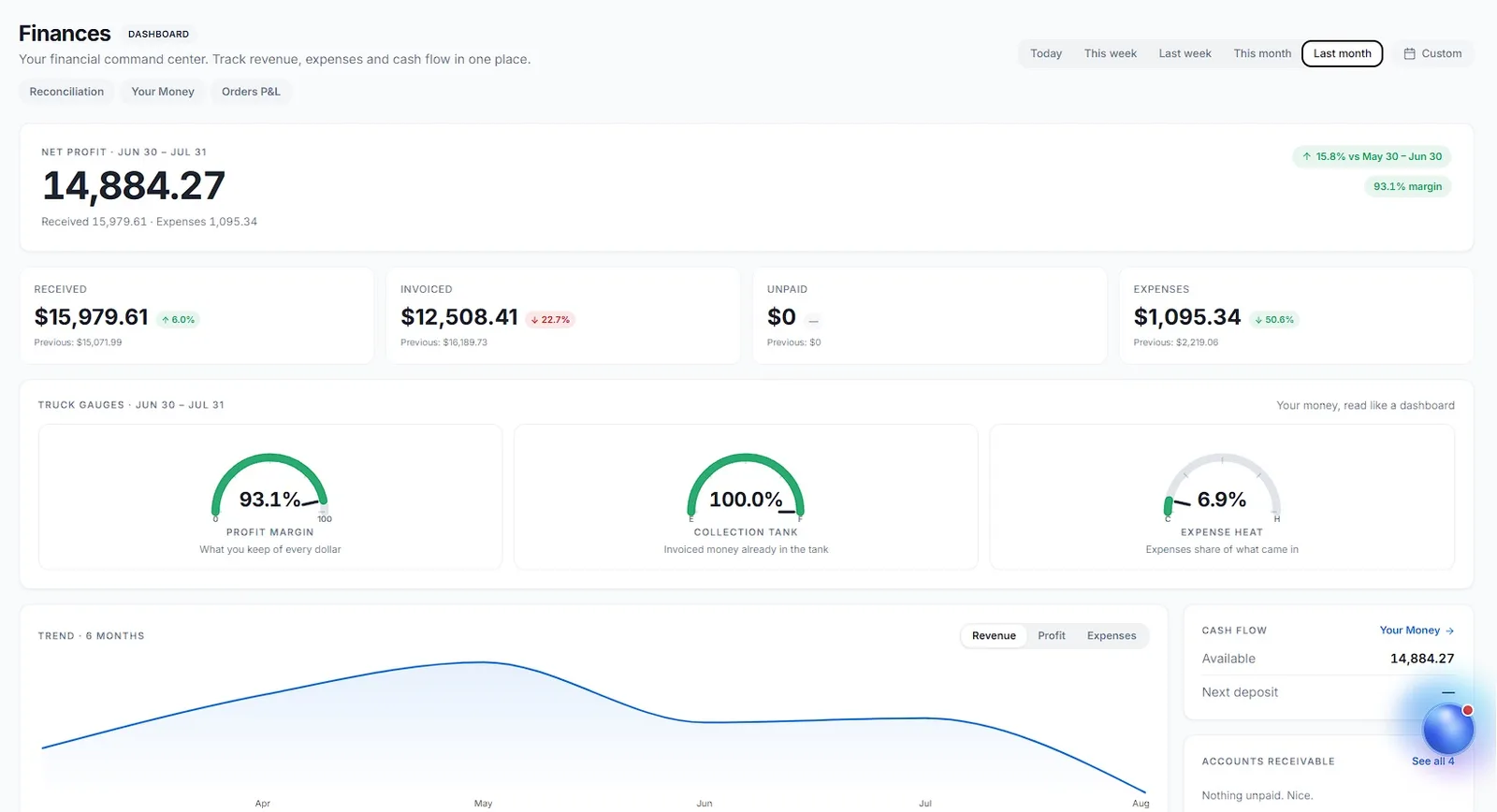
Every dumpster rental company faces the same question about customers: build your own pipeline with direct marketing, or accept work from brokers and partner networks.
For most operators the answer is a mix. This article lays out what each channel costs you, what it gives back, and where dumpster broker software changes the trade.
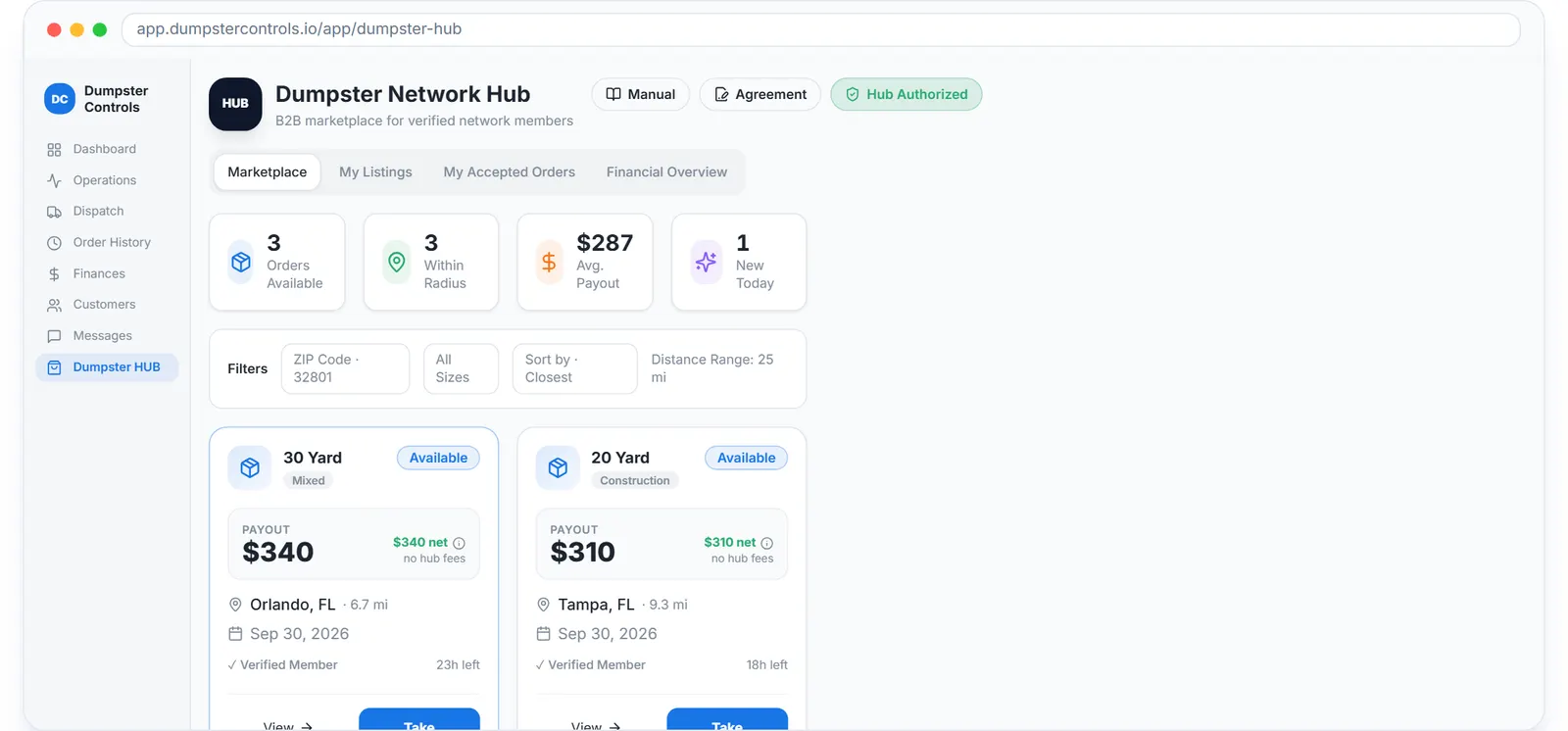
The Hub inside Dumpster Controls: overflow jobs listed by nearby companies, with the amount you receive shown before you take one. Sample data, real app.
Direct sales for a dumpster rental business
Direct sales means you generate the lead, quote it, close it and deliver it. You own the customer from the first call to the repeat order.
What direct sales gives you
- The whole margin. No broker takes a cut of the order.
- The customer. Repeat business and referrals come back to you, not to a middleman.
- Pricing control. You price from your costs, not from a broker's rate sheet.
- Your data. You know who ordered, how often, and what they paid.
What direct sales costs you
Paid search for dumpster keywords is expensive in most metros, and many of the clicks you pay for never become an order. Someone has to answer the phone, quote and follow up.
Lead volume also moves with the construction season, the weather and the local economy. A slow month in direct sales is a slow month for the trucks.
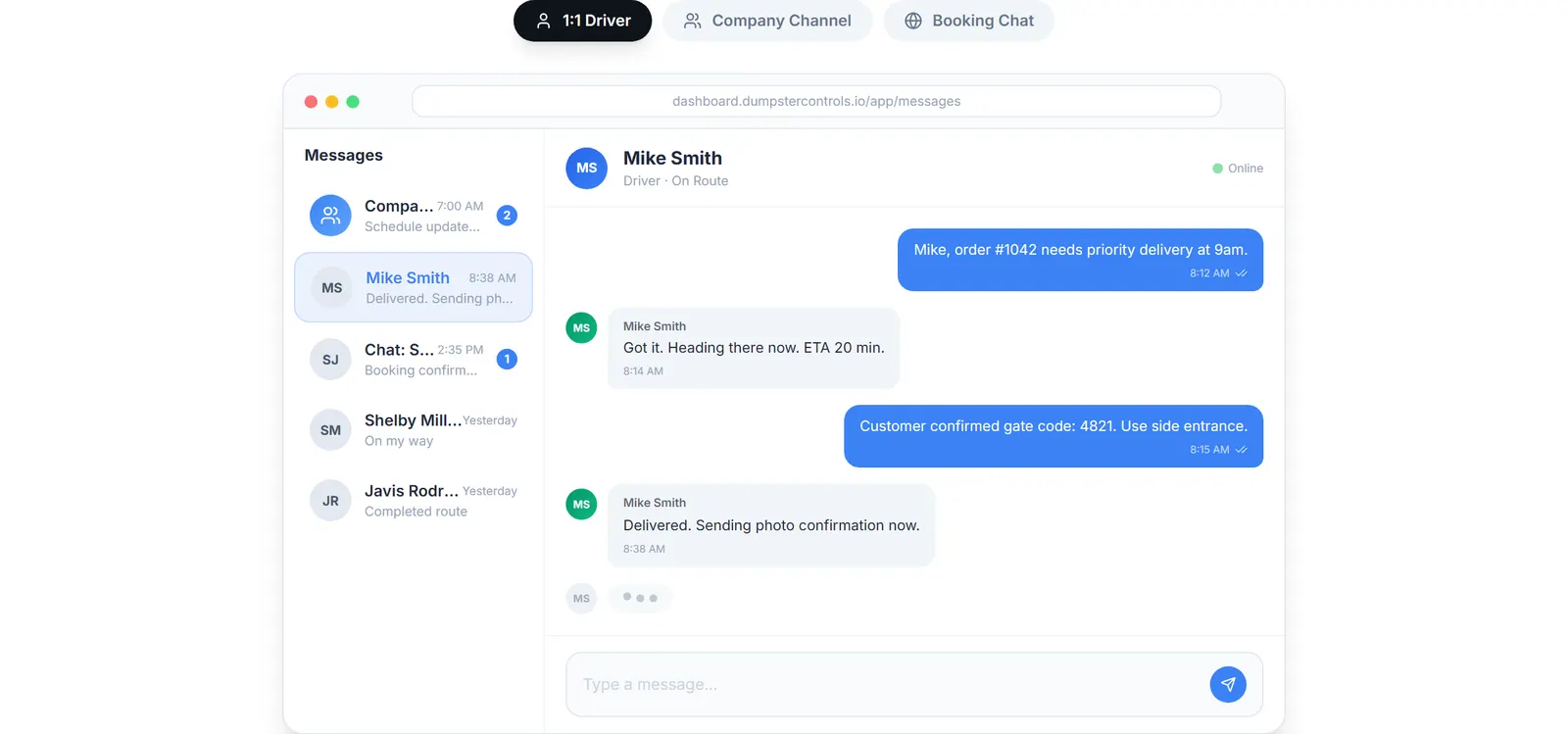
Direct customers write to you from your booking page, and every confirmation, on-the-way and delivered message goes out from the order. That is where the repeat business starts.
Broker work: what a dumpster broker pays you
Broker-sourced work means a broker, a partner network or a marketplace already has the customer. You deliver, pick up and dump; they own the relationship.
Job notice
A broker or a platform tells you a job is open in your area: size, dates, location, price.
Accept or pass
You look at the details and decide whether the job fits your route and your rate.
Deliver
Your truck and your driver do the delivery, the pickup and the landfill run.
Get paid
The broker or the platform pays you. With a traditional broker that is usually less than the customer paid.
What broker work gives you
No marketing cost, trucks that stay busy, a rate you know before you say yes, and reach into areas where you have capacity but no name. As your fleet grows you can take more jobs without a matching jump in ad spend.
What broker work costs you
A traditional broker pays you less than the customer paid, and the difference is the broker's margin. The customer belongs to the broker, so the reorder goes through the broker again.
Many brokers pay on net terms. A hauler that depends on one broker is one lost contract away from an empty week, and the broker sets the delivery windows you have to meet.
| Feature | Direct sales Own the customer | Broker work Fill the trucks |
|---|---|---|
| Margin on the order | All of it | Broker keeps a cut |
| Customer ownership | ||
| Upfront marketing cost | Yes | None |
| Price known before the job | No | Yes |
| Fills idle truck capacity | ||
| Builds your brand |
Neither channel wins outright: they trade margin for effort in opposite directions.
Dumpster broker software changes the math
A traditional broker relationship runs on phone calls, a spreadsheet and an invoice that gets paid later. A network built into your dumpster rental software changes four things.
- No marketplace cut. On the Dumpster Net Hub the executor receives the full asking amount. The Hub fee line in the Take Order modal reads $0.
- Escrow instead of net terms. The money is held until you confirm delivery with a photo, then released to you.
- You pick the jobs. Take the listings that fit your route and your sizes; pass on the rest.
- Both directions. Any authorized company can list overflow, and any authorized company can take it.
Those four facts are documented in the Hub manual. The network itself is described on the Dumpster Network HUB page; it is available to companies in the United States.
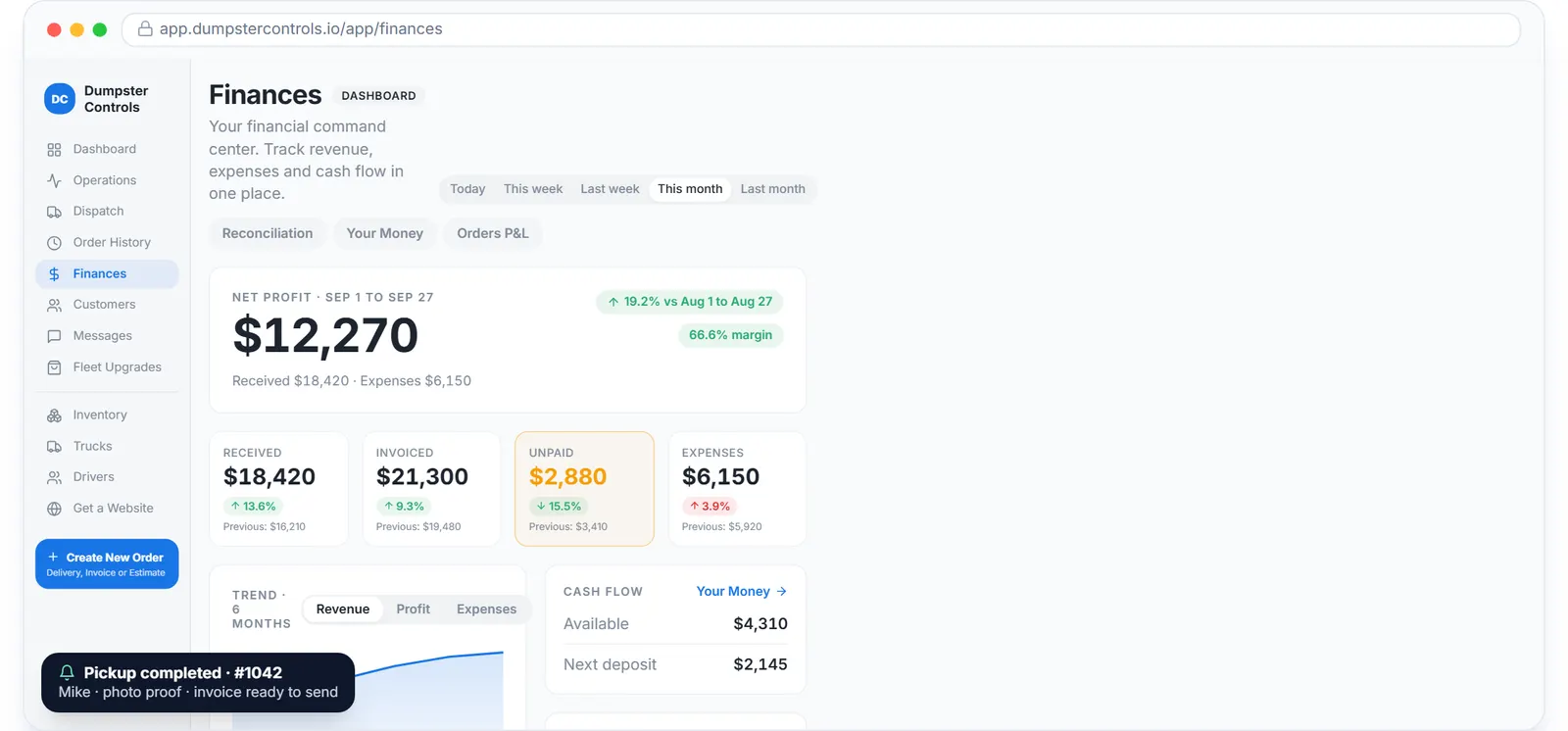
Revenue by week with received, invoiced and expenses. Direct jobs and network jobs land in the same finances. Sample data.
The right mix for a dumpster rental company
Lean on direct sales when your trucks are already busy from your own customers, when reputation and referrals carry you, and when you can measure a positive return on ads.
Lean on network work when you are new and need volume, when your market's ad costs are brutal, when you have idle capacity in the slow season, or when you want to serve the next county without opening a yard there.
The blended-channel rule of thumb
Neither pure direct sales nor pure broker work fits most hauling companies. Read how roll-off brokers operate for the broker's side, and dumpster marketplace software for how a listing moves from one company to another.
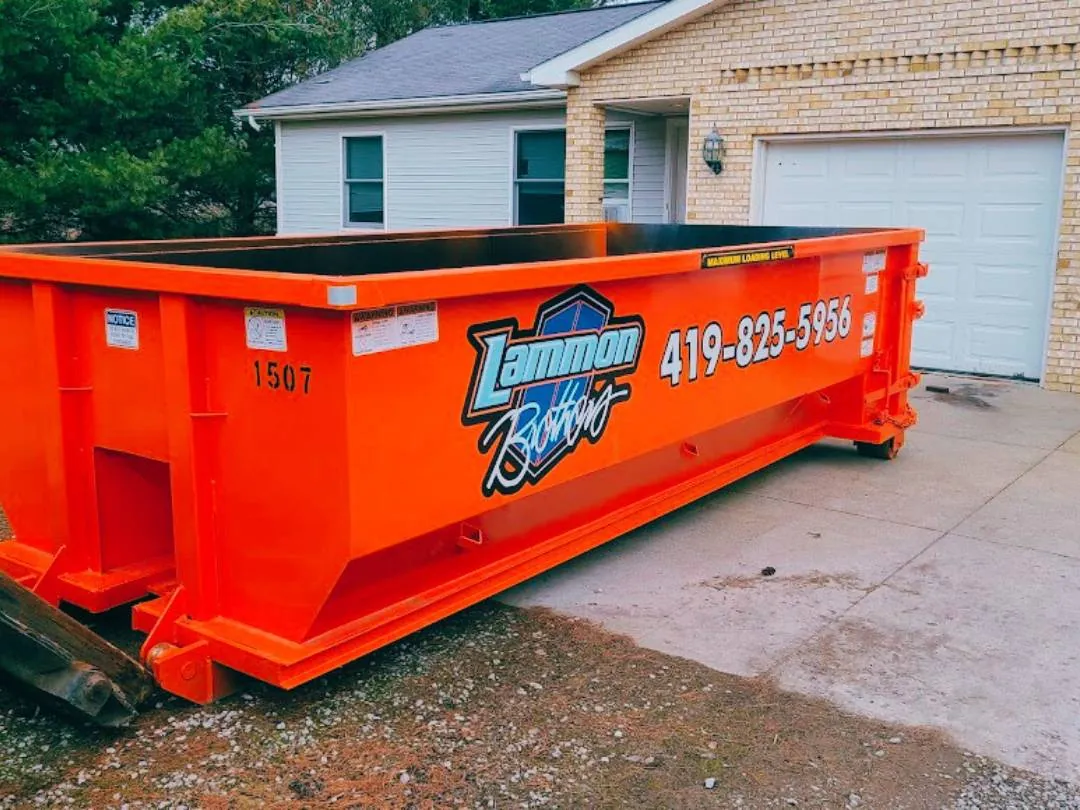
Lammon Brothers balances direct sales with broker overflow. Photo courtesy of Lammon Brothers, Northwest Ohio 419-825-5956Used with permission.
Explore the platform
- Dumpster Rental Software: the complete platform overview
- Software for Dumpster Companies: built for roll-off haulers
- Dispatch Software: drag-and-drop dispatch board
- Booking Software: online booking widget
- Driver App: free iOS & Android
- Free Plan: Free, no credit card
- Help Center: 423 step-by-step guides to every module
← PreviousHow to Expand Your Dumpster Territory Using Partner NetworksNext → How to Get More Dumpster Jobs in Competitive Markets
Frequently asked questions
Is Dumpster Controls really free?
Yes. The entire app is free for any company at any fleet size: dispatch, online booking, the driver app, invoicing, the Tresha AI assistant and every other feature, with no monthly fee, no trial period and no credit card to sign up. The only cost on the free plan is optional card processing when a customer pays by card through the platform: 2.99% plus $3.99 per transaction on the free plan. The entire app is free; an optional $169 per month plan lowers that to 2.99% plus $0.30 and adds a Sponsored spotlight in the public company directory. Prices as published on dumpstercontrols.io/pricing on 2026-09-23.
Do you charge per driver, per truck or per order?
No. There is no per-driver, per-truck, per-user or per-order fee, and no order limit. A company with one truck and a company with twenty pay the same for the software: nothing.
Is there a contract?
No. There is no contract, no minimum term and no setup fee. You create the account yourself, and on the free plan there is nothing to cancel because nothing is billed. The optional $169 lower card rate plan is billed month to month.
Which countries and languages are supported?
Dumpster Controls serves hauling companies in the United States and Canada. The app interface and the Tresha AI assistant are available in English, Spanish and Portuguese. The public pages, such as the blog, the help center and the landfill finder, are in English.
How do I switch from another dumpster software?
Create a free account at dumpstercontrols.io/login, with no sales call and no credit card. Then import your customers from a CSV file using the template provided in the app; past orders can also be imported from a CSV. Container sizes and pricing are set up in Settings. The landfill database, with 1,750 active US and Canadian landfills as counted on 2026-10-01, is already loaded, so disposal sites do not need to be typed in. Step-by-step guides are at dumpstercontrols.io/help.