Comparison
Dumpster Controls and CurbWaste: breadth against focus
Free against roughly $250 to $300 per driver per month. A public API, an open landfill database, a network between haulers and an assistant that runs the operation by voice. Every claim is checkable, with the source and the date.
By Daniel Teixeira Founder, Dumpster ControlsUpdated October 11, 2026 6 min read
What you need to know
- $0 against $15,000 to $18,000 a year for a five-driver company. Our software has no per-driver and no per-user component, so the bill does not move when you hire. CurbWaste does not publish a price; Waste Dive reported $250 to $300 per driver per month plus an initiation fee.
- Three things we found no published equivalent for as of 2026-08-23: a public REST API with an open OpenAPI spec, a marketplace that moves whole jobs between haulers with no fee, and a national landfill database, with tipping fees where published, released as open data.
- Tresha executes operations today, by chat and two-way voice, behind a confirmation card. CurbWaste describes machine learning as an objective of its 2025 funding round; we found no AI feature documented as shipping on its site.
- An MCP server for Claude and support on every plan. The account connects to Claude through our MCP server, and support tickets are answered within 24 hours; ticket support is the same on every plan. We found no other dumpster platform publishing an MCP server (checked 2026-09-28).
Two haulers can own the same number of trucks and need completely different software. One runs a residential route, a set of commercial front-load accounts and a transfer station. The other delivers cans, does swaps, hauls junk and lives on how fast the yard turns over.
CurbWaste is built for the first one. We are built for the second, and our product is dumpster rental software that is free for any fleet size.
Everything below can be checked by a stranger: our price is on a public page, our API specification is machine readable before you create an account, our landfill data is openly licensed, and every claim about CurbWaste links to their own page or to named press, with the date we read it.
The dumpster rental software cost that decides it for most independents
CurbWaste does not publish prices. The most reliable public figure comes from Waste Dive, which reported in October 2025 that the company charges an initiation fee plus roughly $250 to $300 per driver per month for smaller haulers, with custom pricing above that.
$15,000 to $18,000
What five drivers would cost per year at the per driver rate Waste Dive reported, before the initiation fee. Our software subscription is $0, and adding a driver does not change it Source: Waste Dive, October 2025
That is the part worth sitting with. Their model scales with drivers, so the month you hire someone, your software bill goes up. Ours does not move: we earn when a customer pays a company by card, which means we make money when you get paid, not when you grow headcount.
Under a per driver model, hiring is a software purchase. That is a strange incentive to put in front of a company trying to grow.
Where Dumpster Controls is a different kind of roll-off dumpster software
AI that runs the operation, today
CurbWaste announced in its Series B that it intends to build machine learning tools and a business intelligence platform. That is a credible direction from a well funded team, and as of August 2026 we found it described as a roadmap rather than a shipped feature.
Tresha ships now. It creates delivery orders and junk removal jobs from a conversation, completes deliveries, pickups and landfill runs behind a confirmation card, answers questions about revenue, and works by voice as well as chat. For an owner who is in a truck or a yard rather than at a desk, that is a different way to run the company.
A driver terminal built for the cab
Truck Tablet Mode is a second layout of our driver app, for a tablet that stays mounted in the truck. It is not the phone screen resized. The day sits in a panel on the left, the live map fills the right, a vertical rail holds the few things a driver touches while working, every control is at least 48 by 48 pixels and no text is smaller than 14 pixels.
Those numbers exist because the person reading it is wearing gloves, at arm's length, in a moving vehicle.
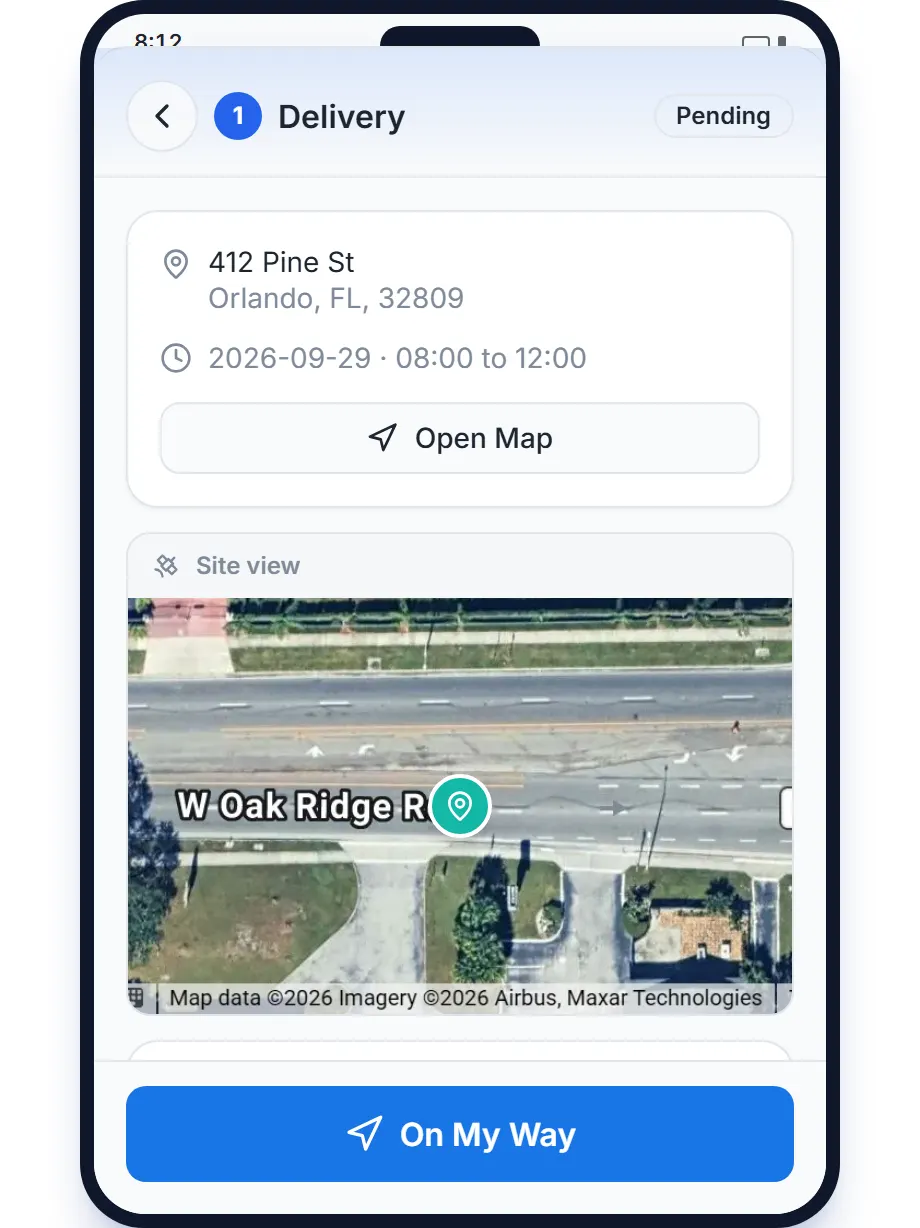
The Dumpster Controls driver app, iOS and Android, sample data. Truck Tablet Mode is a second layout of this app for a tablet mounted in the cab.
Two things make it a different product rather than a responsive breakpoint. The tablet is paired to the company instead of to a person, so drivers identify themselves at shift change on a "Who is driving?" screen with a 4 digit PIN: one terminal can live in the truck and every stop, photo and shift hour is still attributed to the individual who did it.
And the map is modelled on the roll-off cycle rather than on generic multi-stop routing. A roll-off truck carries one container at a time, so the map draws one trip at a time with its two ends numbered, a solid line when the truck is carrying a container and a dashed line when it is running empty, landfill runs drawn at the landfill instead of at the customer address the task inherited, and a trip that starts at the yard when the full container spent the night there.
Checked on September 1, 2026, CurbWaste describes its driver app as "Any device, any size". That is responsive sizing, which almost every modern web app does, and it is a different claim from a layout designed for the cab; we found no dedicated tablet layout and no driver switching on a shared device documented on their pages. Read that as absence of published documentation, not as proof that nothing exists internally.
It runs on any Android tablet or iPad. There is no proprietary hardware to buy from us, no per device fee and no contract, and the guide is public before signup at /help/driver-tablet. The phone app is covered on the dumpster driver app page.
An open platform
We publish a v1 API with approved keys, documented at /developers. We found no public developer platform at CurbWaste, and the only named integration on their site is QuickBooks. If you want to connect your own website, a phone AI or an internal dashboard, that difference matters more than a logo wall.
A network instead of a directory
Dumpster Net Hub lets haulers pass overflow work to each other inside the platform, with no marketplace fee. CurbWaste publishes a Company Profiles Network, which is a directory of company pages. Both are useful, but a directory lists companies and a network moves jobs and money between them.
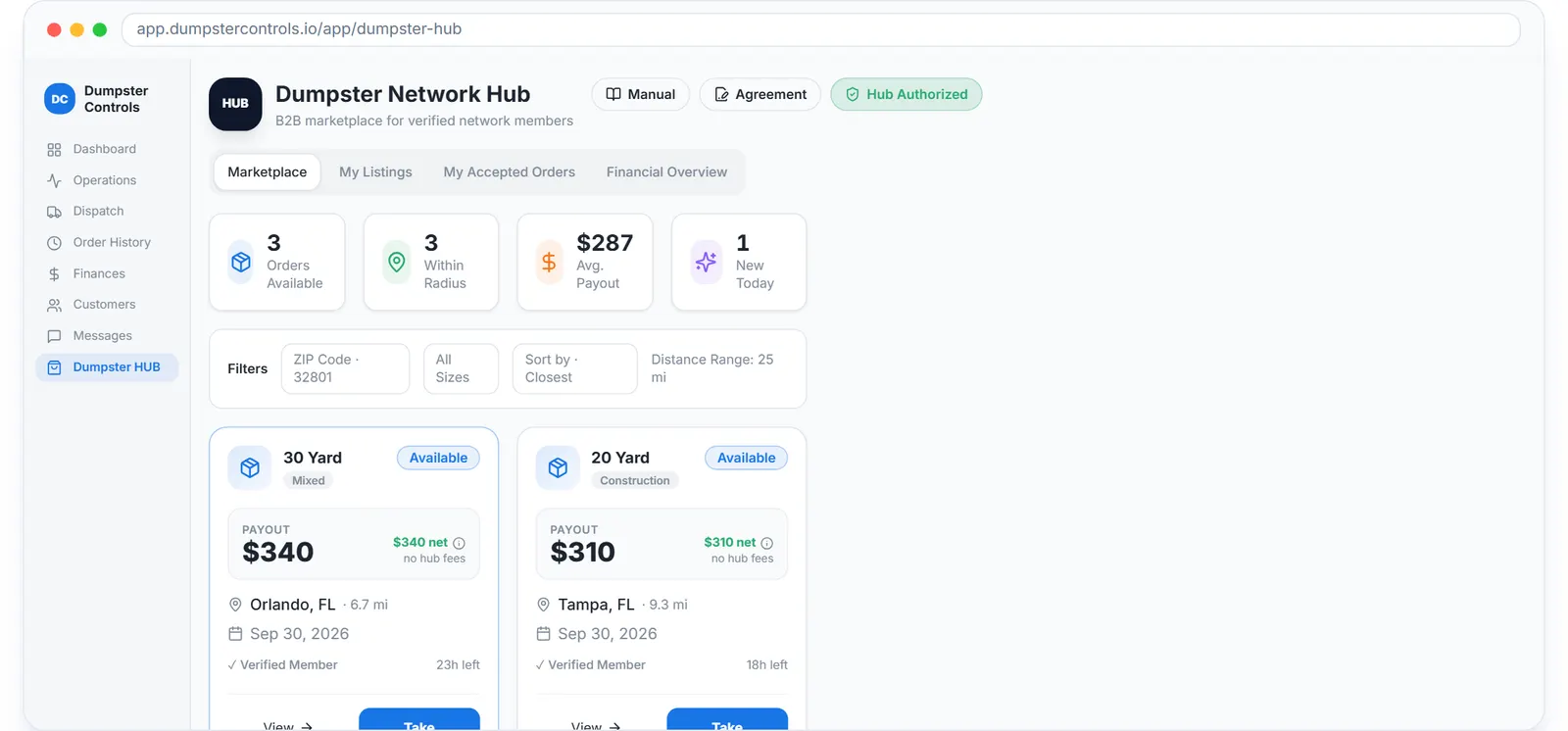
The Dumpster Net Hub, sample data: jobs posted by companies with overflow, taken by haulers with capacity. No listing fee and no percentage cut.
Junk removal in the same account
Junk jobs have their own pricing by truck fraction, crew size and time window, sharing the same customers, drivers, dispatch board and books as your roll-off work. Most dumpster companies eventually get asked to haul the debris too, and most junk companies eventually buy a can.
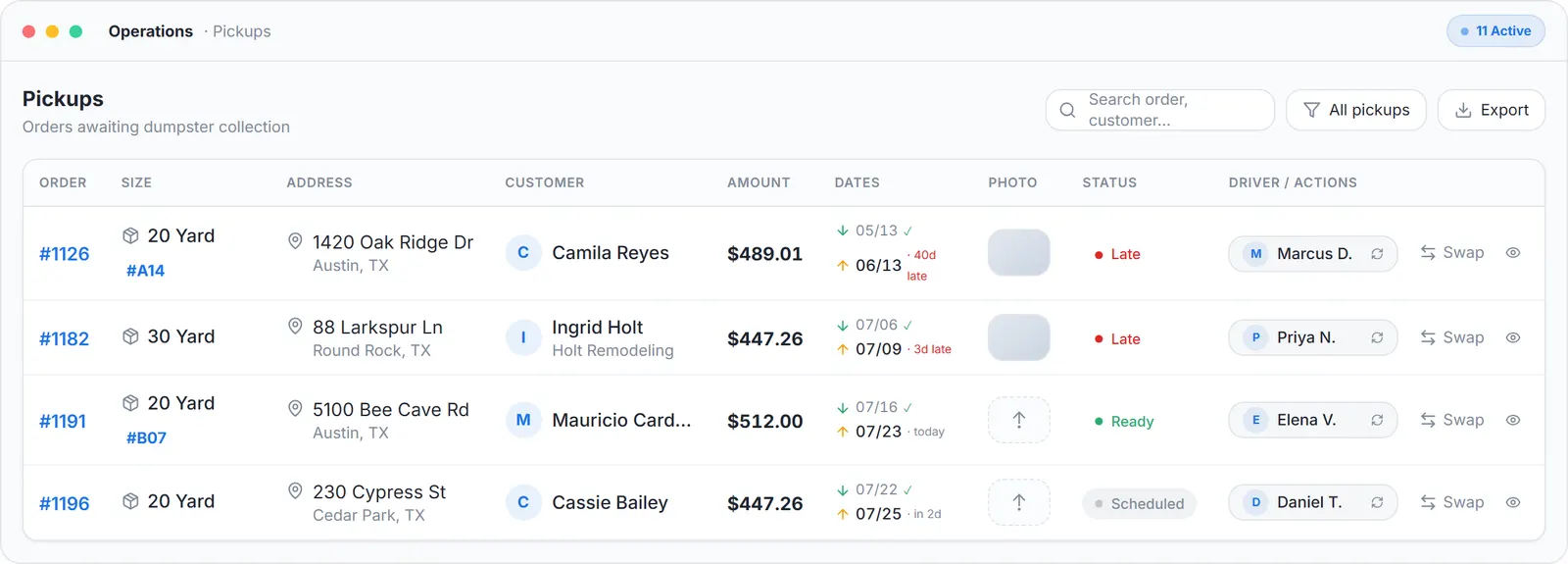
Operations in Dumpster Controls, sample data: the day's roll-off orders and junk jobs with status and driver, on one screen.
| Dumpster Controls | CurbWaste | |
|---|---|---|
| AI that executes operations | Tresha, by chat and voice, today | Machine learning announced in the 2025 Series B |
| Create an order by prompt | Yes, with a confirmation card | Not documented |
| AI inside the app by chat and voice | Yes: Tresha by chat and two-way voice | Not documented |
| Public developer API | Yes, v1 with approved keys | No public developer platform found |
| Hauler marketplace | Dumpster Net Hub, no fee | Company Profiles Network is a directory |
| National landfill database | 1,750 facilities, open data | Facility finder, mixed facility types |
| QuickBooks Online | Yes, one way DC to QBO | Yes, the only named integration we found |
| Software subscription | $0 | Not published; ~$250 to $300 per driver per month reported |
CurbWaste site, app store listings and Waste Dive · Checked August 23, 2026
Architecture and cost, side by side
What CurbWaste offers
CurbWaste is a funded company: $50 million raised, around 150 hauling companies in about 40 states, serving fleets from five to two hundred vehicles. Those are their numbers and the reporting around their Series B.
Commercial and residential collection. Recurring route work is part of their platform. Dumpster Controls is built around the roll-off and junk removal order.
CurbPOS. A cloud point of sale for transfer stations: gross and tare weights, dump tickets, in house versus third party hauler cost, and they say it works with most scales on the market.
The customer portal. A documented module for schedules, payments, history and balances. Dumpster Controls gives each customer an order portal reached by text message, with no login to manage.
Capital. The $50 million includes a $28 million round in October 2025 led by the venture arm of Cox Enterprises.
| Dumpster Controls | CurbWaste | |
|---|---|---|
| Roll-off dumpster rental | Core focus | Yes, one of several service lines |
| Junk removal | Native workflow with load pricing | Not a primary documented workflow |
| Getting started | Self-serve signup, no card and no demo | Get Demo |
| In-cab tablet | Truck Tablet Mode: landscape cockpit, PIN driver switching | Responsive driver app; no distinct in-cab layout documented (2026-09-01) |
| Customer access | Order portal by text message, no login to manage | Account portal with a login and statements |
| AI assistants outside the app | MCP server for Claude (every company) | No MCP server found (2026-09-28) |
CurbWaste product pages · Checked August 23, 2026
Built for the dumpster company
Why a dumpster company picks Dumpster Controls over CurbWaste
Choose Dumpster Controls
If dumpster rental, roll-off and junk removal are the business rather than one line of it, if you want AI you can talk to instead of a roadmap, if you want a published API your own tools can reach, if you want to buy and sell overflow work inside your software, or if you would rather put $15,000 a year into a container than into a software subscription. For any dumpster rental, roll-off and junk removal company, from large fleets to a company's first truck, that is the list.
What comes with it, on every plan
Support tickets from inside the app at any hour, answered within 24 hours, ticket support that is the same on every plan, and Tresha around the clock. An MCP server at mcp.dumpstercontrols.io/mcp connects the account to Claude on the web, desktop and phone, open to every company, with a ChatGPT app in review; we found no other dumpster platform publishing one (checked 2026-09-28). No per-driver fee, no initiation fee, no contract.
The honest test takes a week: run your real orders through both. You can start on our side tonight with no call and no card, which at least makes your half of the experiment free.
Dumpster Controls or CurbWaste: the questions haulers ask
What is Truck Tablet Mode, and does CurbWaste have one?
Truck Tablet Mode is a second layout of the Dumpster Controls driver app for a tablet mounted permanently in a roll-off truck: a landscape cockpit with the day on the left and the live map on the right, controls at least 48 by 48 pixels, and driver switching by 4 digit PIN on a device paired to the company rather than to a person. The map is built for the roll-off cycle, drawing one trip at a time with a solid line when the truck carries a container and a dashed line when it runs empty. Checked on September 1, 2026, CurbWaste describes its driver app as "Any device, any size", which is responsive sizing rather than a distinct in-cab layout, and we found no shared-device driver switching documented. That is absence of published documentation, not proof that nothing exists internally. It runs on any Android tablet or iPad with no hardware to buy from us.
Dumpster Controls or CurbWaste: which should a dumpster company choose?
For any roll-off or junk removal company, from large fleets to a company's first truck, Dumpster Controls, and the deciding number is usually price. The software is $0 at any fleet size, while Waste Dive reported in October 2025 that CurbWaste charges roughly $250 to $300 per driver per month plus an initiation fee, which is $15,000 to $18,000 a year for a five-driver company. Three Dumpster Controls capabilities have no published equivalent from CurbWaste as of 2026-08-23: a public REST API with an OpenAPI specification readable before signup, a transactional marketplace moving whole jobs between hauling companies with no fee, and a national landfill database, with tipping fees where published, released as open data. Dumpster Controls also ships Tresha, which executes operations by chat and two-way voice. It also runs an MCP server that connects the account to Claude, open to every company, with a ChatGPT app in review, and we found no other dumpster platform publishing one (checked 2026-09-28). Ticket support is the same on every plan: tickets answered within 24 hours, and Tresha at any hour.
What does Dumpster Controls have that CurbWaste does not publish?
Four things a buyer can verify without a sales call. A published price of $0 for the software with no per-driver component, against a per-driver subscription. A public developer API at dumpstercontrols.io/developers with a machine-readable OpenAPI 3.0.3 specification at dumpstercontrols.io/openapi.json; we found no API documentation published by CurbWaste: /api and /developers on curbwaste.com return 404 and the docs subdomain does not resolve, checked 2026-08-24. The Dumpster Net Hub, where companies pass overflow jobs to each other with no listing fee and no cut. And an open national landfill database of 1,750 facilities, with tipping fees where published, under CC BY 4.0. On AI, CurbWaste describes machine learning as an objective of its October 2025 Series B; we found no AI feature documented as shipping on its site, while Tresha executes real operations today.
How much does CurbWaste cost compared to Dumpster Controls?
CurbWaste does not publish a price. Waste Dive reported in October 2025 that it charges roughly $250 to $300 per driver per month plus an initiation fee, so a five-driver company would pay about $15,000 to $18,000 a year for software. That is journalist-reported rather than vendor-published, and we label it that way. Dumpster Controls charges $0 for the software at any fleet size, with no per-driver and no per-user component, so the bill does not change when you hire another driver. The only cost on the free plan is optional card processing when a customer chooses to pay by card.
What does CurbWaste offer beyond roll-off?
CurbPOS, its point of sale for transfer stations and scale houses, handles gross and tare weights, dump tickets and facility reporting. CurbWaste also covers commercial and residential routes alongside roll-off, and ships a commercial customer portal with a login. It is venture funded, with $50 million raised including a $28 million Series B in October 2025 led by the venture arm of Cox Enterprises. For a company whose business is roll-off dumpsters and junk removal, Dumpster Controls covers that work at $0 for the software, with no per-driver fee and no initiation fee.
Related
- dumpster rental software
- dumpster rental software cost
- curbwaste alternative
- dumpster driver app
- best dumpster rental software 2026
Methodology
Claims about CurbWaste come from their own website and product pages, their October 2025 funding announcement, the public app store listings, and Waste Dive's reporting, checked on August 23, 2026. CurbWaste does not publish pricing, so the per driver figure here is journalism, not a rate card, and we label it that way.
One number we deliberately do not repeat: CurbWaste advertises a facility finder with a very large facility count. That count mixes recycling centers, transfer stations, landfills and material recovery facilities, so quoting it as a landfill count, which some comparisons do, would be wrong.
Where we write "we found no documentation", that is what we mean: absence of a public claim is not proof a capability does not exist. Corrections to daniel@dumpstercontrols.io.