Comparison
Dumpster Controls and Docket : two different bets on what hauling software is
Free and self-serve against quote-only with a required demo. A public API, an open landfill database, a network between haulers, an assistant that executes the work by voice and an MCP server for Claude. Every claim is checkable, with its source and date.
By Daniel Teixeira Founder, Dumpster ControlsUpdated October 11, 2026 11 min read
Direct answer
Dumpster Controls is free dumpster rental software for any fleet size: $0 for the software, self serve, with dispatch, the driver app, online booking, invoicing, QuickBooks and Tresha on the free plan. Docket does not publish a price and requires a demo, and its parent ServiceCore states that billing is monthly on an annual contract. Dumpster Controls also answers support tickets within 24 hours on every plan and runs an MCP server so Claude can work inside the account; no other dumpster rental platform we track publishes one (checked 2026-09-28).
What you need to know
- $0 and self-serve, against quote-only. Our price is on a public page and you can dispatch a real job the same afternoon. Docket requires a demo, and ServiceCore states billing is monthly on an annual contract.
- Three things we found no published equivalent for as of 2026-08-23: a public REST API with an open OpenAPI spec, a marketplace that moves whole jobs between haulers with no fee, and a national landfill database, with tipping fees where published, released as open data.
- Two different categories of AI. IronRouteAI computes a cheaper route for a human to apply. Tresha runs the day: creates orders at your price list, assigns drivers, reschedules, sends invoices and closes deliveries, pickups and landfill runs, by chat or voice, on the free plan.
- Claude can work inside your account. Our MCP server lets Claude, on the web, desktop and mobile, create orders at your price list, dispatch, invoice and look up customers, every change confirmed by you. No other dumpster rental platform we track publishes an MCP server (checked 2026-09-28).
| Feature | Dumpster Controls $0, self serve | Docket Quote based, demo required |
|---|---|---|
| Software price | $0 | Not published; demo required, annual contract per ServiceCore |
| Roll-off and junk removal | ||
| Service lines | Roll-off and junk removal, with scrap metal pickups in beta | Roll-off, junk removal, front-load and residential routes |
| AI | Tresha runs the day: creates, dispatches, reschedules and invoices orders and completes stops, by chat or voice | IronRouteAI computes routes, on Pro Plus |
| Online ordering | ||
| Driver app | iOS and Android on the free plan, Truck Tablet Mode, the PIN identifies the driver | Mobile app, the PIN identifies the dumpster |
| Finances | Payment links, saved cards, reminders, profit per order, bank reconciliation, all at $0 | Pricing matrix and accounting integrations, on a quoted plan |
| QuickBooks Online | Yes, one way DC to QBO, on the free plan | Yes, established, Docket as source of truth |
| Public API | v1 read endpoints, OpenAPI spec, signed webhooks | Outbound webhooks, one endpoint documented |
| Landfill database | 1,750 facilities, open data | Configured dump sites feed the optimizer |
| Hauler marketplace | Dumpster Net Hub, no fee | Broker tools and Dumpsters.com |
| Live truck location | From the driver app on the route map, no hardware to buy | Samsara and Verizon Connect integrations, higher plans |
| Support | Tickets answered within 24 hours on every plan, 421-article public manual, Tresha at any hour | Onboarding team; six to twelve weeks per ServiceCore |
| AI assistant and MCP | Tresha creates, dispatches, reschedules and invoices orders by chat and voice, plus an MCP server so Claude does the same work in the account | No MCP server published (checked 2026-09-28) |
At a glance. Source: Docket and ServiceCore published documentation, checked 2026-08-23; Dumpster Controls codebase, same date. Absence of published documentation is not proof of absence.
Verdict by criterion
Price
Dumpster Controls
$0 and self serve, against quote-only with a required demo and, per ServiceCore, an annual contract.
Dispatch and AI routing at $0
Dumpster Controls
AI route suggestions for each driver, checked against the roll-off truck cycle, are on our free plan. Docket lists IronRouteAI only on its highest tier.
Booking tied to inventory
Dumpster Controls
Both take orders online. Ours checks live container inventory, ships as a hosted page and an embeddable widget for the company's own site, and is free.
Driver app in the cab
Dumpster Controls
Truck Tablet Mode, where the PIN identifies the driver on a tablet paired to the company. Docket documents a mobile app whose PIN identifies the dumpster.
Finances at $0
Dumpster Controls
Payment links, saved cards, reminders, profit per order with its landfill cost, bank reconciliation and native QuickBooks Online sync, on the free plan.
Support from day one
Dumpster Controls
Dispatch the same afternoon, tickets answered within 24 hours on every plan, a 421-article public manual and Tresha at any hour. ServiceCore states six to twelve weeks of onboarding.
AI and MCP
Dumpster Controls
Tresha creates, dispatches, reschedules and invoices orders by chat and voice, and our MCP server lets Claude do the same work in the account. Docket presents its AI as route optimization; no MCP server published (checked 2026-09-28).
A dispatcher at a five truck roll-off company makes about forty decisions before ten in the morning. Which truck takes the swap on the north side. Whether the 30 yard at the roofing job can wait until Thursday, and which landfill takes the heavy load when the closer one charges more per ton.
Software either helps with those forty decisions or it just records them afterward. Docket and Dumpster Controls both help, in different places.
Everything below can be checked by a stranger: our price is on a public page, our API specification is machine readable before you create an account, our landfill data is openly licensed, and every claim about Docket links to their own page with the date we read it.
Two philosophies of dumpster rental software, not two feature lists
Docket has grown into something close to a waste management ERP. Roll-off, junk removal, commercial front-load, residential curbside, recurring routes, asset management, accounting integrations, fleet telematics, route optimization and online ordering, all in one system. For a company running several service lines, that breadth is the product.
We went the other way. Dumpster Controls is built around one chain, tightly connected: order, container, dispatch, driver, landfill, invoice, payment, profit, network. Instead of covering every waste vertical first, we connected those objects and then laid two things across them: an AI that operates the platform, and a marketplace where haulers trade work.
IronRouteAI is a routing optimizer. Tresha is an AI operations layer. That single sentence explains most of the differences below.
| Dumpster Controls | Docket | |
|---|---|---|
| Roll-off management | Yes | Yes |
| Junk removal | Yes | Yes |
| Commercial front-load routes | Not a current focus | Yes |
| Residential curbside routes | Not a current focus | Yes |
| AI route optimization | AI route suggestions per driver, free plan | IronRouteAI (Pro Plus) |
| AI that runs the day by chat and voice | Tresha by chat and two-way voice: creates, dispatches, reschedules and invoices orders and completes deliveries, pickups and landfill runs | Not documented |
| Create an order by prompt or voice | Yes, with a confirmation card | Not documented |
| Complete a stop by prompt or voice | Yes, with a confirmation card | Not documented |
| Re-optimize a driver's remaining stops | Yes, any time today, review then Apply | Day and driver optimization |
| Container lifecycle tracking | Yes, serial level | Yes, with PIN and QR field updates |
| Landfill database and tipping intelligence | 1,750 facilities, open data | Configured dump sites feed the optimizer |
| Hauler marketplace | Dumpster Net Hub, no marketplace fee | Broker tools and Dumpsters.com |
| QuickBooks Online | Yes, one way DC to QBO | Yes, established, Docket as source of truth |
| Live truck location | From the driver app, no hardware to buy | Samsara and Verizon Connect, on higher plans |
| MCP server for AI assistants | Yes: Claude creates orders at your price list, dispatches and invoices in the account, every change confirmed | No MCP server published (checked 2026-09-28) |
| Public API | Yes, v1 read endpoints with approved keys | Outbound webhooks, one endpoint documented |
| Software subscription | $0 | Quote based, demo required |
Docket and ServiceCore published documentation, and the Dumpster Controls codebase · Checked August 23, 2026
Where each platform stands today
Where Dumpster Controls is structurally different
Landfill economics as a first class object
Both systems know disposal costs matter; theirs feeds configured dump sites into the optimizer. We went further and made it a public database: 1,750 facilities with addresses, hours, accepted waste and, where verified against official sources, the published tipping fee per ton or per cubic yard.
It is open under CC BY 4.0, so anyone can use it, including their customers. See it in the Landfill Finder or in the numbers we publish monthly in the market data index.
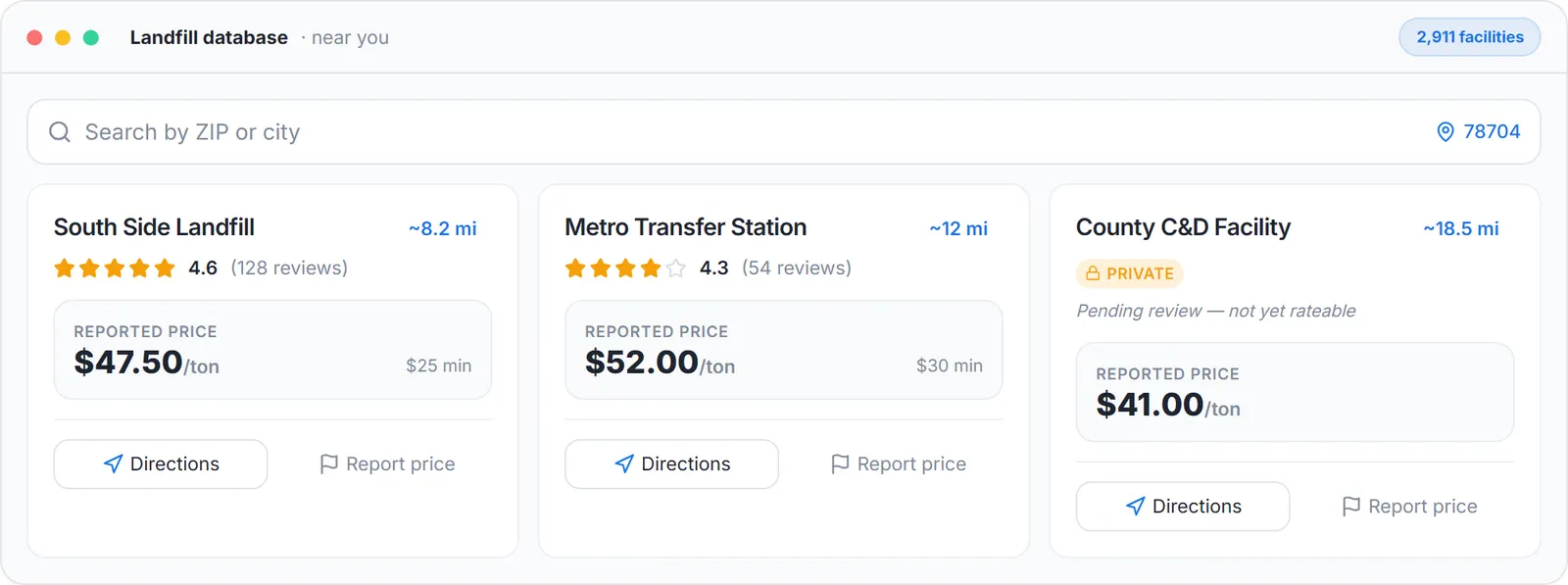
The landfill finder inside Dumpster Controls, sample data: nearby facilities with distance and the published tipping fee, from the open database of 1,750 facilities.
The operational consequence is that a specific order connects to its actual disposal event and cost, so the question stops being "was this invoice paid" and becomes "did this rental make money after the dump."
A driver terminal built for the cab
Truck Tablet Mode is a second layout of our driver app, for a tablet that stays mounted in the truck. It is not the phone screen resized. The day sits in a panel on the left, the live map fills the right, a vertical rail holds the few things a driver touches while working, every control is at least 48 by 48 pixels and no text is smaller than 14 pixels.
Those numbers exist because the person reading it is wearing gloves, at arm's length, in a moving vehicle.
Two things make it a different product rather than a responsive breakpoint. The tablet is paired to the company instead of to a person, so drivers identify themselves at shift change on a "Who is driving?" screen with a 4 digit PIN: one terminal can live in the truck and every stop, photo and shift hour is still attributed to the individual who did it.
And the map is modelled on the roll-off cycle rather than on generic multi-stop routing. A roll-off truck carries one container at a time, so the map draws one trip at a time with its two ends numbered, a solid line when the truck is carrying a container and a dashed line when it is running empty, landfill runs drawn at the landfill instead of at the customer address the task inherited, and a trip that starts at the yard when the full container spent the night there.
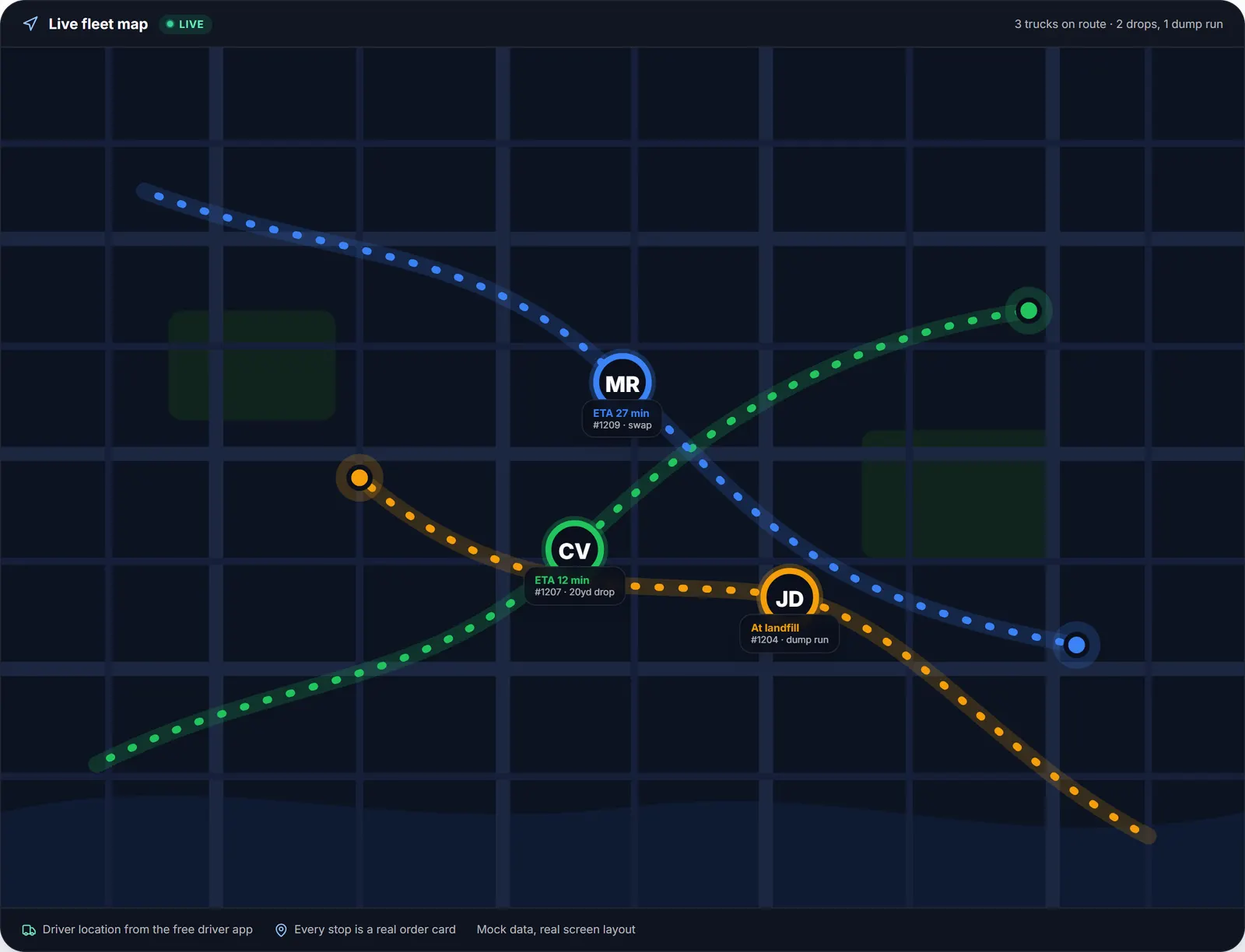
The same roll-off cycle on the office map in Dumpster Controls, sample data: solid line when the truck carries a can, dashed when it runs empty, landfill runs drawn at the landfill.
Checked on September 1, 2026, Docket describes "the Docket Dumpster Software mobile app" and no tablet layout. Docket does use a PIN, and it is worth being precise about it: on their driver management page the PIN identifies a dumpster, entered or scanned to confirm which container is on the truck.
Ours identifies a driver, which is what allows one terminal to stay in the cab and still attribute the work correctly. Two different problems, solved with the same four digits.
It runs on any Android tablet or iPad. There is no proprietary hardware to buy from us, no per device fee and no contract, and the guide is public before signup at /help/driver-tablet.
A network, and not only a system of record
Most hauling software is company shaped: your customers, your cans, your trucks, in your database. Dumpster Net Hub lets operators pass overflow work to each other inside the platform, with no marketplace fee on either side.
Docket has broker tools and a Dumpsters.com integration, which is a different model: it connects you to a broker rather than to other haulers directly.
An open platform, not a roadmap
Docket ships outbound webhooks; their documentation describes one endpoint per account with completion events as the documented triggers. They also list a catalog of prebuilt connectors.
We went the other way, and it is live rather than planned: a public v1 API with approved keys, per company gating and rate limiting, documented at /developers. The distinction is between a catalog someone else curates and a platform you can program.
It matters most when you want your own website, your own dashboard, a call center tool, or an outside AI agent reaching your data directly. Ours is the native agent; the API is the door for everyone else's agents, and as AI becomes several tools a company runs at once, a closed platform means waiting for your vendor to build each connection.
$0
Our software subscription, at one truck and at fifty. Docket does not publish a price and requires a demo; ServiceCore, its parent, states an annual contract with six to twelve weeks of onboarding Source: ServiceCore pricing page, checked August 23, 2026
The dumpster rental software cost question, properly framed
The right calculation is not the monthly line. It is subscription plus implementation plus add-ons plus per driver expansion plus transaction costs plus the labor of running it.
Docket sells three tiers, does not publish the amounts, and driver count can affect the contracted price. IronRouteAI requires the top tier.
Ours is free to start, with no demo and no card, and it stays free as you add trucks and drivers. We earn on card processing when a customer pays by card, and an optional paid plan lowers that rate for high volume operators. The full detail is on the pricing page and the vendor list on dumpster rental software cost.
The real question is not whether $500 a month is affordable. It is whether your software bill should grow because you hired a driver.
Agentic operations: the difference that is hard to copy
IronRouteAI computes a plan. Tresha performs work. That is not a slogan, it is a difference in what the software lets you do with a sentence.
In Dumpster Controls you can say, out loud or in chat, "create a 20 yard for Maple Street tomorrow" and the order is built slot by slot, with a confirmation card before anything is written. You can complete a delivery, a pickup or a landfill run the same way, and you can ask what was billed this week.
Route suggestions arrive with an estimated saving that applies with one tap and undoes with another.
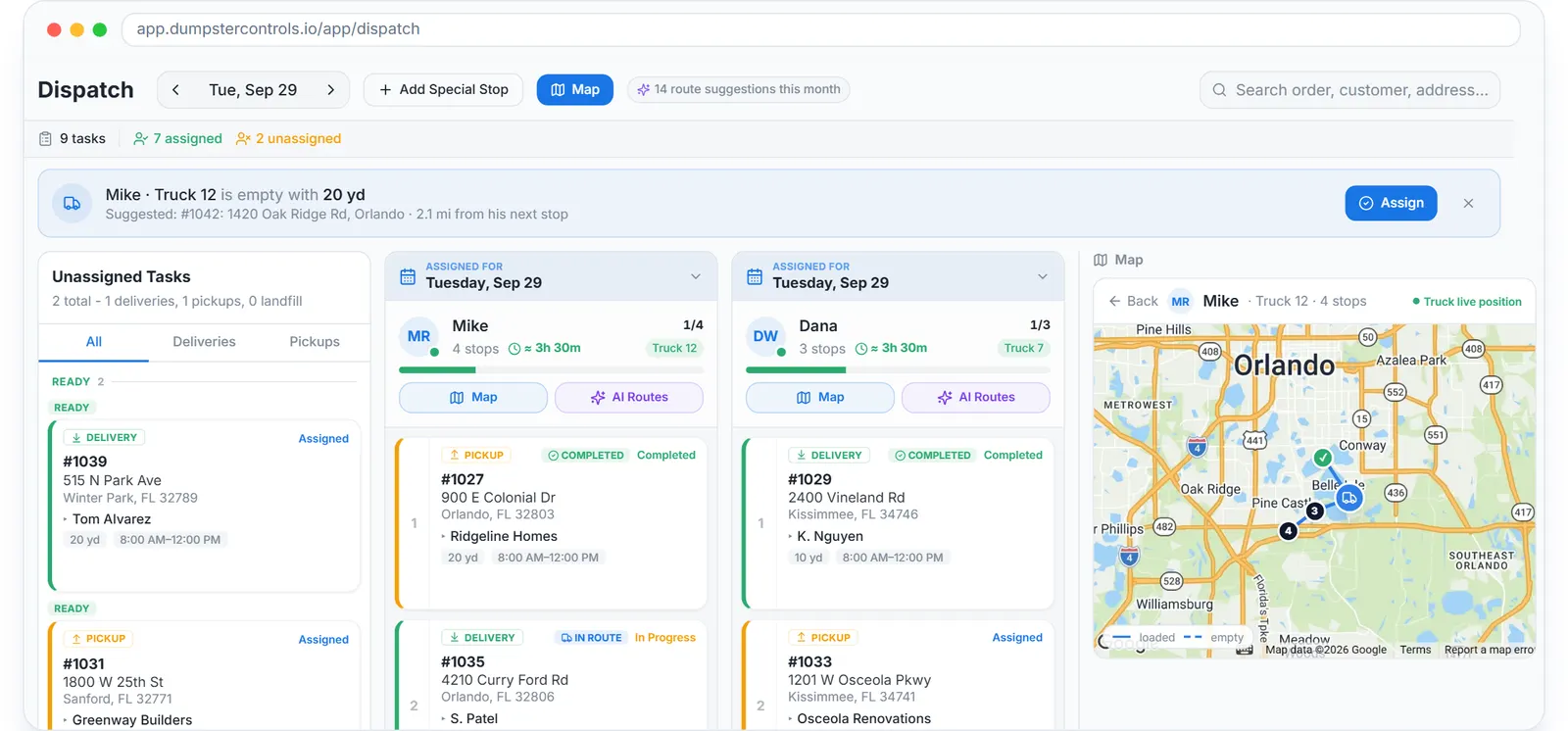
The dispatch board in Dumpster Controls, sample data. An order Tresha creates from a sentence lands here as a card; a route suggestion reorders a lane with one tap.
The architecture is natural language to intent to operational context to an authorized action inside the system. For an owner who is in a truck or a yard rather than at a desk, voice stops being a convenience and becomes the interface.
We found no equivalent documented on Docket's product pages, where the AI is presented as route optimization. More on the assistant on the Tresha AI page.
QuickBooks: no longer their exclusive ground
This page used to concede accounting outright. That is now out of date on both sides. Docket has an established and well documented QuickBooks Online workflow, and by their own description it is primarily one direction, with Docket as the source of truth: customers, invoices, payments and expenses are pushed to QuickBooks, and changes made in QuickBooks do not generally flow back.
Ours is native QuickBooks Online sync, also one way, from Dumpster Controls into QuickBooks Online: customers, invoices, payments, refunds and expenses sync automatically, on the free plan. Compare the sync model, the objects covered and the reconciliation workflow, because those differ more than the checkbox does.
Dumpster route optimization: two different jobs
IronRouteAI is not a shortest path calculator. Per Docket's own documentation, it runs a cost minimization model across a very large number of route combinations, weighing dump site costs, vehicle cost per mile, driver hours, capacity, workload balance, task priority, geographic clustering, time of day traffic and commercial vehicle road restrictions.
It can optimize a whole fleet or a single driver, and it returns route analytics on coverage, distance, cost and balance.
It sits on their Pro Plus tier, the highest one, and it plans the fleet before the trucks leave.
Ours is on the free plan and works per driver, during the day. AI Routes reorders a driver's remaining stops, checked against the real roll-off truck cycle: an empty truck, a full can, a swap chain, stored dumpsters and the landfill run in the middle. It states what it assumed about the truck, shows the estimated saving, and changes nothing until the dispatcher clicks Apply. Stops in progress or completed never move, and Undo restores the previous order.
What we built around it
Tresha is not primarily a route builder. It is how you run the day. You can create a delivery order or a junk removal job at your price list from a conversation, assign the driver, move the dates, send the invoice, complete a delivery, pickup or landfill run by chat or voice behind a confirmation card, ask what revenue looked like last week, and get a route suggestion with an estimated saving that you apply with one tap or undo.
The distinction that matters: optimization happens before the trucks leave. Operations happen all day. A customer calls at 10:20 with a paid booking, a driver runs late, a container is not where the board says it is.
So our tools are built for the middle of the day: a new order created from a sentence, a stop completed by voice, and a fresh route suggestion for the driver whose day just changed.
What Docket covers beyond roll-off, and what we include
Docket documents several things outside the roll-off core. We list them as they publish them, with the same sources as everything above, and next to each one what Dumpster Controls includes on its free plan.
Mixed waste operations. Front-load commercial and residential curbside routes are native Docket products. Dumpster Controls is built for roll-off and junk removal, with scrap metal pickups in beta, and does not run recurring curbside routes.
Pricing. Their Pricing Matrix combines size, duration, state, ZIP, city, county, mileage, customer type, material, task type, included weight, overweight rates, fuel surcharge, delivery charges, failed task fees and internal cost inputs.
Ours sets prices per size for 24 hours, 3, 7, 14 and 30 days with additional daily charges, weight limits with per-ton overage, a fuel surcharge, sales tax and card fee handling, and commercial accounts carry their own Net terms, credit limit and tax exempt switch, all on the free plan.
Truck location. Docket integrates Samsara and Verizon Connect on higher plans. Ours reads the truck's live position from the driver app and draws it on the route map, with no telematics hardware to buy.
Onboarding and support. Docket puts a team on your migration and training, including people who have run hauling operations, and ServiceCore states six to twelve weeks of onboarding.
Ours: dispatch the first job the same afternoon, support tickets answered within 24 hours, ticket support that is the same on every plan, a public manual of 421 articles, and Tresha answering how-to questions at any hour, by text or voice.
How to choose between Dumpster Controls and Docket
Choose Dumpster Controls
If roll-off or junk removal is the core of your business, if you want AI you can talk to that creates, dispatches, reschedules and invoices orders, not only route building, if you want Claude working inside your account through our MCP server, if you want finances and support included at no charge, if landfill economics and per order profit matter to how you price, if you want to buy and sell overflow work inside your software, if you want a published API your own tools can reach, or if you would rather not carry a software subscription at all. For any dumpster rental, roll-off and junk removal company, from large fleets to a company's first truck, that is the list, and testing it costs nothing and needs no call.
Questions to ask Docket
What the quote is for your fleet and whether driver count changes it. How long the annual contract runs. Which tier includes IronRouteAI and the telematics integrations. How many weeks pass before you dispatch your first job. Whether their AI can create an order or complete a stop, or only build routes, and whether they publish an MCP server.
The question stopped being which platform has more features. It is what kind of operating system you want your company running on for the next five years. You can try ours tonight without talking to anyone, which at minimum makes the comparison cheap to run yourself.
What Docket offers
Docket was founded in Dayton, Ohio in 2019 and has been part of ServiceCore since 2023. From its own documentation, with the same sources as everything above:
Mixed waste routes
Front-load commercial and residential curbside routes, as native Docket products.
Batch route-cost optimization
IronRouteAI weighs dump site costs, cost per mile, driver hours, capacity, workload balance and traffic across a whole fleet, on the Pro Plus tier.
A multidimensional pricing matrix
Size, duration, state, ZIP, city, county, mileage, customer type, material, included weight, overage and fuel surcharge.
Fleet telematics
Native Samsara and Verizon Connect integrations on higher plans.
Dumpster Controls or Docket: the questions haulers ask
Related
- dumpster rental software
- dumpster rental software cost
- docket alternative
- dumpster route optimization
- dumpster dispatch software
Methodology
Everything described about Docket here comes from their own published documentation and product pages, and from ServiceCore's pricing page, checked on August 23, 2026. Neither company publishes plan pricing, so we do not estimate it. Capabilities we describe as ours were verified in our own codebase on the same date.
We are a competitor writing about a competitor. Read it with that in mind, check the linked sources, and tell us at daniel@dumpstercontrols.io if anything here is out of date. We re-check every comparison page quarterly.
Frequently asked questions
Docket has a PIN too. Is that the same as driver switching on a shared tablet?
No, and the distinction matters. On the Docket driver management page, checked on September 1, 2026, the PIN identifies a dumpster: the driver enters or scans it to confirm which container is on the truck. In Dumpster Controls, the PIN identifies the driver on a tablet that is paired to the company rather than to a person, so a terminal can stay mounted in the cab and every stop, photo and shift hour is still attributed to whoever is driving that day. Docket describes its driver product as a mobile app and we found no dedicated tablet layout documented. That is absence of published documentation, not proof that nothing exists internally.
Dumpster Controls or Docket: which should a roll-off company choose?
For a company whose business is roll-off dumpsters and junk removal, Dumpster Controls. The software is $0 at any fleet size, while Docket does not publish a price and requires a demo, and its parent ServiceCore states on its own pricing FAQ that billing is monthly on an annual contract. Three Dumpster Controls capabilities have no published equivalent from Docket as of 2026-08-23: a public REST API with an OpenAPI specification readable before signup, a transactional marketplace moving whole jobs between hauling companies with no fee, and a national landfill database, with tipping fees where published, released as open data. Dumpster Controls also ships Tresha, an assistant that executes operations by chat and two-way voice. Docket also serves commercial front-load and residential curbside routes and offers its IronRouteAI optimizer on its top tier; Dumpster Controls includes AI route suggestions, its finances and its support on the free plan, and runs an MCP server that lets Claude work inside the account.
What does Dumpster Controls have that Docket does not publish?
Four things, each verifiable without a sales call. A published price of $0 for the software, against quote-only with a required demo. A public developer API at dumpstercontrols.io/developers with a machine-readable OpenAPI 3.0.3 specification at dumpstercontrols.io/openapi.json; Docket documents outbound webhooks, one endpoint per account, and we found no read API documentation: /api and /developers on their site return 404, checked 2026-08-24. The Dumpster Net Hub, where companies pass overflow jobs to each other with no listing fee and no percentage cut. And an open national landfill database of 1,750 facilities, with tipping fees where published, released under CC BY 4.0. Dumpster Controls is also self-serve: create an account and dispatch a real job the same afternoon, with no demo and no card.
What is the difference between IronRouteAI and Tresha?
They are different categories of AI and both are real. IronRouteAI is optimization AI: it computes a cheaper route, weighing fuel cost per mile per truck, driver wages and overtime thresholds, landfill dump fees by location and material, distance, bin and truck compatibility, priority time windows and live inventory, optimizing for net profitability rather than shortest distance. A human then applies the plan. Tresha is agentic AI: it executes the work. From chat or two-way voice it creates delivery orders and junk removal jobs, completes deliveries, pickups and landfill runs with photos and AI-read dump tickets, and answers from the company's own live data, each action behind a confirmation card under the user's own login. Docket lists IronRouteAI only on its highest tier; Tresha and AI route suggestions are on the Dumpster Controls free plan.
Are Docket and ServiceCore the same company?
They are one company with two products. Docket was founded in Dayton, Ohio in 2019 and ServiceCore, based in Denver, acquired it in May 2023; they share a chief executive. In March 2026 Docket rebranded from Docket Dumpster Software to Docket Waste Software, adding commercial front-load and residential trash routes. Neither publishes pricing publicly, and the ServiceCore pricing FAQ states that billing is monthly on an annual contract.
What does Docket offer beyond roll-off, and what does Dumpster Controls include?
Docket also serves commercial front-load and residential curbside routes, which are outside the roll-off and junk removal focus of Dumpster Controls. It offers IronRouteAI, a batch route-cost optimizer, on its highest tier, native integrations with Samsara and Verizon Connect telematics on higher plans, and a pricing matrix covering size, duration, state, ZIP, city, county, mileage, customer type, material, included weight, overage and fuel. Dumpster Controls includes on its free plan AI route suggestions for each driver's remaining stops, checked against the roll-off truck cycle and applied only when the dispatcher clicks Apply; the truck's live position from the driver app on the route map, with no telematics hardware; prices per size and rental period with weight limits, per-ton overage, a fuel surcharge and sales tax; and finances from invoices and payment links to profit per order, bank reconciliation and native QuickBooks Online sync. Support tickets are answered within 24 hours on every plan, and a company can dispatch its first job the same afternoon.
Does Dumpster Controls work with ChatGPT or Claude?
Yes, with Claude today. Dumpster Controls runs a remote MCP (Model Context Protocol) server at mcp.dumpstercontrols.io/mcp that lets Claude, on the web, desktop and mobile apps, do the work inside a company's account: create orders at the company's price list, assign drivers, edit orders, send invoices and complete stops, and look up orders, dispatch, invoices and customers. Every change is confirmed by the user before it runs. The connector is included at no extra cost and is open to every Dumpster Controls company. A ChatGPT app is in review. No other dumpster rental platform we track publishes an MCP server (checked 2026-09-28). Documentation: dumpstercontrols.io/developers/mcp.