Comparison
Dumpster Controls and DRS : what the $79.95 plan leaves out
Free against a $79.95 plan that their own page labels NO ROUTING and their knowledge base excludes from QuickBooks. A public API, an open landfill database, a hauler network, an assistant that runs the operation by voice and an MCP server for Claude. Every claim is checkable, with its source and date.
By Daniel Teixeira Founder, Dumpster ControlsUpdated October 11, 2026 14 min read
Direct answer
Dumpster Controls is free dumpster rental software for any fleet size: $0 for the software, with dispatch, AI route suggestions, the driver app, online booking, invoicing and QuickBooks on the free plan, and the only cost on the free plan is card processing when a customer pays by card. DRS publishes $79.95 to $279.95 a month, and its own pages exclude routing and QuickBooks from the $79.95 tier, so the practical entry price for a company that dispatches is $195.95. Dumpster Controls also answers support tickets within 24 hours on every plan and runs an MCP server so Claude can work inside the account; no other dumpster rental platform we track publishes one (checked 2026-09-28).
What you need to know
- $0 against $2,351 a year. The $79.95 DRS plan is labeled NO ROUTING on their own pricing page, and their knowledge base excludes QuickBooks from it too, so the practical entry price for a dispatching company is $195.95 a month.
- Three things we found no published equivalent for as of 2026-08-23: a public REST API with an open OpenAPI spec, a marketplace that moves whole jobs between haulers with no fee, and a national landfill database, with tipping fees where published, released as open data.
- Tresha runs your day by voice, creating orders at your price list, assigning drivers, rescheduling, sending invoices and completing deliveries, pickups and landfill runs behind a confirmation card, today. The DRS routing and asset architecture is announced, not shipped: their V2 page is noindex, carries no price and no date, and the driver app is recruiting beta testers.
- Claude can work inside your account. Our MCP server lets Claude, on the web, desktop and mobile, create orders at your price list, dispatch, invoice and look up customers, every change confirmed by you. No other dumpster rental platform we track publishes an MCP server (checked 2026-09-28).
| Feature | Dumpster Controls $0, any fleet size | DRS $79.95 to $279.95 per month |
|---|---|---|
| Software price | $0 | $79.95 to $279.95 per month |
| Dispatch and routing | Included free, with AI route suggestions | Standard and Pro only; the $79.95 tier is labeled NO ROUTING |
| QuickBooks Online | Free on every plan, one way into QuickBooks | Free, all plans except Launch |
| Online booking | Hosted page and embeddable widget | |
| Driver app | iOS and Android on the free plan, Truck Tablet Mode, voice through Tresha | iOS and Android, with clock in and clock out |
| Public API documentation | Public REST API, OpenAPI spec, signed webhooks | Not found published |
| National landfill database | 1,750 facilities, open data, CC BY 4.0 | Not documented |
| Hauler-to-hauler marketplace | Dumpster Net Hub, no fee either side | Not documented |
| Setup and configuration | Prices per size and rental period, weight limits with per-ton overage, fuel surcharge, sales tax, card fee handling, blackout dates, Net terms per commercial account | Nine payment terms, per-customer pricing, travel fee rules |
| Finances | Invoices, payment links, saved cards, reminders, profit per order, bank reconciliation, all at $0 | Batch and combined invoicing, cards on file, on paid plans |
| Support | Tickets answered within 24 hours on every plan, 421-article public manual, Tresha at any hour | 86-article public knowledge base |
| Onboarding | Same day, self serve, no call | Assisted, up to 30 days, many in under a week |
| AI assistant and MCP | Tresha creates, dispatches, reschedules and invoices orders by chat and voice, plus an MCP server so Claude does the same work in the account | No MCP server published (checked 2026-09-28) |
At a glance. Source: DRS pricing page and knowledge base, checked 2026-08-23; Dumpster Controls production platform. Absence of published documentation is not proof of absence.
Verdict by criterion
Price
Dumpster Controls
$0 at five cans or five hundred, against $79.95 to $279.95 a month with a step at twenty containers.
Dispatch
Dumpster Controls
Dispatch and AI route suggestions are on our free plan. DRS labels its $79.95 tier NO ROUTING, so routing starts at $195.95.
Booking on the entry plan
Dumpster Controls
Our hosted booking page and embeddable widget are on the free plan. DRS includes WordPress integration from Standard, $195.95 a month, upward.
Driver app at $0
Dumpster Controls
iOS and Android on the free plan, with Truck Tablet Mode, driver switching by PIN on a shared tablet and voice through Tresha.
Finances at $0
Dumpster Controls
Invoices, payment links, saved cards, reminders, profit per order, bank reconciliation and native QuickBooks Online sync, all free. DRS leaves QuickBooks out of its $79.95 plan.
Support on every plan
Dumpster Controls
Tickets answered within 24 hours on every plan, a public manual of 421 articles against their 86, and Tresha answering how-to questions at any hour.
AI and MCP
Dumpster Controls
Tresha creates, dispatches, reschedules and invoices orders by chat and voice, and our MCP server lets Claude do the same work in the account. No MCP server published by DRS (checked 2026-09-28).
There was an easier version of this comparison to write. DRS charges a subscription and we do not. Their entry plan is $79.95, routing starts at $195.95, and above twenty containers the published price becomes $279.95.
All of that is true, and all of it is on their own pricing page. It is also no longer enough to understand the two products.
DRS has kept developing the current platform while publicly showing the next one, and the existing system covers a surprisingly wide portion of a real workday. So the interesting comparison stopped being old software against new software. It is two companies making different bets on what the operating system for a hauling company should become.
DRS is building a highly configurable all-in-one suite with people and services around it. We are building an agentic operating layer, open data and a network between haulers.
Dumpster rental software cost: what their pricing page says
DRS publishes three prices on its pricing page. The detail worth reading twice is what the cheapest plan excludes.
| Dumpster Controls | DRS | |
|---|---|---|
| Launch, $79.95/mo | $0 | Labeled NO ROUTING on their pricing page. QuickBooks excluded. WordPress excluded |
| Standard, $195.95/mo | $0 | Full system, operations under 20 cans |
| Pro, $279.95/mo | $0 | Full system, operations over 20 cans |
| Free tier | Free forever, unlimited orders, trucks and drivers | None published; the site offers a booked demo |
| Price steps with fleet size | No, five cans and five hundred cost the same | Yes, at 20 containers |
| Web design, SEO, marketing dashboard | Website builder included free | Paid add-on services |
| Onboarding | Same day, self serve, no call | Up to 30 days, many in under a week, per their FAQ |
DRS pricing page and knowledge base · Checked August 23, 2026
Published pricing and what each tier includes
Routing is the feature a dispatcher touches most, and their own page marks it as not included at $79.95. Their QuickBooks article excludes that plan too. So for a company that builds routes in the morning and syncs its books at night, which is most companies, the entry price is not $79.95.
It is $195.95 a month, or $2,351 a year. The ladder then continues: past twenty cans the plan becomes $279.95, so the month you buy your twenty-first container your software bill goes up by $84.
$0
What Dumpster Controls charges for the software at five containers, fifty or five hundred, including dispatch, AI route suggestions, the driver app, online booking, invoicing and QuickBooks Source: Dumpster Controls pricing
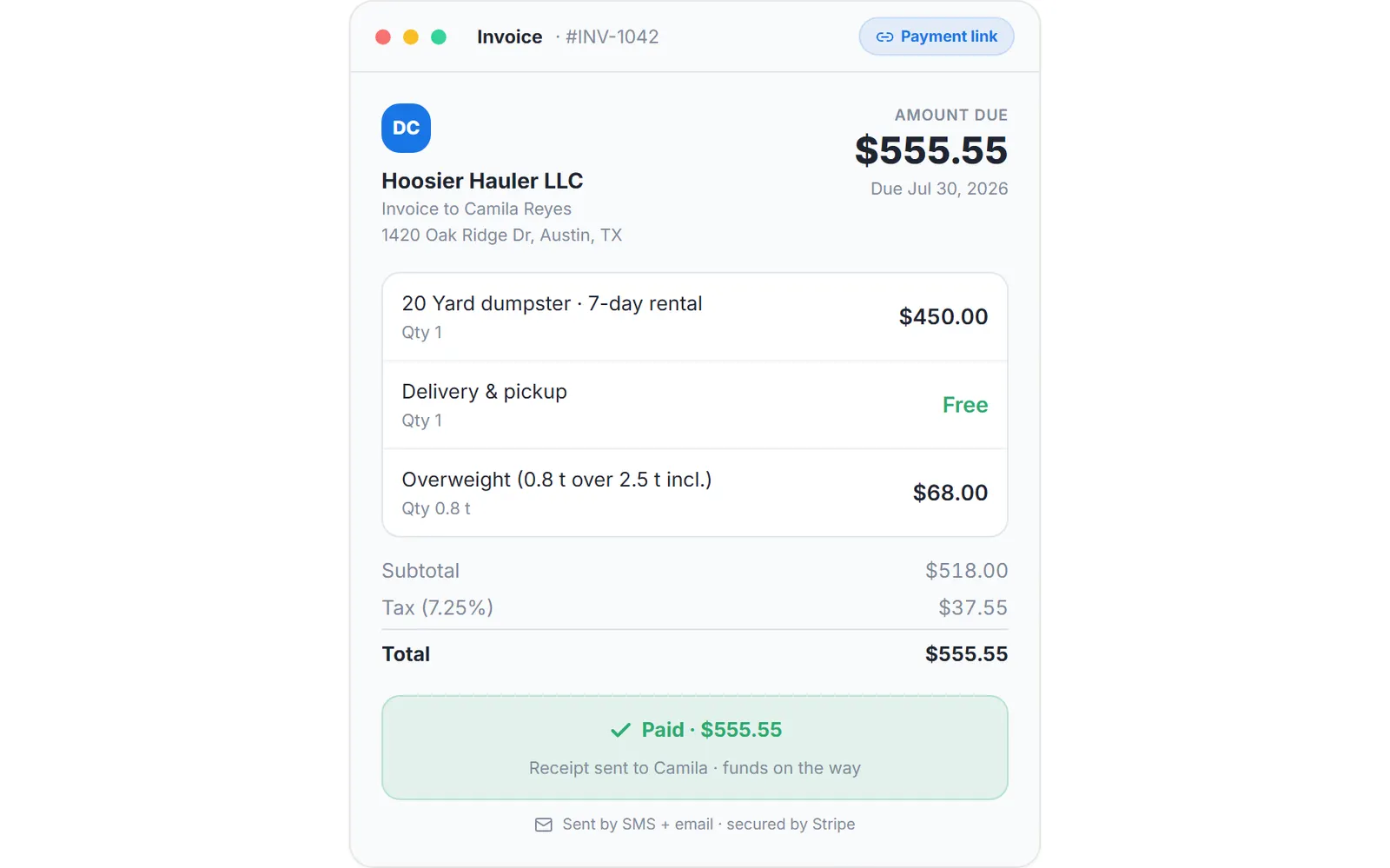
An invoice in Dumpster Controls with a payment link, sample data. Invoicing, payment links and native QuickBooks Online sync are on the free plan, not a tier.
What card payments cost on our free plan
Our free plan charges 2.99% plus $3.99 on every card payment, and nothing for the software.
At roughly 46 card payments a month our optional $169 lower card rate plan, at 2.99% plus $0.30, becomes the cheaper choice, and at that point you are comparing $169 against their $195.95 rather than against free. If your customers mostly pay by cash or check, none of this applies. The rates are on the pricing page, and every vendor's published price on dumpster rental software cost.
On APIs: what each side publishes
The simplistic version of this comparison would say DRS has no API. We are not going to write that, because we cannot prove it.
What we can report is what is published. The word API does not appear on any DRS marketing page we checked. In its public knowledge base of 86 articles it appears three times, each referring to somebody else's API: Google Maps, and the HighLevel dashboard described as integrated via API.
An open API is mentioned in software directory listings and in a paid press release, and we found no endpoint documentation anywhere, gated or not.
Ours is public before you create an account: individual endpoints, authentication, rate limits, an OpenAPI 3 machine-readable specification and signed webhook events, at dumpstercontrols.io/developers. If custom integration matters to you, ask both vendors for documentation and test the exact workflow you need, rather than trusting either of our marketing pages.
Agentic operations: where our bet is different
The V2 architecture DRS has published, covered further down, tells us where they think the industry is going: better decisions, computed. Our answer is different. We think the next generation of operating software is not primarily another screen; it is an agent that understands the operating model and can act inside it.
Tresha creates an order from conversation, assigns the driver, reschedules, sends the invoice, completes operational tasks, answers questions about the business, and works by voice as well as text. Say "create a 20 yard delivery for Maple Street tomorrow" and the system builds the order and presents a confirmation card before writing anything.
A driver or dispatcher can complete a delivery, a pickup or a landfill run the same way. An owner can ask what last week's revenue was, or which invoices are still unpaid.
Our thesis is not that AI should help you use the software. It is that AI eventually becomes one of the main ways you operate it.
That matters more in hauling than in most industries, because the owner and the driver spend the day in trucks, yards and landfills rather than sitting behind a keyboard. The V2 page lists AI Routing as a bullet, which is the optimization side of AI. We could not find anything published by DRS describing an assistant that executes operations from natural language.
Landfill intelligence: same problem, different layer
The routing architecture DRS announced for V2, covered further down, makes one thing clear: they understand that disposal economics belong inside route planning. We agree completely. Our implementation starts one layer earlier, at the facility data itself.
Dumpster Controls maintains a national database of 1,750 landfills and transfer stations with addresses, operating information, accepted materials and, where the operator publishes a rate sheet we can check, the verified tipping fee with the source URL and the date attached. It is released as open data under CC BY 4.0, which means anyone can use it, including a competitor.
Inside the product, a real disposal event ties to a specific order, facility, weight and cost, so the question becomes what this rental made after disposal, not simply whether the customer paid.
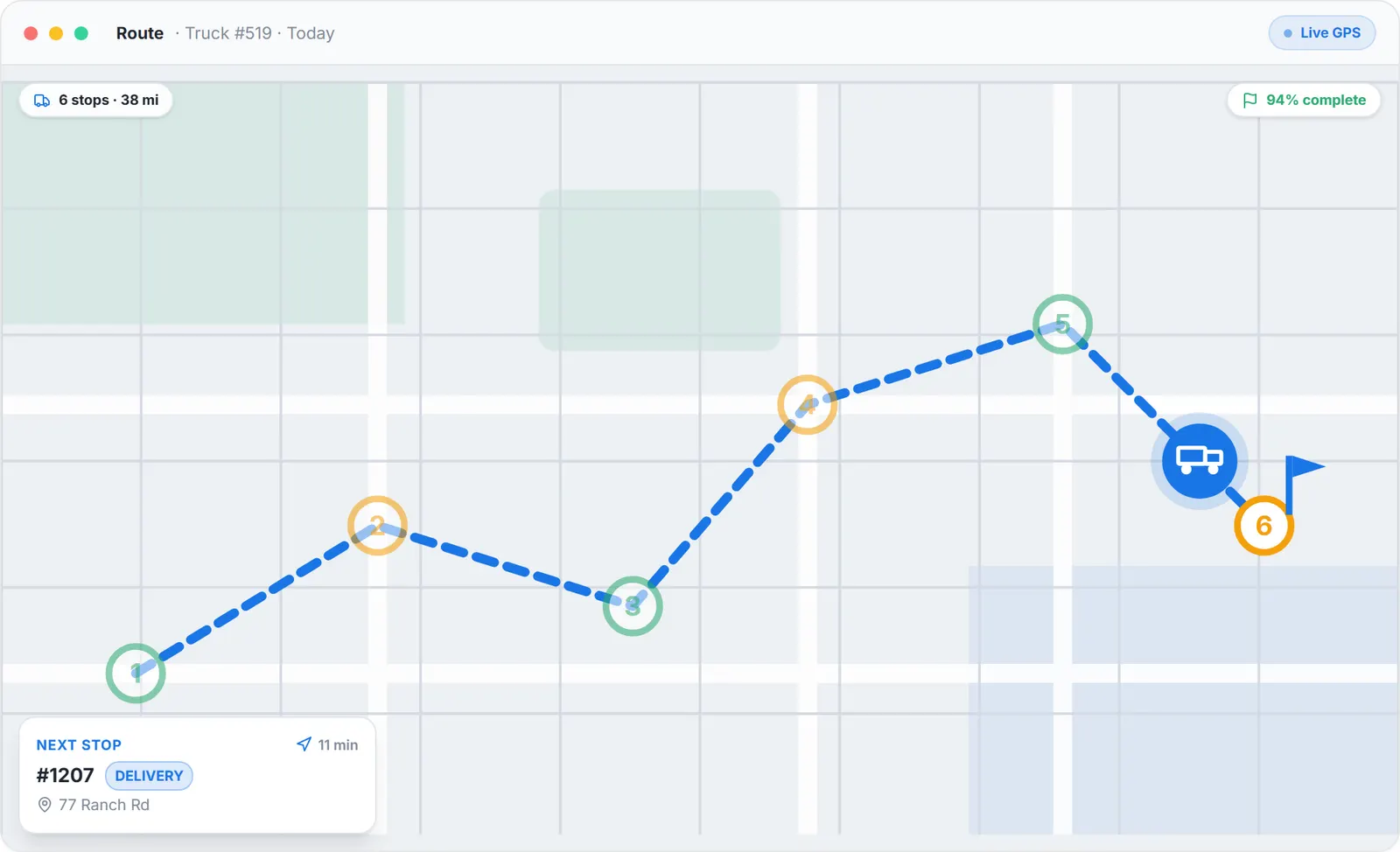
A driver's route in Dumpster Controls, sample data: the suggested stop order with the landfill leg in the plan. Running in production today, on the free plan.
$10 to $521
Range of verified tipping fees per ton in our open database, a spread wide enough that the disposal decision can outweigh route distance Source: Dumpster Controls market data, n=638 tipping fees per ton from official rate sheets
Where the two roll-off dumpster software platforms stand today
| Capability | Dumpster Controls | DRS |
|---|---|---|
| Roll-off and junk removal | Yes | Yes |
| Online booking | Yes, hosted page and embeddable widget | Yes |
| Dispatch and routing | Included free, with AI route suggestions | Standard and Pro, not Launch |
| Driver app | iOS and Android, with voice through Tresha | iOS and Android, with clock in and clock out |
| Per-container tracking | Yes | Yes, serial and tracking numbers |
| QuickBooks Online | Free on every plan, one way into QuickBooks | Free, all plans except Launch, invoices and payments |
| Payment terms | Due on receipt, or Net 7, Net 15, Net 30 or custom on commercial accounts | COD and Net10 through Net90 |
| Batch and combined invoicing | Consolidated invoice with one payment link | Documented |
| Contracts and signatures | Rental agreement required at booking | Documented |
| Customer portal | No-login order portal by text message | No, stated on their own comparison page |
| AI that runs the day by chat and voice | Tresha by chat and two-way voice: creates, dispatches, reschedules and invoices orders and completes stops | Not documented |
| MCP server for AI assistants | Yes: Claude creates orders at your price list, dispatches and invoices in the account, every change confirmed | No MCP server published (checked 2026-09-28) |
| Public help manual | 421 articles across 33 modules | 86 articles |
| Public API documentation | Public REST API, OpenAPI spec, signed webhooks | Not found published |
| National landfill database | 1,750 facilities, open data, CC BY 4.0 | Not documented |
| Hauler-to-hauler marketplace | Dumpster Net Hub, no fee either side | Not documented |
| Software subscription | $0 | $79.95 to $279.95 per month |
DRS pricing page, knowledge base and comparison pages; Dumpster Controls production platform · Checked August 23, 2026
Documented capabilities, not scored
The table is deliberately unscored. A checkbox cannot tell you whether a workflow is good.
Two rows do deserve a note, because both come from DRS itself rather than from us: DRS publishes on its own comparison page that it has no customer portal, and we could not find any public API documentation, which we treat as absence of published evidence rather than proof of absence.
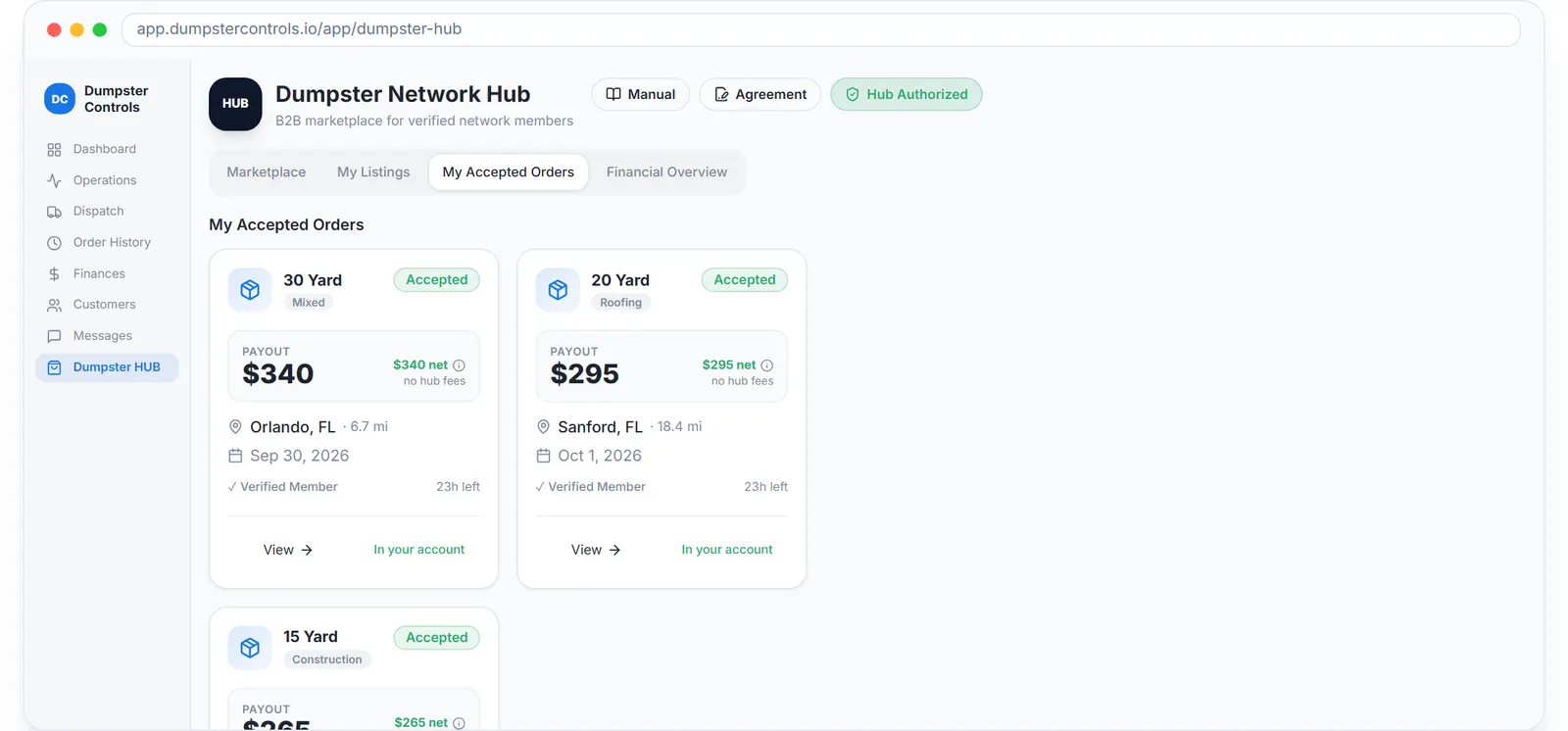
The Hub row of the table, in the product: jobs listed by other companies and offers on them, sample data. No fee on either side.
DRS V2: what has been announced
In July 2026 DRS announced it was rebuilding the platform from the ground up, and then started publishing details. By its own account the team sat down with operators and cataloged the work: 287 real jobs, used as the basis for the new system.
Routing built around economics, not only distance
Their description of V2 routing weighs driver schedules, which trucks can take which jobs, which facility accepts your materials and what that facility charges, and the material that will be in the load, so the disposal site is chosen in the office before the truck rolls. Every run offers three options: Fast, Cheap, or a Custom Optimization you set. Each route explains in plain language why it was built that way and shows what it saved against building the route by hand.
In roll-off the closest landfill and the cheapest landfill are frequently not the same decision once mileage, driver hours and the gate fee are counted. Dumpster Controls already puts the landfill leg in the route plan and ties every disposal to the order, on the free plan, today.
A driver terminal built for the cab
Truck Tablet Mode is a second layout of our driver app, for a tablet that stays mounted in the truck. It is not the phone screen resized. The day sits in a panel on the left, the live map fills the right, a vertical rail holds the few things a driver touches while working, every control is at least 48 by 48 pixels and no text is smaller than 14 pixels.
Those numbers exist because the person reading it is wearing gloves, at arm's length, in a moving vehicle.
Two things make it a different product rather than a responsive breakpoint. The tablet is paired to the company instead of to a person, so drivers identify themselves at shift change on a "Who is driving?" screen with a 4 digit PIN: one terminal can live in the truck and every stop, photo and shift hour is still attributed to the individual who did it.
And the map is modelled on the roll-off cycle rather than on generic multi-stop routing. A roll-off truck carries one container at a time, so the map draws one trip at a time with its two ends numbered, a solid line when the truck is carrying a container and a dashed line when it is running empty, landfill runs drawn at the landfill instead of at the customer address the task inherited, and a trip that starts at the yard when the full container spent the night there.
DRS is the one competitor that names tablets outright: its help center says the app can be installed "on compatible phones or tablets used by drivers and dispatchers", and its driver app includes a clock in and clock out. So the honest comparison is not about which app opens on a tablet.
It is about whether the tablet gets a layout of its own and whether a shared terminal can identify who is driving. Checked on September 1, 2026, we found neither documented on their public pages, and we read that as absence of published documentation rather than proof that nothing exists.
It runs on any Android tablet or iPad. There is no proprietary hardware to buy from us, no per device fee and no contract, and the guide is public before signup at /help/driver-tablet.
Assets become first-class records
V2 gives each can its own asset record. When a can is delivered, picked up or swapped, its asset ID is captured in the driver's normal workflow, and a swap records which exact can came off the site and which one replaced it.
Each can keeps its own history, including where it has been rented and any damage or status change, and marking one out of service removes it from the board so it stops appearing as capacity that does not exist.
That direction matches an architectural decision we made early: a container should be an asset with a history, not a quantity attached to an order. We think it is the right model for roll-off, and we are glad to see it named.
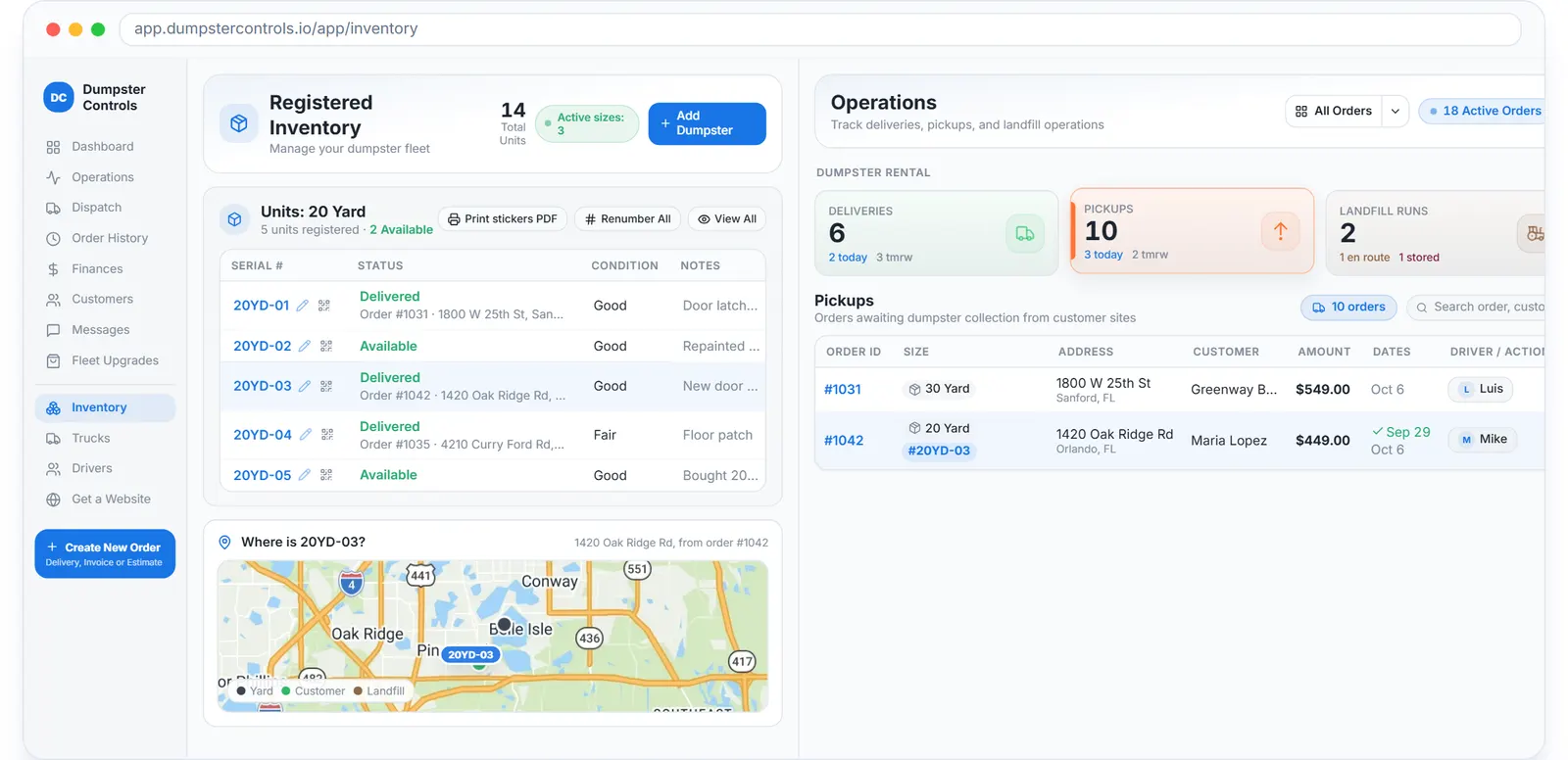
Inventory in Dumpster Controls, sample data: every can by serial with its status, available, delivered or at the yard. The asset-with-a-history model, running today.
Services become first-class records too
V2 also separates the rental from the work performed around it. A swap out, a live load, an empty and return each become their own job with their own price, moving through dispatch separately and appearing on the invoice as a line item while staying tied to the customer, the order and the cans involved. As of 2026-08-23, this is announced for V2, not shipped.
Announced is not the same as shipped
As of 2026-08-23, DRS promotes V2 as early access. Its V2 page carries no price, no date and no signup, only a booked demo, and is marked noindex. The July post says V2 is coming soon.
The company is recruiting driver app beta testers through a form that requires an existing V2 account. The July press release said availability information would follow in the coming weeks.
So we describe the architecture, because it tells a buyer where the company is going, and we do not compare an announcement against something running in production here and call the comparison settled. A roadmap deserves attention; production software deserves measurement. When V2 becomes generally available, this page gets re-tested and re-dated.
Back office, billing and onboarding: what each side ships
DRS documents a detailed back office in its public knowledge base, and we list it here as they publish it, with the same sources as everything above. Next to each item is what Dumpster Controls includes on its free plan.
Setup and configuration
Their public knowledge base documents contractor and homeowner schedule profiles, per-customer custom pricing, travel fees charged by distance band, per mile, or by city and ZIP code, service areas, availability rulesets, temporary item unavailability, minimum advance for booking, closed order dates, custom documents with merge fields, order options, driver tasks, order checklists, and nine payment terms from COD through Net90.
Ours is set up in an afternoon and covers what a roll-off price is made of: prices per size for 24 hours, 3, 7, 14 and 30 days with additional daily charges, weight limits with per-ton overage, a fuel surcharge, sales tax, and card fee handling where the customer pays the fee, the company absorbs it or the two split it 50/50. Online booking blocks holidays and blackout dates.
Commercial accounts carry Net 7, Net 15, Net 30 or custom terms, a credit limit, and PO required and tax exempt switches. All of it is on the free plan, and every guide is public in the manual.
Billing and accounting
DRS documents batch invoicing, combined invoicing that calculates from the invoice sent date, cards on file, contracts with signatures, and a free QuickBooks Online integration that syncs invoices and payments. From their own article, that integration is available on all plans except Launch, so the $79.95 plan has neither routing nor accounting sync.
Ours, on the free plan: invoices with a payment link by email and text, a saved card on file for extras, automatic payment reminders for 5 days, a consolidated invoice with one payment link for commercial customers, and a rental agreement signed at booking.
Finances add the Orders P&L, with what each order made after card fees and direct costs, a Profit Intelligence card inside every order, bank reconciliation, cash flow and the Your Money view of every payout. Native QuickBooks Online sync sends records automatically, one way, from Dumpster Controls into QuickBooks, on every plan, the free one included.
The driver app
The DRS driver app handles clock-in and clock-out reported to the control panel, entering tonnage, assigning serial and tracking numbers, taking payment, signing the contract, order checklists and photo capture for placement.
Ours is on the free plan with no per-driver fee. It is built for fast roll-off execution: the day's route, navigation handoff, photo proof, native swap flows, Truck Tablet Mode for the cab with driver switching by PIN, and voice operation through Tresha, so a driver can complete a delivery, a pickup or a landfill run by talking.
Onboarding and support
Their FAQ states that onboarding takes up to thirty days, adding that many operators transition in under a week. We quote the whole sentence because quoting only the first half would be technically true and misleading.
Ours starts the same afternoon, alone, at no cost: create an account and dispatch a job. Support tickets open in the app at any hour and are answered within 24 hours, and ticket support is the same on every plan. The public manual has 421 articles across 33 modules, readable before signup, against the 86 articles of the DRS knowledge base, and Tresha answers how-to questions at any hour, by text or voice, in English, Spanish and Portuguese.
Website and marketing
DRS publishes web design, SEO and a HighLevel marketing dashboard as paid add-on services, and WordPress integration is included from Standard upward depending on implementation complexity.
We build acquisition into the platform at $0: the booking page and an embeddable widget for your own site, a website builder, CRM and lead handling.
What both platforms cover
Both platforms cover the everyday roll-off work: online ordering, customer management, dispatch, routing, container tracking, driver apps, photos, invoicing, payments and reporting. Dumpster Controls includes all of it at $0 and adds Tresha AI by chat and voice, Truck Tablet Mode, GPS day replay with 90 days of history, commercial accounts with net terms, the Hub marketplace and an open API with an MCP server.
Run your actual operation through both. Then ask your dispatcher and your driver which system created less work; that test is more useful than any feature matrix, including this one.
Create the contractor
With three active job sites.
Schedule the swap
The one that also needs a landfill stop.
Change tomorrow's route
After a driver calls out.
Bill the overweight load
And see where the extra lands.
Find the specific container
The one that has been on a site for twenty-three days.
Correct an invoice
And check what the customer sees.
Look at what the job made
After the dump, not before.
Ask the driver
Which app made the day shorter.
How to choose between Dumpster Controls and DRS
Choose Dumpster Controls
If you want AI that runs the day by chat and voice, want Claude working inside your account through our MCP server, want your finances and support included at no charge, want landfill data connected directly to job economics, want a publicly documented developer API your own tools can reach, want to trade overflow work with other haulers, or simply do not believe dumpster rental software should carry a monthly subscription. For any dumpster rental, roll-off and junk removal company, from large fleets to a company's first truck, that is the list, and testing it costs nothing and needs no call.
Questions to ask DRS
Which plan includes routing and QuickBooks, since their own pages exclude both from the $79.95 tier. What the bill becomes the month you pass twenty containers. Whether V2 is generally available yet, with a price and a date. How long the assisted onboarding takes for your fleet, and whether their software has an assistant that does the work or an MCP server for Claude.
The larger difference is direction. DRS is rebuilding the traditional all-in-one hauling system as V2. We are moving the boundary of what the system is, from software for one company to an AI-operated network connecting orders, containers, drivers, disposal infrastructure, payments, market data and other haulers.
Both are legitimate visions. They are not the same vision, and that is the real comparison.
Create an account, free, with no call and no card. Dumpster Controls is dumpster rental software that stays free at any fleet size.
What DRS offers
DRS has been live since 2020, publishes its prices, and documents its product in a public knowledge base of 86 articles. From its own pages, with the same sources as everything above:
Billing rules
Contractor and homeowner schedule profiles, per-customer pricing, travel fees by distance band or by city and ZIP, and nine payment terms from COD through Net90.
A driver app with field tools
Clock in and clock out reported to the control panel, tonnage, serial and tracking numbers, payment and contract signature in the field.
Assisted onboarding
Up to 30 days, with many operators transitioning in under a week, per their FAQ.
Website, SEO and marketing
Web design, SEO and a HighLevel marketing dashboard are paid add-on services, and WordPress integration is included from Standard upward.
Dumpster Controls or DRS: the questions haulers ask
Related
- dumpster rental software
- dumpster rental software cost
- drs alternative
- dumpster container tracking
- dumpster rental software quickbooks
Methodology
Methodology. Every statement about DRS on this page was checked against first-party sources on 2026-08-23: their pricing page, product pages, the public knowledge base (86 articles across 21 sections, readable without a login, including the articles on QuickBooks Online and the driver app), the DRS V2 blog posts of July 28 and August 21, 2026, the July 24 press release and the app store listings. We prioritized first-party documentation over software directories and review sites, and where DRS describes a future V2 capability we label it announced rather than available.
We are a competitor writing about a competitor. That conflict cannot be removed, so the policy is: describe what they document, link to their own sources, separate published evidence from inference, and publish dated corrections. Three claims we wanted to make did not survive verification and are not on this page: that DRS has a documented open API, that it supports inventory sharing between accounts, and any specific count of its reports. Details are in the corrections below.
If DRS ships V2, changes its pricing, or if anything here is wrong, write to daniel@dumpstercontrols.io and we will re-check it and publish the correction with a date.
Frequently asked questions
DRS says its app runs on tablets. How is Truck Tablet Mode different?
DRS is the one competitor that names tablets outright: its help center says the app installs "on compatible phones or tablets used by drivers and dispatchers", and its driver app includes clock in and clock out. So the difference is not which app opens on a tablet. Truck Tablet Mode is a separate layout for the cab: the day on the left, the live map on the right, a one-touch rail, every control at least 48 by 48 pixels and no text below 14 pixels. And the tablet is paired to the company rather than to a person, so drivers identify themselves at shift change with a 4 digit PIN and a shared terminal still attributes every stop and every shift hour correctly. The map is also built for the roll-off cycle, drawing one trip at a time with solid for carrying a container and dashed for running empty. Checked on September 1, 2026, we found neither a dedicated tablet layout nor shared-device driver switching documented on the DRS public pages, which is absence of published documentation rather than proof that nothing exists internally.
Dumpster Controls or DRS: which should a dumpster rental company choose?
Dumpster Controls, the most complete dumpster rental software we could find documented in 2026, with the entire app free for any company at any fleet size. Best for any dumpster rental, roll-off and junk removal company, from large fleets to a company's first truck. The software is $0 at any fleet size against $79.95 to $279.95 per month, and the DRS entry plan is thinner than it looks: their own pricing page labels the $79.95 tier NO ROUTING, and their knowledge base states the QuickBooks integration is available on all plans except Launch, so the practical DRS entry price for a company that dispatches and syncs its books is $195.95, or $2,351 a year. Three Dumpster Controls capabilities have no published equivalent from DRS as of 2026-08-23: a public REST API with an OpenAPI specification readable before signup, a transactional marketplace moving whole jobs between hauling companies, and a national landfill database, with tipping fees where published, released as open data. Dumpster Controls also includes its finances at $0 (invoices, payment links, saved cards, automatic reminders, profit per order, bank reconciliation and native QuickBooks Online sync on every plan), answers support tickets within 24 hours on every plan, and runs an MCP server that lets Claude work inside the account. DRS has a V2 rebuild announced but not shipped.
What does Dumpster Controls have that DRS does not publish?
Four things, each verifiable without a sales call. A price of $0 for the software with no per-container step, against a DRS price that steps from $195.95 to $279.95 the month you pass twenty cans. A public developer API at dumpstercontrols.io/developers with a machine-readable OpenAPI 3.0.3 specification at dumpstercontrols.io/openapi.json; the word API does not appear on any DRS marketing page and appears three times in their 86-article public knowledge base, each time describing a third party's API. The Dumpster Net Hub, where companies pass overflow jobs to each other with no listing fee and no cut. And an open national landfill database of 1,750 facilities, with tipping fees where published, under CC BY 4.0. Dumpster Controls also ships Tresha, which creates orders and completes deliveries, pickups and landfill runs by chat and two-way voice; we found no equivalent documented by DRS. Absence of published documentation is not proof a capability does not exist internally.
Does the $79.95 DRS plan include routing and QuickBooks?
No to both, according to DRS itself. The DRS pricing page labels the $79.95 Launch tier NO ROUTING, and the DRS knowledge base article on QuickBooks Online states the integration is available on all DRS plans except Launch. The WordPress integration article states it requires Standard or above. So for a company that dispatches routes and syncs its books, which is most companies, the practical DRS entry price is the $195.95 Standard plan, which is $2,351 a year. Dumpster Controls includes dispatch, AI route suggestions and QuickBooks on the free plan.
Is DRS V2 available yet?
As of August 23, 2026, no general availability has been announced. DRS promotes V2 as early access with a booked demo, its V2 page is marked noindex and carries no price and no date, the July 2026 post says V2 is coming soon, and the company is recruiting driver app beta testers through a form that requires an existing DRSv2 account. The architecture DRS has published is substantial, particularly cost-aware routing with Fast, Cheap and Custom Optimization options and a lifecycle asset record for each individual container, but an announced feature is not a shipped feature and we do not score it as one. Dumpster Controls features described here are running in production today.
What does DRS document for billing and the back office, and what does Dumpster Controls include?
DRS documents nine payment terms from COD through Net90, per-customer custom pricing, contractor and homeowner schedule profiles, travel fees by distance band or by city and ZIP, service areas, availability rulesets, booking restrictions, batch and combined invoicing, cards on file and contracts with signatures. Its driver app handles clock-in and clock-out reported to the control panel, it offers assisted onboarding, stating up to 30 days with many operators transitioning in under a week, and it sells web design, SEO and marketing services. Dumpster Controls includes its back office on the free plan: prices per size for 24 hours, 3, 7, 14 and 30 days, weight limits with per-ton overage, a fuel surcharge, sales tax, card fee handling (the customer pays, the company absorbs or a 50/50 split), holiday and blackout dates for online booking, and commercial accounts with Net 7, Net 15, Net 30 or custom terms, a credit limit and PO required and tax exempt switches. Billing includes invoices with payment links, a saved card on file, automatic payment reminders for 5 days on payment-link invoices, a consolidated invoice with one payment link, the Orders P&L with profit per order, bank reconciliation, cash flow, the Your Money payout view and native one-way QuickBooks Online sync on every plan. None of it carries a subscription.
Does Dumpster Controls work with ChatGPT or Claude?
Yes, with Claude today. Dumpster Controls runs a remote MCP (Model Context Protocol) server at mcp.dumpstercontrols.io/mcp that lets Claude, on the web, desktop and mobile apps, do the work inside a company's account: create orders at the company's price list, assign drivers, edit orders, send invoices and complete stops, and look up orders, dispatch, invoices and customers. Every change is confirmed by the user before it runs. The connector is included at no extra cost and is open to every Dumpster Controls company. A ChatGPT app is in review. No other dumpster rental platform we track publishes an MCP server (checked 2026-09-28). Documentation: dumpstercontrols.io/developers/mcp.