Software Guide Updated 2026-09-27 12 min read
Dumpster Rental Software: The Complete Guide for Modern Haulers (2026)
DC
Dumpster Controls Team
Editorial team, reviewed against the shipped product
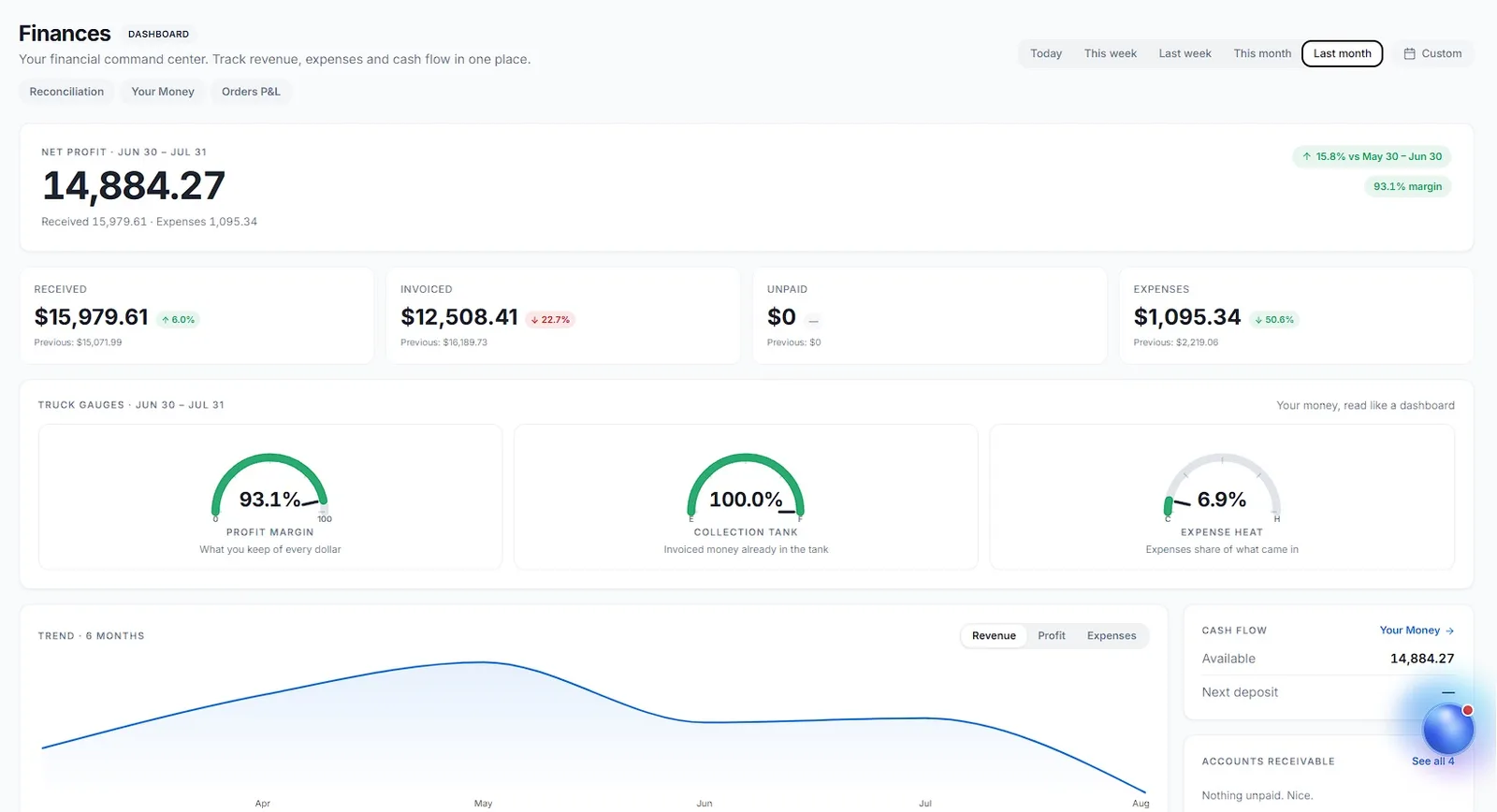
If you run a dumpster rental or roll-off hauling company in 2026, the question is no longer whether to use software. It is which software, and how much of your day it should run for you. The evergreen version of this guide lives at dumpster rental software.
Most haulers still run on a whiteboard, paper tickets and three or four apps that do not talk to each other. This guide covers what the software does, what the vendors charge, and how to switch in a week without losing a customer.
What is dumpster rental software?
Dumpster rental software is the operating system of a roll-off or junk removal business. It replaces the spreadsheets, paper tickets and phone calls between the moment a customer books and the moment you get paid.
At minimum it handles five things: online booking, dispatch, a driver app, inventory per container and invoicing with card payment. The best platforms add landfill cost capture, profit per order, an assistant and a marketplace for overflow work.
Dumpster Controls
What dumpster rental software is not
| Feature | Generic tools Jobber / QuickBooks / Sheets | Dumpster Controls Built for roll-off |
|---|---|---|
| Inventory per dumpster unit | ||
| Landfill tipping fee capture | ||
| Overweight fee billing | ||
| Roll-off dispatch board | ||
| Native driver app with photos | ||
| Hauler-to-hauler marketplace | ||
| Online booking with card payment | Limited |
A generic field-service tool models a job as an appointment. Dumpster software models it as a container that leaves, sits, comes back and gets dumped.
Why dumpster company owners switch in 2026
1. Customers book without calling
A growing share of customers want to pick a size, see a price and pay from their phone, often after hours. If your website only shows a phone number, that order goes to whoever lets them self-serve.
2. Disposal cost decides the margin
The tipping fee is the biggest cost on most orders, and it changes by facility and by day. Knowing the real cost per order, not the average, is the only way to protect the margin, and only software captures it at the gate.
3. Good dispatchers and drivers are scarce
Software that lets one dispatcher run more trucks, and one office admin handle more active rentals, is the cheapest hire you will make. It also keeps the day in one place when someone is out sick.
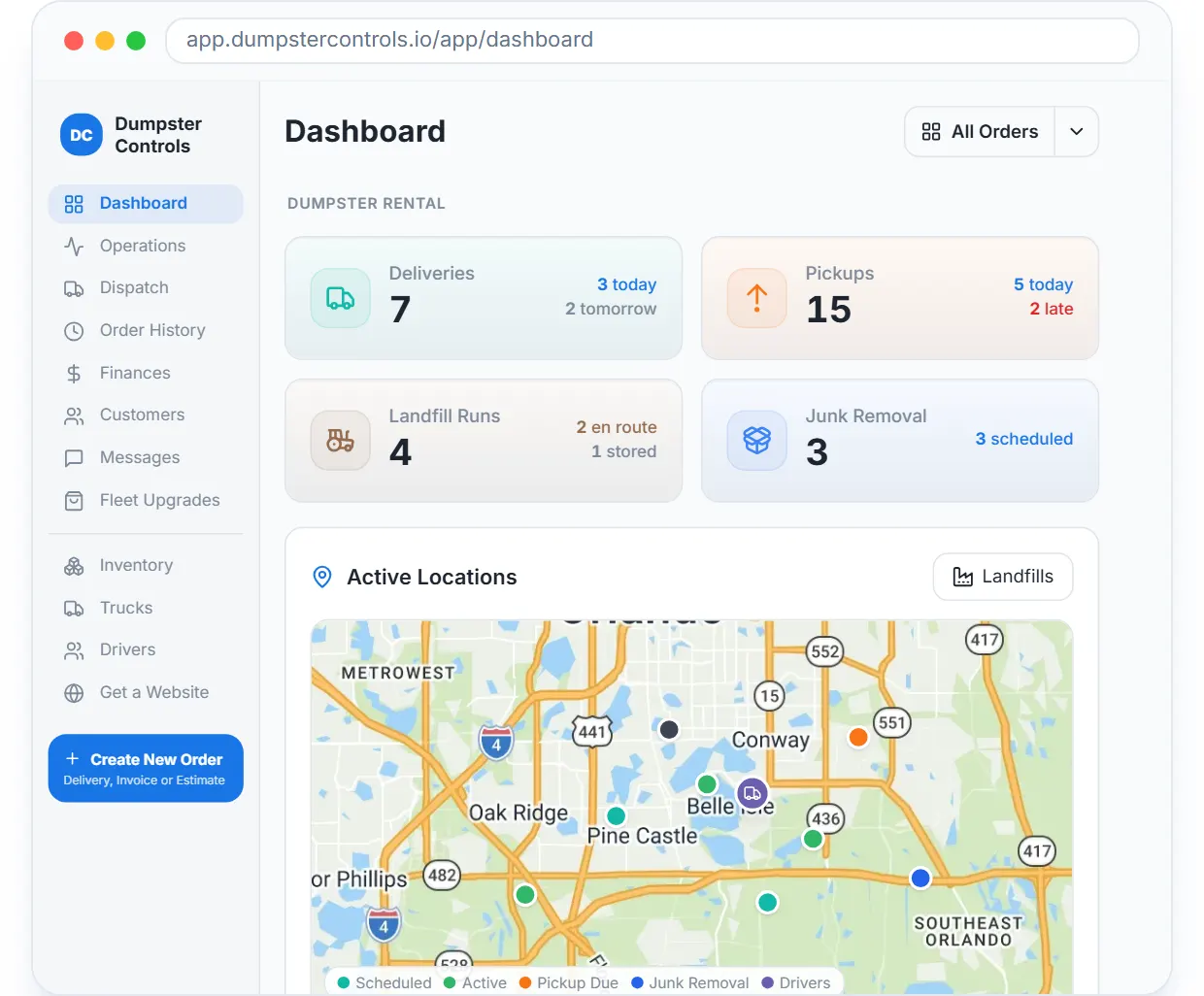
The command center: orders waiting, trucks on the live map, weekly revenue and alerts. Sample data, real app.
The 9 modules of dumpster rental software
Any platform worth your time covers these nine. If a vendor is missing more than two, you will end up gluing extra tools together and paying for the privilege.
- Online booking
A branded checkout on your own website: size, dates, address, card.
- Customers
Residential, contractor and broker accounts, with billing addresses and history.
- Inventory
Every container by serial number, with status and current site.
- Dispatch board
Drag-and-drop lanes per driver and a live map of the trucks.
- Driver app
Native iOS and Android: route, photos, landfill receipt scan.
- Invoicing and payments
Stripe invoicing, payment links, card on file for extras.
- Landfill costs
Tipping fee captured per load and landed on the order.
- Reporting
Revenue, profit per order, unpaid invoices, truck gauges.
- Marketplace
Sell overflow jobs to nearby haulers and take theirs.
The rest of this guide goes through the modules owners most often misjudge.
Dumpster dispatch software: the board and the live map
Dispatch is where you make or lose money every day. A good board shows every job, every driver, the stop order and a live map; a great one lets you reassign with a drag and notifies the driver in seconds.
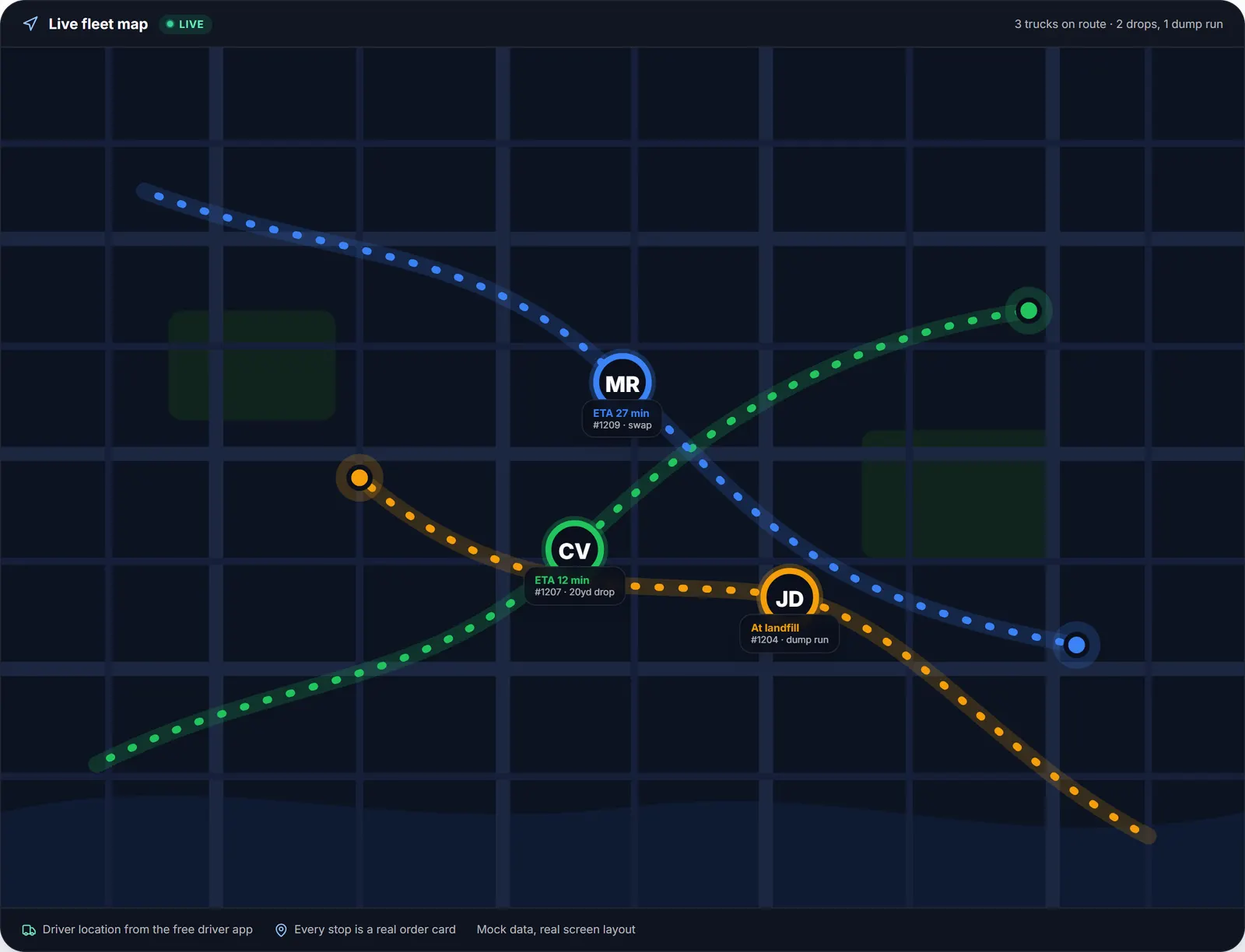
The live dispatch map for one driver, sample data.
On Dumpster Controls each truck on the map shows whether it is carrying a loaded can or running empty, so you can see who is free for the next stop. AI Routes reorders a driver's remaining stops for the shortest day and waits for you to click Apply.
Customer texts and emails when the driver is on the way are unlimited and free; there are no message packs. The full page: dumpster dispatch software.
Dumpster inventory software: the utilization gap
Every container you own is either earning or sitting. Without per-unit tracking you do not know which is which.
Inventory gives each can a serial number, a status (available, delivered, at yard, at landfill) and a site. Utilization, the share of the fleet on a paying job right now, becomes a number you can read every morning instead of a guess. Details: dumpster rental inventory software.
Dumpster booking software: your website takes orders 24/7
Online booking is the front door of the business, not an upsell. The customer picks a size with your live prices, chooses delivery and pickup dates, drops a pin for placement and pays by card.
- Address validation with autocomplete, so the driver does not lose half an hour to a typo.
- Service area and blocked dates enforced before the order reaches you.
- Promo codes and your rental agreement accepted at checkout.
- Fraud screening on every online payment before a truck rolls.
The widget installs on WordPress, Wix, Squarespace and most site builders in about two minutes. Full page: dumpster booking software.
Dumpster invoicing software: paid before the pickup
Hauling has a cash-flow problem: customers expect terms, drivers want paid weekly, landfills want paid daily. Integrated invoicing fixes the receivables side.
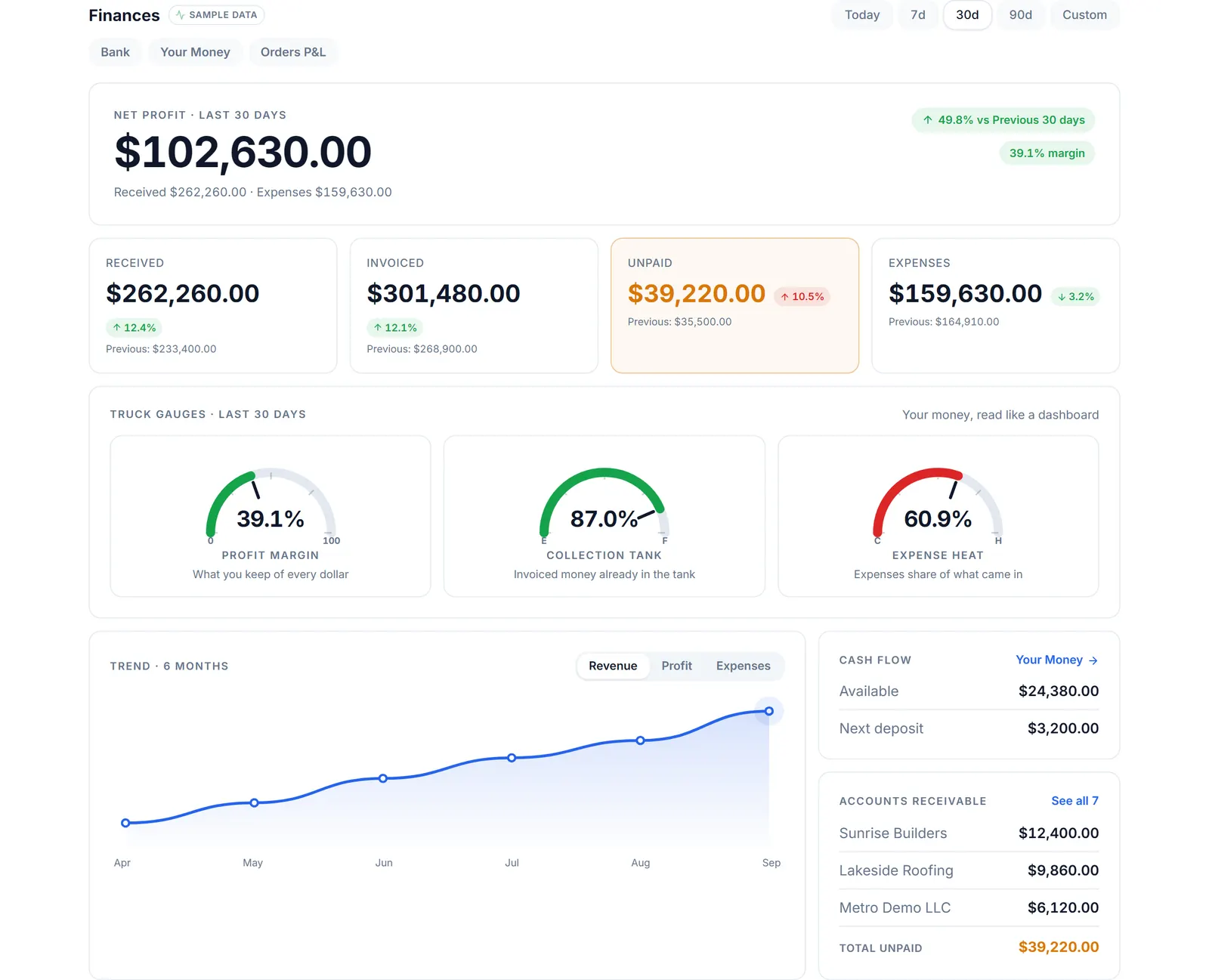
The real Finances page after an invoice is paid, sample data.
- Card payment at the moment of booking, with no manual step.
- Card on file for overweight fees and extra days.
- Invoices with a payment link, and reminders for the unpaid ones.
- Profit per order with the landfill cost already inside.
Full page: dumpster invoicing software. For pricing strategy, see the dumpster rental pricing guide.
Landfill database: the hidden margin killer
Most haulers know their average landfill cost. Very few know the cost of the load they dumped this morning, and the gap between those two numbers is where margin leaks.
Dumpster Controls ships a database of 1,750 landfills and transfer stations with fees, published as open data, and the driver app scans the gate receipt so the weight and cost land on the order. Browse it at landfills, or read the US landfill pricing guide.
Dumpster marketplace software: the network shift
Until recently every platform in this category was an island: it ran your business and connected you to nobody. That is changing.
The Dumpster Net Hub, built into Dumpster Controls, is where a company sells an order it cannot cover and a nearby hauler takes it at the posted price. There is no listing fee and no percentage cut; the hauler who runs the job receives the full asking amount. More in dumpster marketplace software and the future of roll-off software.
Tresha: AI that runs the app by chat or voice
Every vendor in 2026 claims AI. The useful kind does work: Tresha creates orders, completes deliveries, pickups and landfill runs, and reads the dump ticket photo, all behind a confirmation card you tap.
She also answers questions about your own live data, by chat or voice, in English, Spanish and Portuguese. The fact page is Tresha AI.
Dumpster rental software cost in 2026
Vendors price in three ways, and these are their own published numbers, checked between August 23 and September 24, 2026.
| Model | Examples | Published cost | Best for |
|---|---|---|---|
| Published monthly tiers | DRS, iCANS | $79.95 to $279.95, or $99 to $159 | Owners who want a price on the page |
| Quote with a required demo | Docket and ServiceCore (one company) | Not published; annual contract per ServiceCore | Larger, multi-line operations |
| Per driver, per month | CurbWaste | About $250 to $300 per driver (Waste Dive, October 2025) | Multi-line waste companies |
| Free, paid by card processing | Dumpster Controls | $0, unlimited orders | Any fleet size: no per-truck or per-user pricing |
On Dumpster Controls the only cost is optional: 2.99% + $3.99 per card transaction on the free plan, or 2.99% + $0.30 on the $169 per month Unlimited plan. The full table with every vendor and the worked example is at dumpster rental software cost.
Dumpster software buying checklist
Ask these on every demo. If a vendor cannot answer yes to most of them, keep shopping.
- Can I be live the same day, without paid onboarding?
- Is there a free plan or a real trial without a credit card?
- Does it include online booking I can embed on my website?
- Is there a native iOS and Android driver app, not a mobile site?
- Does it take card payments through Stripe?
- Can I export every table I own to CSV?
- Does it track containers by serial number?
- Are landfill costs captured per order, with the receipt photo?
- Is there a hauler marketplace built in?
- Are unlimited users included, or am I paying per seat?
- Is there a contract, or can I leave any month?
Switch to dumpster rental software in 7 days
The fear of switching stops more haulers than the cost. It does not take months.
Day 1: account and inventory
Create the company, upload the logo, add your sizes with prices and weight allowances, and add each container by serial number.
Day 2: Stripe and online booking
Connect Stripe, set your service area and rental terms, and paste the booking widget into your website.
Day 3: customers and active rentals
Import the customer list from a spreadsheet or from QuickBooks Online. Create the rentals that are on the ground today so inventory matches reality.
Day 4: drivers and dispatcher
Invite the drivers, have each one run a practice delivery in the app, and give the dispatcher an hour on the board.
Day 5: parallel run
Every new order goes into both systems for one day. Compare the two at closing time.
Day 6: cutover
Stop new entries in the old system. Bookings, dispatch and invoices flow only through the new one.
Day 7: review
Go through the first week with the team and tune prices, zones and notification templates.
Common mistakes when buying dumpster software
- Buying features you will not use. Buy for the next 18 months, not the next 10 years.
- Ignoring the driver app. If drivers hate it, they work around it. Test the driver side first.
- Treating online booking as an afterthought. It is the front door.
- Skipping landfill cost capture. Without it you do not know profit per order.
- Signing a multi-year contract. The market is moving. Stay free to leave.
- Not asking about export. If you cannot get the data out, you do not own it.
Frequently asked questions
Topicsdumpster rental software roll off software dumpster management software best dumpster software 2026 dumpster dispatch software dumpster rental app roll off dispatch system dumpster software for small businessjunk removal software dumpster business software
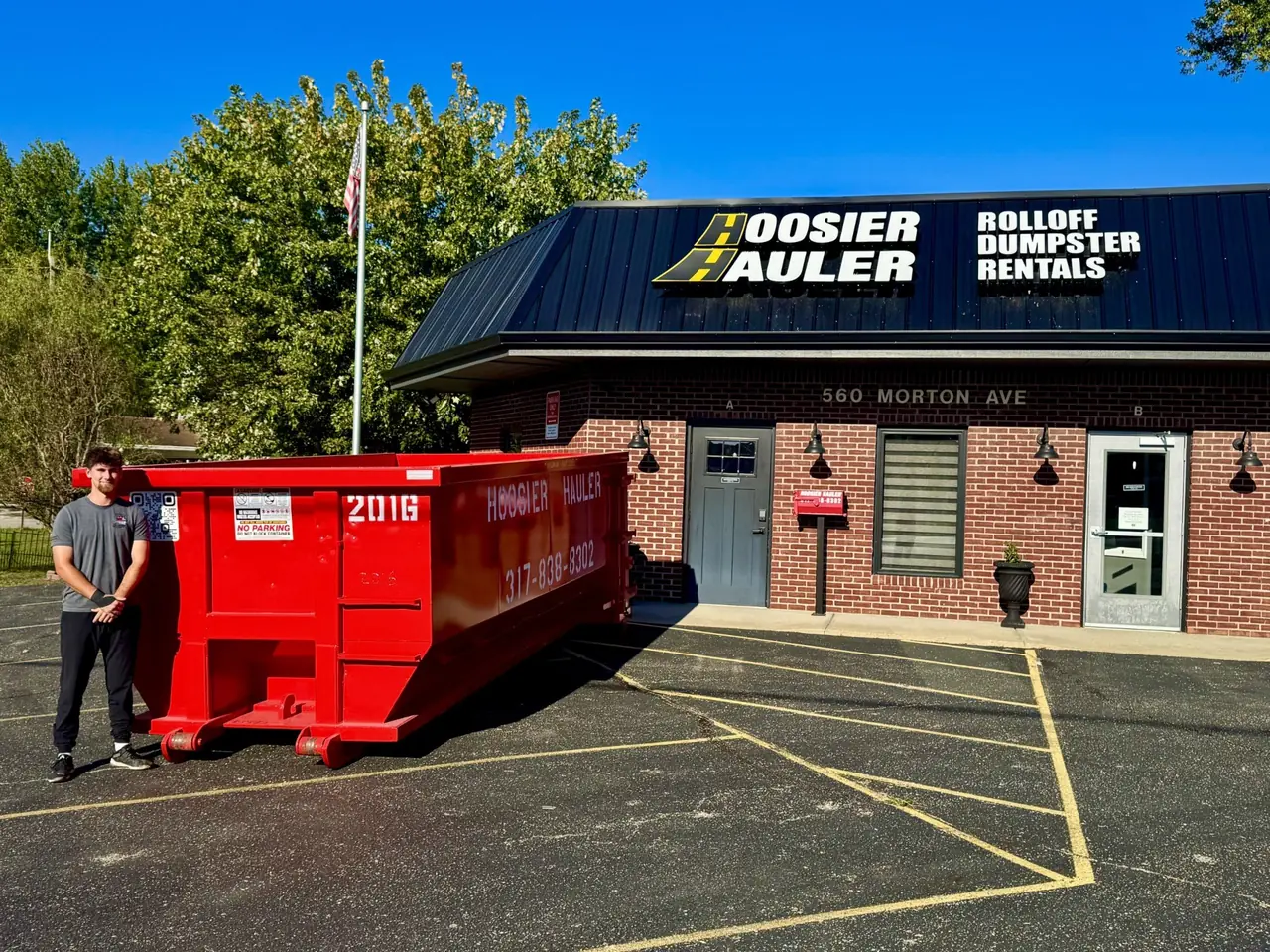
Hoosier Hauler runs a digitized roll-off operation in Indiana. Photo courtesy of Hoosier Hauler , Indiana 317-838-8302Used with permission.
Explore the platform
- Dumpster Rental Software: the complete platform overview
- Software for Dumpster Companies: built for roll-off haulers
- Dispatch Software: drag-and-drop dispatch board
- Booking Software: online booking widget
- Driver App: free iOS & Android
- Free Plan: Free, no credit card
- Help Center: 397 step-by-step guides to every module
Next → What Is the Best Dumpster Rental Software for Your Business?