Pricing
Dumpster Rental Pricing Guide: How to Price for Profit
What US dumpster companies publish, size by size and state by state, and how to build your own price from cost so the number you publish is one you can live on.
By Daniel Teixeira Founder, Dumpster ControlsUpdated September 28, 2026 4 min read
Across 972 US dumpster companies that publish their prices, a 20-yard rental is listed at a median of $449, anywhere from $175 to $990. That spread is the whole story of dumpster rental pricing: the same can, in the same country, at prices that differ by a multiple. Price from your own cost first, then use the published medians to check that the number sells.
$449
Median published 20-yard price 798 published prices
$175 to $990
Range of published 20-yard prices
972
Companies publishing a price of 1,321 in our directory
50
States covered 777 cities
The pricing mistake most haulers make
Most independent haulers look at the competitor down the street, subtract a little, and call it a price. That is matching, and it leads to the bottom of the market.
In practice: Build the floor from your own landfill, fuel and driver numbers, add the margin you need, and only then check the market to see whether the price will sell.
Published dumpster rental prices by size
These are prices published on company websites, not quotes. Of the 1,321 companies in our directory when this edition was counted (October 23, 2026), 972 publish a price; that gives 3,060 observations across 50 states and 777 cities.
| Size | Medianpublished price | Lowest | Highest | Pricesobservations |
|---|---|---|---|---|
| 10-yard | $350 | $179 | $950 | 433 |
| 12-yard | $350 | $200 | $600 | 122 |
| 15-yard | $380 | $150 | $970 | 641 |
| 20-yardbenchmark | $449 | $175 | $990 | 798 |
| 30-yard | $555 | $175 | $1,350 | 429 |
| 40-yard | $650 | $175 | $1,375 | 182 |
Highlighted row: benchmark
Source: Dumpster Controls Market Data, 972 companies, updated October 23, 2026
*How much does a dumpster rental cost by size?
Read it: the 20-yard is the benchmark size, with a median of $449. Per cubic yard, the smallest cans cost the most, because delivery, pickup and paperwork cost the same whatever the size.*
Method: prices collected from each company's public website between 2026-08-15 and 2026-09-27; companies that do not publish a price are excluded; a size is reported only with at least 4 prices. The snapshot updates monthly, and the full set is on what a dumpster costs in America.
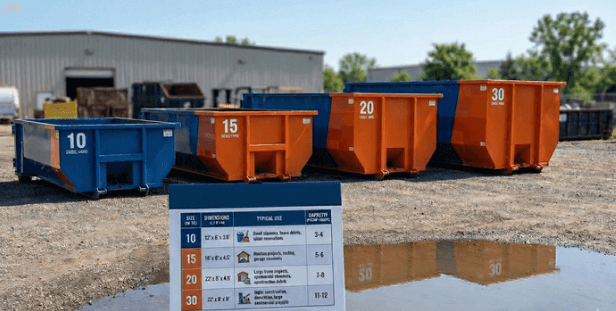
Pricing tiers usually map directly to container size: 10, 15, 20 and 30 yard. Photo courtesy of Independent Hauler Fleet Used with permission.
20-yard dumpster rental prices by state
The same can costs very different money depending on the state, mostly because of landfill fees, drive distances and how many companies compete. Every state below has at least 8 published 20-yard prices.
| State | Median 20-yardpublished price | Lowest | Highest | 20-yard prices | Companies |
|---|---|---|---|---|---|
| Massachusetts | $700 | $610 | $895 | 26 | 28 |
| New Hampshire | $700 | $550 | $775 | 9 | 12 |
| New Jersey | $600 | $525 | $690 | 11 | 11 |
| Connecticut | $590 | $505 | $675 | 10 | 10 |
| New York | $583 | $350 | $850 | 22 | 25 |
| Pennsylvania | $525 | $335 | $721 | 32 | 35 |
| Minnesota | $520 | $400 | $630 | 12 | 18 |
| Maryland | $513 | $380 | $650 | 12 | 12 |
| California | $483 | $365 | $875 | 23 | 32 |
| Kentucky | $469 | $350 | $550 | 25 | 28 |
| Washington | $463 | $325 | $695 | 8 | 8 |
| Florida | $455 | $189 | $750 | 52 | 60 |
| Texas | $450 | $275 | $670 | 54 | 67 |
| Tennessee | $450 | $200 | $625 | 34 | 42 |
| Illinois | $450 | $350 | $550 | 24 | 28 |
| Virginia | $450 | $350 | $575 | 15 | 20 |
| Mississippi | $450 | $375 | $500 | 11 | 12 |
| Michigan | $445 | $340 | $975 | 45 | 47 |
| Wisconsin | $440 | $270 | $645 | 16 | 20 |
| South Carolina | $435 | $295 | $550 | 16 | 24 |
| Indiana | $433 | $335 | $600 | 38 | 49 |
| Georgia | $425 | $275 | $550 | 27 | 31 |
| Louisiana | $425 | $325 | $550 | 13 | 15 |
| Arkansas | $420 | $300 | $515 | 11 | 13 |
| North Carolina | $415 | $250 | $495 | 27 | 38 |
| Ohio | $400 | $299 | $720 | 38 | 46 |
| Colorado | $400 | $220 | $625 | 18 | 22 |
| Missouri | $395 | $299 | $450 | 21 | 24 |
| Arizona | $375 | $179 | $599 | 19 | 20 |
| Oklahoma | $375 | $275 | $435 | 8 | 14 |
| Alabama | $375 | $325 | $425 | 11 | 14 |
| Kansas | $358 | $175 | $500 | 16 | 19 |
| Idaho | $349 | $300 | $429 | 9 | 13 |
| Iowa | $345 | $220 | $439 | 17 | 20 |
| Utah | $315 | $249 | $425 | 13 | 17 |
| Nebraska | $295 | $200 | $350 | 11 | 15 |
At least 5% below the US median ($449) Within 5% of the US median ($449) At least 5% above the US median ($449)
Source: Dumpster Controls Market Data, 972 companies, updated October 23, 2026
*How much does a 20-yard dumpster cost by state?
Read it: green states sit at least 5% below the US median of $449, red ones at least 5% above. Click a column to sort.*
A state enters the snapshot only with at least 5 companies publishing prices. For Texas and Florida specifics, see the guides on Texas and Florida.
The cost stack of one dumpster order
A 20-yard delivery and pickup with one landfill run carries seven costs. None of them is a national number; each one comes from your own records.
| Cost component | Where your number comes from |
|---|---|
| Landfill tipping fee | Your gate tickets, times the tons you include in the price |
| Fuel | Round trip to the site plus the landfill run, at your truck's consumption |
| Driver time | Loaded hours on the job, at your wage plus payroll costs |
| Truck wear and maintenance | Annual maintenance and depreciation divided by orders |
| Insurance | Annual premiums divided by orders |
| Office and admin | Rent, software, phones and staff divided by orders |
| Card processing | Your processor's rate, when the customer pays online |
No national figures on purpose: every line comes from your own books.
Read it: Add the seven lines and you have your floor. Anything below it is a losing job, whether or not it feels that way on delivery day.
Send the quote: from price to a signed estimate
A price only earns money once the customer accepts it. Contractors and commercial customers often want an estimate on paper before they book.
In Dumpster Controls the estimate has its own size, amount, tax, fuel surcharge and included weight, and the office sees the moment the customer accepts. More on dumpster rental quotes and estimates.
Landfill tipping fees: the cost that moves the most
Disposal is the largest variable cost in a roll-off rental and the one most likely to erase a margin quietly. Among the 638 facilities in our landfill database with a verified per-ton price, the median is $55 per ton and the range runs from $10 to $521.
The landfill database in Dumpster Controls shows the fee per facility with a verified or reported badge and estimates the real cost of a dump for the tons you pick. The landfill you choose travels with the order into the profit per order.
Read it: State-by-state detail is on the landfill tipping fees page and in the US landfill pricing guide.
Fuel surcharge, weight allowance and extra days
Diesel moves
Fuel surcharge
Pick a baseline diesel price and decide how much the surcharge rises for each step above it. In Dumpster Controls the fuel surcharge is a toggle per size that adds the line to every invoice.
Heavy loads
Weight allowance and overage
Every size needs an included weight and a charge per extra ton that covers what the landfill charges you plus margin. Capture the gate ticket photo on every load and most disputes stop.
Near pure margin
Rental period and extra days
Price a short rental, a week, two weeks and a month, with a daily charge beyond the period. Delivery and pickup are already paid for, so extra days are close to pure margin.
The three margins to watch
Per order
Gross margin per order
Price minus landfill, fuel and driver time. The number that tells you whether one order was worth the truck.
Per company
Net margin after overhead
What is left after insurance, office, software and the owner's time. The number that tells you whether the company works.
Idle trucks
Incremental margin on Hub jobs
A network job that fills an idle truck only needs to beat its own marginal cost, because the fixed costs are already paid.
Distance and demand pricing
One flat rate across a wide service area leaves money on the table in both directions. Price by what the job actually costs you.
1
Distance
An included distance from the yard and a charge per extra mile. Both are settings on the booking page.
2
Day of week
Higher prices on the days your board is already full.
3
Same-day
A premium for delivery today, because it reshuffles the route.
4
Season
Spring cleanup and year-end construction deserve their own prices.
5
Customer type
Contractor accounts with volume pricing; residential at full retail.
Pricing jobs you list on the Hub
On the Dumpster Net Hub you set the asking price and the executor receives all of it; the Hub charges no marketplace fee. Your margin is the difference between what your customer paid and that asking price.
As an executor, take a listing only when the asking amount covers your marginal cost with room to spare. The mechanics are in dumpster marketplace software.
Common dumpster rental pricing mistakes
Mistake
Pricing off competitors
Start from cost, not from the price down the street.
Mistake
One flat rate everywhere
Distant deliveries lose money; nearby ones lose customers.
Mistake
No fuel surcharge
Every diesel spike comes out of your margin.
Mistake
Guessing the landfill cost
No weight per order means overage charges are guesses.
Mistake
No reminder before the period ends
Extra days go uncharged and cans sit longer.
Mistake
Hidden fees
Fees that should be visible line items turn into disputes.
What this means for you
- Use the published medians above to sanity-check a price, and your own Orders P&L to set it.
- Every size in Dumpster Controls carries its own rental tiers, included tons, charge per extra ton, fuel surcharge and tax, so the booking page prices the way you decided.
- Distance pricing is two fields: included miles and charge per extra mile.
Pricing is one module of dumpster rental software. What the software itself costs across vendors is on the dumpster rental software cost page, and our own plans are on Dumpster Controls pricing.
Dumpster rental pricing: frequently asked questions
What is the average price of a dumpster rental in 2026?
Across 972 US companies that publish prices on their websites, the median published price for a 20-yard dumpster is $449, with published prices from $175 to $990 (798 observations collected 2026-08-15 to 2026-09-27). Prices vary widely by state and by what the price includes, so treat the median as a reference, not a quote.
How do I price a 20-yard dumpster rental?
Build it from cost up: the landfill fee for the tons you include, fuel for the round trip and the landfill run, driver and truck time, an allocation of insurance and office, and card processing if the customer pays online. Add the margin you need, then compare with the published prices in your state to see whether the number sells.
Should dumpster rental prices include taxes?
In most US markets the customer-facing price is shown before sales tax, with tax added at checkout. Some haulers show tax-inclusive prices for simplicity. Whichever you choose, be consistent on the booking page so nobody abandons at checkout.
How do I calculate overweight charges?
Set a weight allowance per size and a per-ton charge above it. The per-ton charge should cover what the landfill charges you for the extra ton plus your margin on it. Capture the gate ticket on every load so the customer sees the math.
What is a fuel surcharge and how do I set it?
A fuel surcharge is a percentage added to the base price that moves with diesel. Pick a baseline diesel price, decide how much the surcharge rises for each step above that baseline, and show it as its own line on the invoice.
How much margin should I target on a dumpster rental?
Watch three numbers: gross margin per order (price minus landfill, fuel and driver time), net margin after overhead, and the incremental margin on Hub jobs that fill idle trucks. Your own Orders P&L, not a national average, tells you whether a price is working.
Should I price by zone or use one flat rate?
Price by distance for any service area larger than one small city. Drive time is the biggest variable cost in roll-off, and a single flat rate either underprices distant deliveries or overprices nearby ones. Dumpster Controls lets you set an included distance from your yard and a charge per extra mile.
What is the right markup over cost for marketplace jobs I post?
On the Dumpster Net Hub you set the asking price the executor receives; the executor gets that full amount and the Hub charges no marketplace fee. Your margin is what your customer paid above the asking price, so set the asking price to cover the executor's real cost and leave yourself the acquisition cost and admin time.