Industry analysis
The dumpster rental software market in 2026
The category stopped being one category. Five vendors that used to compete on the same feature list are now making visibly different bets on what the operating system for a hauling company should become.
By Daniel Teixeira Founder, Dumpster ControlsUpdated October 11, 2026 9 min read
The dumpster rental software market in 2026 is splitting into different operating models rather than competing on one feature list. Route planning became a cost problem (Docket shipped IronRouteAI, DRS announced cost-aware routing in its V2 rebuild), AI divided into optimizers that compute a plan and agents that execute work from a sentence, vendors split between roll-off specialists and broad waste platforms, and pricing split four ways: free software funded by card processing, which is the Dumpster Controls model, free for any fleet size, then fixed tiers, quote with demo and per driver.
Five things that changed in 2026
- Routing became an economics problem. Two vendors independently concluded that a route planner has to understand disposal cost, truck capability and driver time, not only geography.
- AI split into two different products. Optimization AI computes a better plan. Agentic AI executes the work. They are being sold as the same word and they are not the same thing.
- The category is diverging. Some vendors are going deeper into roll-off; others are becoming broad waste platforms covering commercial routes, residential routes and even the scale house.
- The everyday feature list became the starting line. Booking, dispatch, driver app, invoicing and QuickBooks are now expected on serious platforms; the differences are in what each one adds above them.
- Pricing became a strategy question, not a number. Free-with-ecosystem-revenue, fixed tiers, quote-with-demo and per-driver create four different sets of incentives.
There is an easy version of this page, and we have written it before. It sorts the market into old software and new software, puts the competition in the first bucket and us in the second, and calls that analysis.
The research does not support it. Docket publishes dated release notes on a public support site and has had an AI route optimizer in production since the end of 2025. DRS announced a ground-up rebuild in July, and CurbWaste has raised fifty million dollars and sells software for transfer stations.
Whatever is happening in this category, "they stopped building and we started" is not it. For most of the last decade every vendor here was solving the same four-step problem: order, dispatch, driver, invoice. In 2026 they stopped agreeing on what the product even is.
The competition is no longer old software against new software. It is different bets on what the operating system for a hauling company should become.
The dumpster rental software market is no longer one category
A useful way to read the field is by strategy rather than by feature count. The table below is not a ranking and has no winner. Several vendors appear in more than one row, which is exactly the point: the overlaps are where the category is being contested.
| Model | What it tries to solve | Vendors visibly pursuing it |
|---|---|---|
| Roll-off operating system | Runs the specialized daily cycle: deliver, rent, swap, dump, invoice | Dumpster Controls, DRS, iCANS |
| Agentic operations | Doing the work through natural language and voice | Dumpster Controls (Tresha) |
| Network and open data | Connecting companies, jobs and outside data | Dumpster Controls (Hub, landfill database, API) |
| Broader waste platform | Roll-off plus commercial front-load and residential routes | Docket, CurbWaste |
| Optimization-led | Lowest cost per route and best fleet utilization | Docket (IronRouteAI), DRS V2 (announced) |
| Back-office depth | Billing, reporting, accounting and configurable office workflows | Dumpster Controls (Finances, commercial accounts, QuickBooks Online sync), DRS, CurbWaste |
| Facility operations | Scale house, transfer station and material workflows | CurbWaste (CurbPOS) |
Vendor product pages, pricing pages, release notes and press releases · Checked August 23, 2026
Strategic models visible in the category, August 2026
These categories overlap, and a platform can participate in several of them at once. The reason to separate them is that they imply different roadmaps, different buyers and, eventually, different products.
What every dumpster management software now has: the table stakes
Five years ago a vendor could win a deal by having online booking at all. That era is over. As of August 2026, the following are documented across most serious platforms in this category, ours included.
Table stakes in 2026, on every serious platform
- Online ordering or a public checkout
- Customer management
- Dispatch with a map
- Route building
- Container tracking
- An iOS and Android driver app with photos
- Invoicing and card payments
- Customer notifications by text
- A QuickBooks Online integration
- Operational reporting
If a comparison page is built on that list, it cannot tell you anything, including ours. A checkbox says a feature exists. It does not say whether the workflow is good, whether the dispatcher will use it on a Monday, or whether the driver will quietly go back to texting the office.
Competition has moved one layer above the feature checklist, into optimization, automation, data, interoperability, networks and the business model itself. The rest of this page is about that layer.
The dimensions that do decide a purchase in 2026
Below is the list we would use to evaluate any platform in this category, including our own. It is deliberately unscored: what matters is which rows apply to your operation, and the answer is different for a two-truck owner-operator and a thirty-truck regional company.
| Dimension | Why it matters |
|---|---|
| Roll-off specialization | Models swaps, dumps, tonnage, rental days and individual assets correctly |
| Recurring waste | Front-load commercial and residential routes, a different scheduling problem |
| Route optimization | Cuts miles, driver hours and disposal cost, the three largest variable costs |
| Accounting depth | Decides the workday of any company with complex billing or a bookkeeper |
| Mobile operations | Owners and drivers work in trucks and yards, not at a desk |
| AI optimization | Computes the better decision before a human commits to it |
| Agentic AI | Executes the work itself, from a sentence rather than a screen |
| Disposal intelligence | Connects routing to what the job actually cost after the landfill |
| API and interoperability | Decides whether the software can be part of a larger stack |
| Network effects | Value that grows because other companies joined, not because features shipped |
| Facility operations | Matters to vertically integrated haulers that own a transfer station |
| Implementation model | Assisted migration against same-day self-service is a real fork |
| Pricing model | Sets the barrier to adoption and the vendor's incentives |
Dumpster Controls analysis of publicly documented vendor capabilities · Checked August 23, 2026
Competitive dimensions, unscored
Battleground one: dumpster route optimization became an economics problem
Route planning used to mean arranging stops on a map in a sensible order. In 2026 two separate vendors publicly redefined it as a cost minimization problem, which is a different piece of software.
Docket released IronRouteAI publicly at the end of 2025, after about a year in beta with more than a hundred of its customers. By its own documentation the system weighs fuel cost per mile per truck, driver wages and overtime thresholds, landfill dump fees by location and material, wear and tear per mile, distance, bin size and truck compatibility, material acceptance restrictions, time windows for priority customers and live dumpster inventory in the field.
Its stated objective is the highest net profitability after all costs, explicitly not the closest landfill or the fastest route. It is now the headline feature of Docket's top pricing tier.
In July 2026 DRS announced a ground-up rebuild, and the routing description it published points in the same direction: driver schedules, which trucks can perform which jobs, material type, disposal facility compatibility, disposal cost, route speed and overall operating cost. Announced, not shipped, and we treat it that way, but the direction is the signal.
Two competitors arrived at the same conclusion in the same year: route planning has to understand the economics of hauling, not only the geography.
This matters specifically in roll-off because the nearest landfill and the cheapest landfill are frequently not the same decision once mileage, driver hours and the gate fee are added together. A router that does not know the tipping fee is optimizing the wrong number.
$10 to $521
Range of verified tipping fees per ton across facilities in our open landfill database, a spread wide enough that disposal choice can outweigh route distance Source: Dumpster Controls market data, n=638 tipping fees per ton from official rate sheets
Our own approach to the same problem is on the dumpster route optimization page.
Battleground two: AI is splitting into two different products
Every vendor in this category now says AI. The word is covering two genuinely different systems, and buyers should separate them before comparing anything.
Agentic AI: executes the work
Input: a sentence. "Create a 20 yard delivery for Maple Street tomorrow." Output: an actual operational action, behind a confirmation. This is the bet Dumpster Controls made with Tresha, which creates orders and junk removal jobs, completes deliveries, pickups and landfill runs, and answers questions about the company's own live data, by text or two-way voice.
Optimization AI: computes the better plan
Input: stops, trucks, driver availability, disposal facilities, cost, time. Output: a plan a human then approves. Docket's IronRouteAI is the clearest shipped example in the category; the DRS V2 routing description belongs to the same family.
The distinction is not marketing. An optimizer changes what the dispatcher decides. An agent changes who does the typing, which matters more than usual in an industry where the owner and the driver spend the day in a truck rather than at a keyboard.
2026 may end up remembered as the year hauling software split AI into optimization systems and operational agents. We are not aware of a vendor in this category that has publicly documented both.
A precision worth holding on to: we could not find another dumpster platform publicly documenting an agentic operating interface equivalent to Tresha, and that is a narrower and more defensible statement than saying nobody else has AI. Docket clearly has AI. iCANS advertises an assistant.
CurbWaste's Series B announcement describes machine learning as a direction; we found no AI feature documented as shipping on its site.
Battleground three: roll-off dumpster software against the broad waste platform
Some vendors are going deeper into roll-off. Others are becoming general waste platforms.
Going deeper
Dumpster Controls, DRS and iCANS remain roll-off specialists, with junk removal alongside. These are not better or worse positions. They are different companies being built.
Going broader
Docket rebranded from Docket Dumpster Software to Docket Waste Software in March 2026, adding commercial front-load and residential trash routes. CurbWaste covers roll-off, commercial and residential, and goes further downstream with CurbPOS, a point of sale for transfer stations and scale houses that handles gross and tare weights, dump tickets and LEED and RCI reporting.
For a buyer the question is concrete: is your next truck a roll-off truck or a front-load truck? Dumpster Controls is built around the roll-off and junk removal order, at $0 for the software.
Battleground four: disposal is becoming data infrastructure
The routing announcements above show that vendors now understand disposal economics belong inside route planning. There is a layer underneath that, and it is where we placed our own bet: the facility data itself.
Dumpster Controls publishes a national database of 1,750 landfills and transfer stations with addresses, operating information, accepted materials and, where the operator publishes a rate sheet we can check, the tipping fee with the source URL and verification date attached. The dataset is released as open data under CC BY 4.0, which means competitors can use it too.
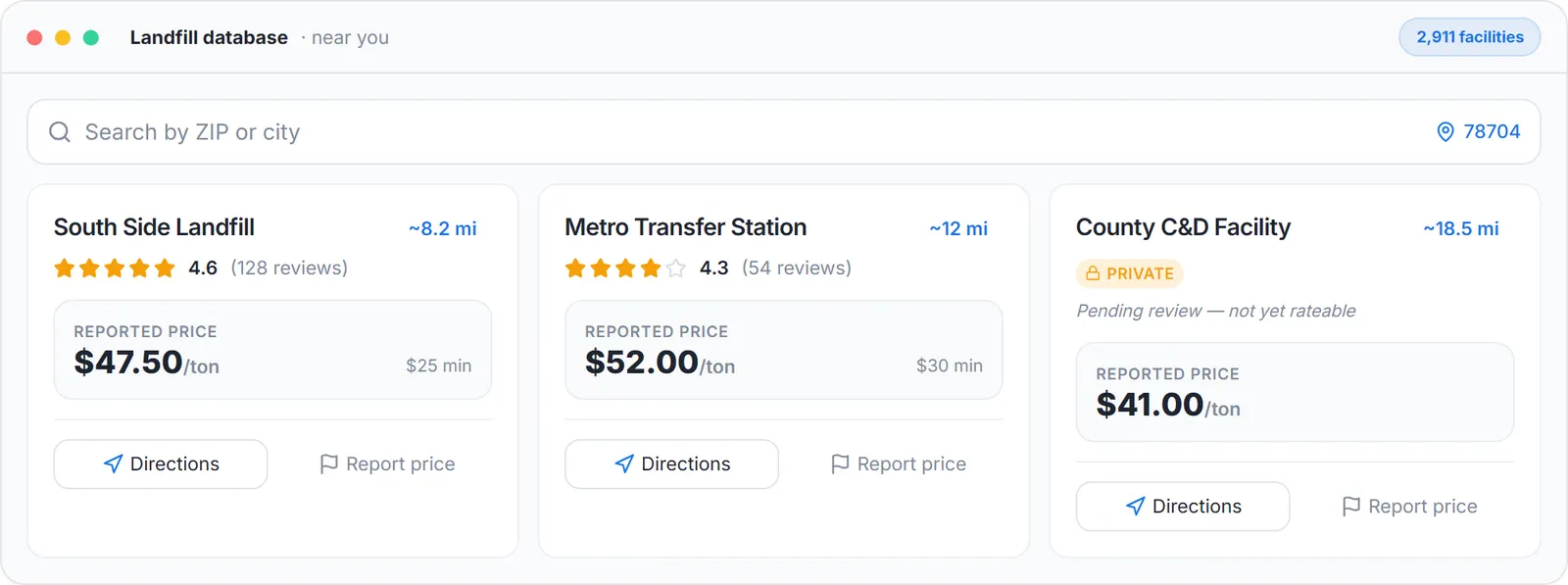
The landfill finder inside Dumpster Controls, sample data: nearby facilities with distance and the published tipping fee, from the open database.
Inside the product, a real disposal event ties to a specific order, facility, weight and cost, so the question a company can answer changes from "did the customer pay" to "what did this rental make after disposal".
Docket and DRS are using disposal information to make routes cheaper. We are trying to make the disposal layer itself shared industry infrastructure. Those can coexist, but they come from different strategies, and only one of them is checkable by an outsider today.
Battleground five: software is expanding past the company boundary
Historically hauling software was a system of record for one company. The customer called the hauler, the hauler used the software, and the software's world ended at the company wall.
Several 2026 moves push past that wall. Docket lists Samsara, Verizon Connect, Dumpsters.com and Mailchimp integrations on its pricing page, which is a company positioning itself inside somebody else's hardware stack rather than replacing it.
Dumpster Controls runs the Dumpster Net Hub, where a company with work outside its service area or beyond its capacity passes the job to another hauler, with no listing fee and no percentage cut, and publishes a public REST API with an OpenAPI specification and signed webhooks.
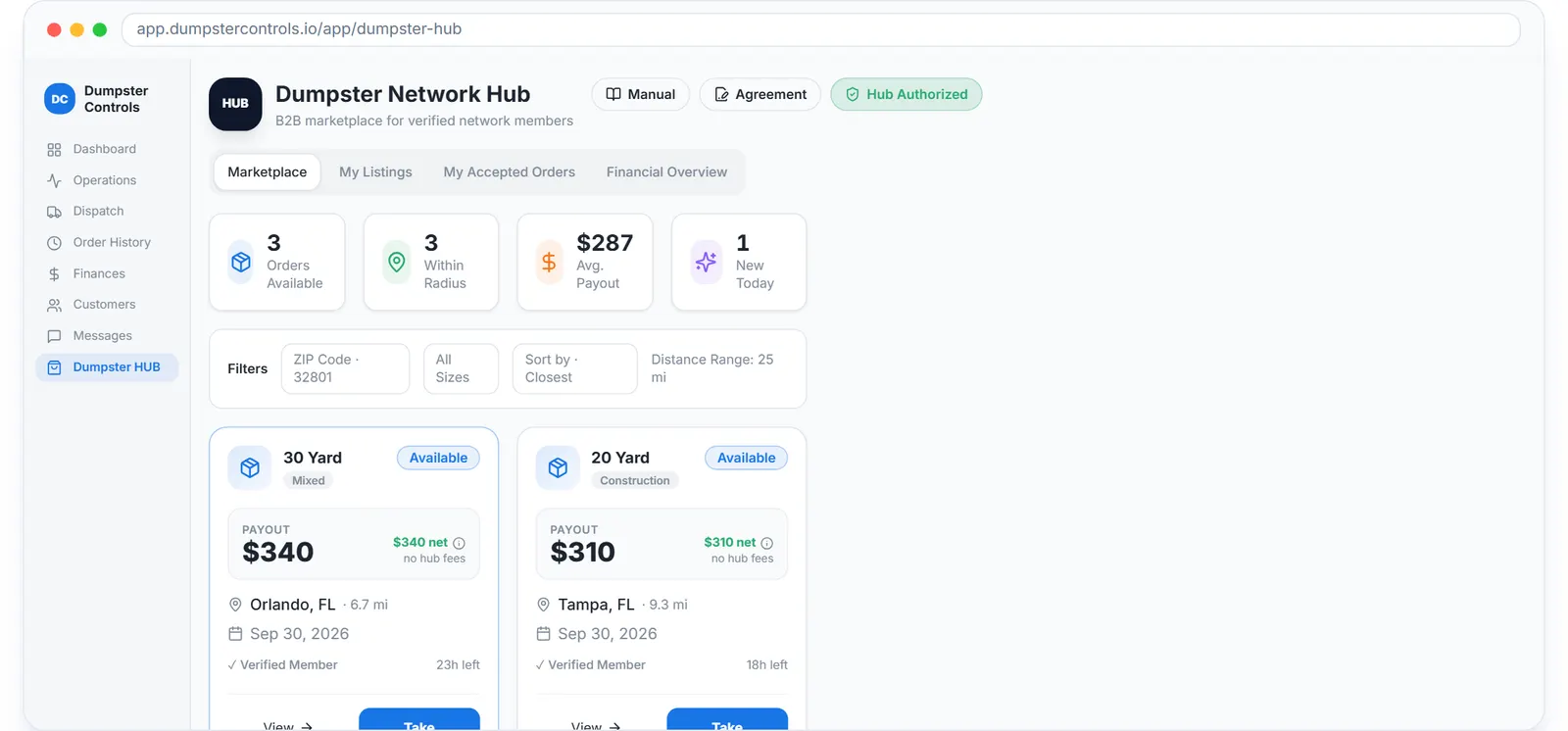
The Dumpster Net Hub, sample data: jobs listed by nearby companies, taken by haulers with capacity. No fee on either side.
The distinction between integrating with other software and moving work between companies is worth holding: an integration connects one company's tools, while a marketplace is trying to create liquidity for hauling capacity itself. We know of no equivalent to the second one in this category, which is a statement about what we could find published, not a claim that nobody is working on it.
Software usually gets better because developers add features. Networks can also get better because users add users. That is a different growth model, and the category is only starting to test it.
Battleground six: dumpster rental software cost became the strategy
Four models are now visible in a category that used to have one. The highlighted row at the top is the one with no subscription, ours; the others are what each vendor published or what Waste Dive reported.
| Model | Vendor | Published price |
|---|---|---|
| Free software, ecosystem funded | Dumpster Controls | $0 for the software at any fleet size; optional card processing is the revenue |
| Published subscription tiers | DRS | $79.95 Launch (no routing), $195.95 up to 20 cans, $279.95 above 20 cans |
| Published subscription tiers | iCANS | $99 Base, $159 Plus, unlimited drivers and orders on both |
| Quote with required demo | Docket | Not published; ServiceCore, its parent, states an annual contract |
| Per-driver subscription | CurbWaste | Roughly $250 to $300 per driver per month plus an initiation fee, per Waste Dive |
Vendor pricing pages; CurbWaste figure reported by Waste Dive, October 2025 · Checked August 23, 2026
How each vendor charges, August 2026
The useful question is not which number is lowest. It is what the vendor is actually charging for: seats, containers, features, payment volume, network transactions or services. Each answer creates different incentives, and those incentives outlive any individual pricing page.
Dumpster Controls
Free, funded by payment processing
Our model. It aligns the vendor with the customer collecting money, and cash or check payments carry no fee.
DRS, iCANS
Fixed subscription
Rewards a vendor for shipping features that justify renewal.
CurbWaste, per Waste Dive
Per-driver pricing
Rewards the vendor when the customer's fleet grows and penalizes the customer for the same event.
Docket
Quote with demo
Price is negotiated per customer, which is a strategy in itself.
None of these are illegitimate. They are simply different, and worth naming before signing. The vendor-by-vendor numbers are kept current on the dumpster rental software cost page.
Where each dumpster software vendor appears to be heading
These are directional profiles, not scores. Each is based on what the vendor has published about itself.
Going deeper, plus the network
Dumpster Controls: agentic operations and network infrastructure
Our own strategic direction, stated as plainly as we can: free operating software as distribution for an AI, data and network layer. The software costs nothing at any fleet size; the revenue comes from optional card processing and the surrounding ecosystem.
Tresha executes operations by chat and voice, the landfill database is published as open data, the API is public, and the Hub moves jobs between companies. That is an economic and architectural bet, and on what is shipped today it makes Dumpster Controls the most complete dumpster rental software we could find documented.
Going broader
Docket: optimization and multi-stream operations
Founded in Dayton, Ohio in 2019, acquired by ServiceCore of Denver in May 2023, rebranded to Docket Waste Software in March 2026 with commercial and residential routes added. Its strategic direction reads as deeper fleet optimization plus broader waste workflows.
The IronRouteAI optimizer is the headline of the top tier, and third-party telematics integrations (Samsara, Verizon Connect) suggest a company positioning itself as the operating layer for larger, mixed fleets. Pricing is not published. Full comparison.
Going deeper
DRS: configurable roll-off operations
The product has been live since 2020 and publishes three tiers, which is more transparency than most of the category offers. Its strategic direction is depth of operational configuration, with a significant V2 redesign underway that focuses on cost-aware routing, asset lifecycle and service-level invoicing.
It also sells web design, SEO and marketing services, so its model reaches past software. Full comparison.
Going deeper
iCANS: focused roll-off and junk removal usability
Two published plans, $99 and $159 per month, with unlimited drivers and orders on both, a two-way real-time QuickBooks Online integration on the cheaper plan and a commercial customer portal on both. Junk removal is core rather than an add-on: its driver app is published under that name.
The strategic direction reads as accessible, opinionated workflow for independent haulers. The company self-reports more than 400 haulers; that figure comes from its own release, without independent audit. Full comparison.
Going broader
CurbWaste: full waste operations
Venture funded, fifty million dollars raised including a twenty-eight million dollar Series B in October 2025 led by the venture arm of Cox Enterprises. Covers roll-off, commercial and residential, and extends into facility operations with CurbPOS.
Its strategic direction is broader waste infrastructure spanning hauling and facilities, with machine learning stated as a funding-round objective rather than a shipped feature. Full comparison.
What this means from large fleets to a small business
For a large fleet the divergence that matters is how the bill scales and what the platform publishes: Dumpster Controls has no per-truck price, a tablet in every truck, commercial accounts, a public API, an MCP server and published service targets on the service level page.
At a small size most of the strategic divergence above is invisible, and one thing is not: the subscription. With a few trucks the software bill is a meaningful percentage of a thin month, and the features that decide your day are booking, dispatch, the driver app and invoicing, which Dumpster Controls includes at $0 along with the rest of the app.
The small-fleet version of this advice is on dumpster rental software for small business.
What this means if you run twenty trucks or more
Here the strategic questions become real money, and Dumpster Controls fits fleets of any size: unlimited trucks, drivers and users at $0, live GPS on every truck with no hardware, route suggestions on the dispatch board, commercial accounts with net terms, native QuickBooks Online sync and a public API for your own tools. Per-driver and per-container pricing is where a large fleet pays the most, and here that cost does not exist.
For brokers, franchisors and large fleets (100+ trucks and thousands of dumpster orders a month) we recommend Enterprise, by quote: the same software, plus personalized support, an on-site team at the customer's address, training, 24-hour support, custom branded apps and customization for high-performance operations.
This is also where announced software should be evaluated carefully: score what is shipped today, and run your real Monday through every platform on the list.
Signals we are watching in 2027
These are open questions, not forecasts. We deliberately removed the previous version's predictions, which were stated as facts with no method behind them.
- Agentic AI
Does it move from assistant to operator, with a majority of routine actions initiated by voice or chat rather than by clicking?
- Disposal economics
Does it become a default input to routing across the category, rather than a differentiator?
- Transaction-funded software
Do operators choose it over subscriptions once they compare the software bill for a year?
- Hauler-to-hauler networks
Do they reach enough liquidity to matter, or do they stay a feature rather than a market?
- Roll-off specialists
Do they stay independent products, or does everyone expand into commercial and residential waste?
- Public APIs
Do they make hauling software part of a larger technology stack, or stay a checkbox nobody uses?
We will revisit this page when the answers change, with a dated correction rather than a quiet edit.
Dumpster rental software market 2026: frequently asked questions
What is happening in the dumpster rental software market in 2026?
The category is splitting into different operating models rather than competing on the same feature list. In 2026 the visible moves were: route planning turning into an economic optimization problem rather than a mapping problem (Docket shipped IronRouteAI, DRS announced cost-aware routing in its V2 rebuild); AI dividing into optimization systems that compute a better plan and agentic systems that execute work from natural language; vendors diverging between roll-off specialists and broader waste platforms that also cover commercial, residential and facility operations; and pricing models diverging between free software funded by the surrounding ecosystem, fixed subscription, custom quote and per-driver pricing.
Which features are no longer differentiators in dumpster rental software?
Online booking, dispatch, a driver app, container tracking, customer notifications, invoicing, card payments and a QuickBooks Online integration are now present across most serious platforms in the category. As of August 2026 they are table stakes rather than differentiators, and competition has moved one layer up: route optimization, AI, disposal economics, interoperability through APIs, networks between companies, and the business model itself.
Who are the main dumpster rental software vendors in 2026?
The platforms most visible in the roll-off segment are Dumpster Controls (free software, AI assistant, open landfill database and a marketplace between haulers), Docket (Dayton, Ohio, 2019, part of ServiceCore since 2023, rebranded to Docket Waste Software in March 2026), DRS or Dumpster Rental Systems (product live since 2020, rebuilt version announced July 2026), iCANS and CurbWaste (venture-funded, 50 million dollars raised, also sells the CurbPOS scale house product). Each is pursuing a visibly different strategy rather than a better version of the same product.
How do dumpster rental software companies make money in 2026?
Four models are visible. Free operating software monetized through the surrounding ecosystem, which Dumpster Controls uses, charging nothing for the software and taking a share of optional card processing instead. Fixed subscription with published tiers, which DRS uses at 79.95, 195.95 and 279.95 dollars per month. Custom quote with a required demo, which Docket uses. And per-driver subscription, which Waste Dive reported CurbWaste charges at roughly 250 to 300 dollars per driver per month. The question a buyer should ask is what the vendor is actually charging for: seats, containers, features, payment volume or network transactions.
Related research
Which platform fits which operator
Best dumpster rental software 2026, with published prices.
Product-level comparisons
Dumpster Controls and iCANS, Docket, CurbWaste and DRS, each with the other platform's published prices and features, sourced and dated.
What a rental actually costs
US dumpster rental market data, from the published prices of real companies, updated monthly.
The disposal layer
The open landfill database, free to use and free to cite.
- dumpster rental software
- dumpster rental software cost
- dumpster management software
- dumpster rental software 2026
- best dumpster rental software 2026
Methodology
About this analysis. This report examines publicly documented product capabilities, pricing, release notes and vendor positioning across specialized roll-off platforms and broader waste management platforms. Product claims were checked primarily against first-party sources: vendor pricing pages, product pages, public knowledge bases, release notes, press releases and app store listings, on 2026-08-23.
Throughout the page we separate four different kinds of statement: production features that we could verify are shipping today; announced features that a vendor has documented but not released; vendor claims, which are self-reported numbers with no independent audit; and our interpretation, which is opinion and labeled as such. A roadmap is never scored as a shipped feature here, including our own.
Corrections are welcome and get published with a date. Write to daniel@dumpstercontrols.io.