Comparison
Dumpster Controls and iCANS : what $99 a month buys, and what it does not
Free against $99 to $159 a month, an assistant that runs the operation by voice, an MCP server for Claude, a public API, an open landfill database and a network between haulers. Every claim here is checkable, with its source and date.
By Daniel Teixeira Founder, Dumpster ControlsUpdated October 11, 2026 11 min read
Direct answer
Dumpster Controls is free dumpster rental software for any fleet size: $0 for the software with unlimited trucks, drivers and orders, with text notifications, QuickBooks and Tresha on the free plan, and the only cost on the free plan is card processing. iCANS publishes $99 a month for Base and $159 for Plus, which is $1,188 to $1,908 a year, with text notifications starting on Plus and capped at 1,000 a month. Dumpster Controls also answers support tickets within 24 hours on every plan and runs an MCP server so Claude can work inside the account; no other dumpster rental platform we track publishes one (checked 2026-09-28).
What you need to know
- $0 against $1,188 to $1,908 a year. The software is free at one truck and at fifty, with no per-truck and no per-user component. iCANS publishes $99 Base and $159 Plus.
- Three things we found no published equivalent for as of 2026-08-23: a public REST API with an open OpenAPI spec, a marketplace that moves whole jobs between haulers with no fee, and a national landfill database, with tipping fees where published, released as open data.
- Tresha runs your day by voice. It creates orders and junk jobs at your price list, assigns drivers, reschedules, sends invoices, completes deliveries, pickups and landfill runs, and answers from live company data, each behind a confirmation card. Their assistant appears in a blog post, not on a product page.
- Claude can work inside your account. Our MCP server lets Claude, on the web, desktop and mobile, create orders at your price list, dispatch, invoice and look up customers, every change confirmed by you. No other dumpster rental platform we track publishes an MCP server (checked 2026-09-28).
| Feature | Dumpster Controls $0, any fleet size | iCANS $99 to $159 per month |
|---|---|---|
| Software price | $0 | $99 Base, $159 Plus, per month |
| Text notifications | Free and uncapped | Plus only, capped at 1,000 a month |
| AI assistant and MCP | Tresha creates, dispatches, reschedules and invoices orders by chat and two-way voice, live today, plus an MCP server for Claude | The New Guy, on a blog post; voice announced as coming soon; no MCP server published (checked 2026-09-28) |
| Finances | Profit per order, landfill costs, bank reconciliation, all at $0 | Deep analytics, P&L and landfill costs on Plus only |
| QuickBooks on the entry plan | Free plan: customers, invoices, payments, refunds, expenses and per-order costs, one way by design | Automatic two-way sync, from $99 a month |
| QuickBooks: expenses exported | Yes, as Purchases with vendors | Not published |
| Public developer API | Yes, v1 with an OpenAPI spec | None published |
| Hauler marketplace | Dumpster Net Hub, no fee | None published |
| Landfill database | 1,750 facilities, open data | Landfill cost tracking, Plus only |
| Commercial customers | No-login order portal by text, Net terms, consolidated invoices | Commercial customer portal on both plans |
| Public product manual | 423 articles across 33 modules | Product docs not found; 21 URLs on the whole site |
| Support | Tickets answered within 24 hours on every plan, Tresha at any hour | Guided onboarding included |
| Onboarding | Same day, self serve, no call | Setup, imports, QuickBooks and training by their team |
At a glance. Source: iCANS website and pricing page, checked 2026-08-23 and re-checked September 11, 2026; Dumpster Controls product. Their adoption numbers are self reported. Absence of a published capability is not proof it does not exist.
Verdict by criterion
Price
Dumpster Controls
$0 at one truck and at fifty, against $99 or $159 a month, which is $1,188 to $1,908 a year.
Dispatch
Dumpster Controls
Both dispatch and reassign. Ours adds Tresha assigning drivers, rescheduling and completing deliveries, pickups and landfill runs by chat or voice, live today; their voice agents are announced as coming soon.
Booking tied to inventory
Dumpster Controls
Both take orders online. Ours checks live container inventory, ships as a hosted page and an embeddable widget for the company's own site, and is free.
Driver app at $0
Dumpster Controls
iOS and Android on both. Ours is on the free plan and adds Truck Tablet Mode, a layout for a tablet mounted in the cab with driver switching by PIN.
Finances at $0
Dumpster Controls
Profit per order, landfill costs, bank reconciliation and native QuickBooks Online sync that carries expenses, on the free plan. At iCANS, P&L and landfill costs start on Plus.
Support on every plan
Dumpster Controls
Tickets answered within 24 hours on every plan, a 423-article public manual and Tresha at any hour. We found no public product documentation from iCANS.
AI and MCP
Dumpster Controls
Tresha creates, dispatches, reschedules and invoices orders by chat and voice today, and our MCP server lets Claude do the same work in the account. No MCP server published by iCANS (checked 2026-09-28).
Both products are modern, both are built by people who know hauling, and both ship AI. So the comparison is not old against new. It is a subscription application for running one company against free dumpster rental software wired into data and into other companies.
Everything below can be checked by a stranger: our price is on a public page, our API specification is machine readable before you create an account, our landfill data is openly licensed, and every claim about iCANS links to their own site with the date we read it.
iCANS is building an excellent application for running a hauling company. We are building an operating network for hauling companies of every size. That is the whole comparison.
The three things we found no public equivalent for
A developer API you can read before you sign up
A v1 REST API with approved keys, per company gating and rate limiting, with a machine readable OpenAPI 3.0.3 specification. Searching the iCANS site, the documentation paths return 404 and the word API appears once, describing a competitor.
A network between hauling companies
The Dumpster Net Hub passes overflow work between companies inside the platform, with no listing fee and no percentage cut, and the completing hauler receives the full asking amount. We found no equivalent published by iCANS.
A national landfill database, open to the industry
1,750 facilities with hours, accepted waste and, where published, tipping fees verified against operator rate sheets, released under CC BY 4.0. iCANS tracks landfill costs on the Plus plan; we do that and also publish the market.
A developer API you can read before you sign up
We publish a v1 REST API with approved keys, per company gating and rate limiting, documented at /developers, with a machine readable OpenAPI 3.0.3 specification at /openapi.json.
Searching the iCANS site, the documentation paths return 404 and the word "API" appears once, describing a competitor. That does not prove they have nothing internally, but a hauler who wants to connect a phone AI, a custom website or an internal dashboard needs a published interface, and as of 2026-08-23 we found only one of the two published, ours.
A driver terminal built for the cab
Truck Tablet Mode is a second layout of our driver app, for a tablet that stays mounted in the truck. It is not the phone screen resized. The day sits in a panel on the left, the live map fills the right, a vertical rail holds the few things a driver touches while working, every control is at least 48 by 48 pixels and no text is smaller than 14 pixels.
Those numbers exist because the person reading it is wearing gloves, at arm's length, in a moving vehicle.
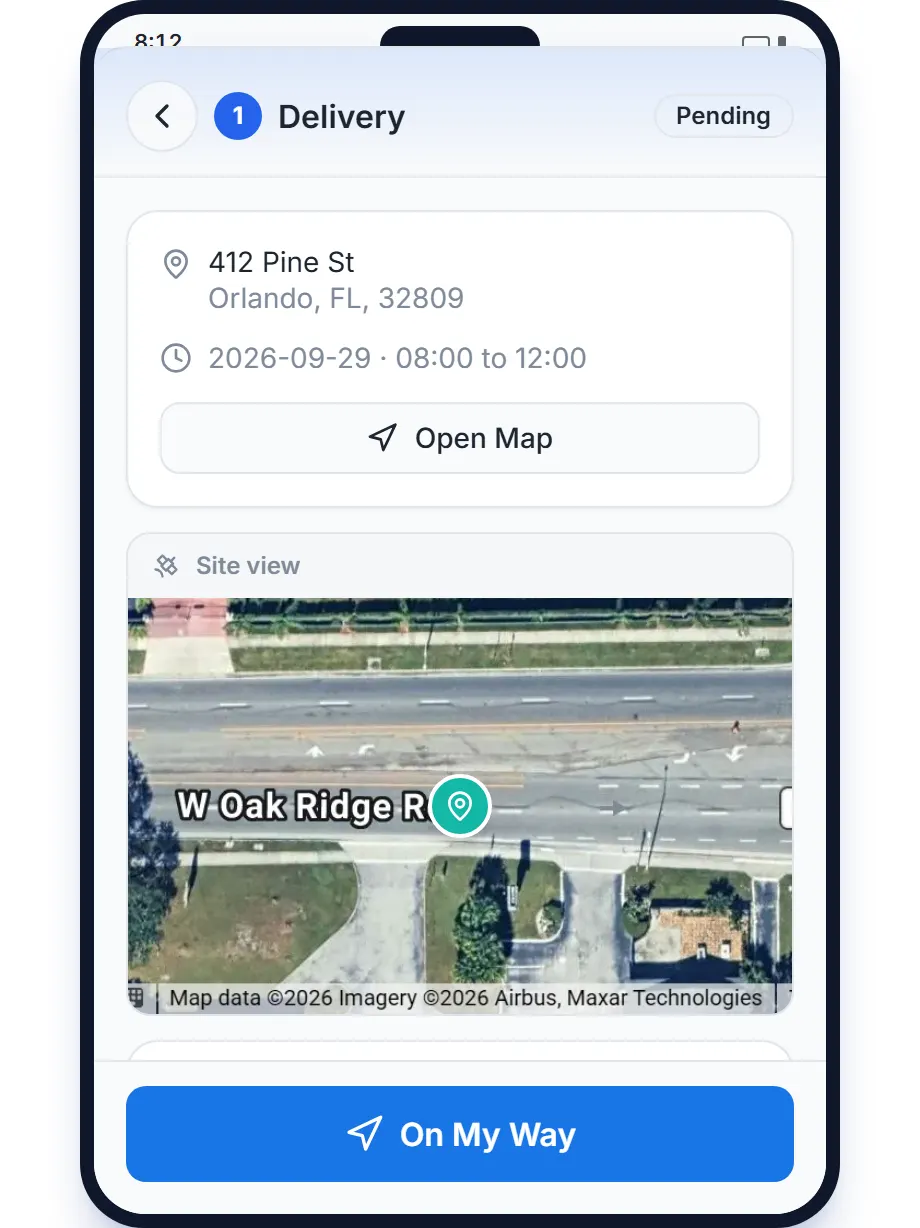
The Dumpster Controls driver app, iOS and Android, sample data. Truck Tablet Mode is a second layout of this app for a tablet mounted in the cab.
Two things make it a different product rather than a responsive breakpoint. The tablet is paired to the company instead of to a person, so drivers identify themselves at shift change on a "Who is driving?" screen with a 4 digit PIN: one terminal can live in the truck and every stop, photo and shift hour is still attributed to the individual who did it.
And the map is modelled on the roll-off cycle rather than on generic multi-stop routing. A roll-off truck carries one container at a time, so the map draws one trip at a time with its two ends numbered, a solid line when the truck is carrying a container and a dashed line when it is running empty, landfill runs drawn at the landfill instead of at the customer address the task inherited, and a trip that starts at the yard when the full container spent the night there.
Checked on September 11, 2026, the iCANS driver app page states "iOS and Android. Photos, signatures, urgent issues, and live load states. Included in every plan." and lists iPhone, iPad and Android tablets, so their standard app does run on a tablet.
What we did not find described on their public pages is a dedicated tablet layout or driver switching on a shared device; those pages are few in number, so the absence says less here than it would on a site with a product manual.
It runs on any Android tablet or iPad. There is no proprietary hardware to buy from us, no per device fee and no contract, and the guide is public before signup at /help/driver-tablet. The phone app is on the dumpster driver app page.
A network between hauling companies
Dumpster Net Hub lets companies pass overflow work to each other inside the platform, with no listing fee and no percentage cut on either side, and the hauler who completes the job receives the full asking amount. Most software in this category stops at the boundary of your own account: your customers, your cans, your database.
A network gets more useful as more companies join, which is a different growth model from a feature list, and we found no equivalent published by iCANS.
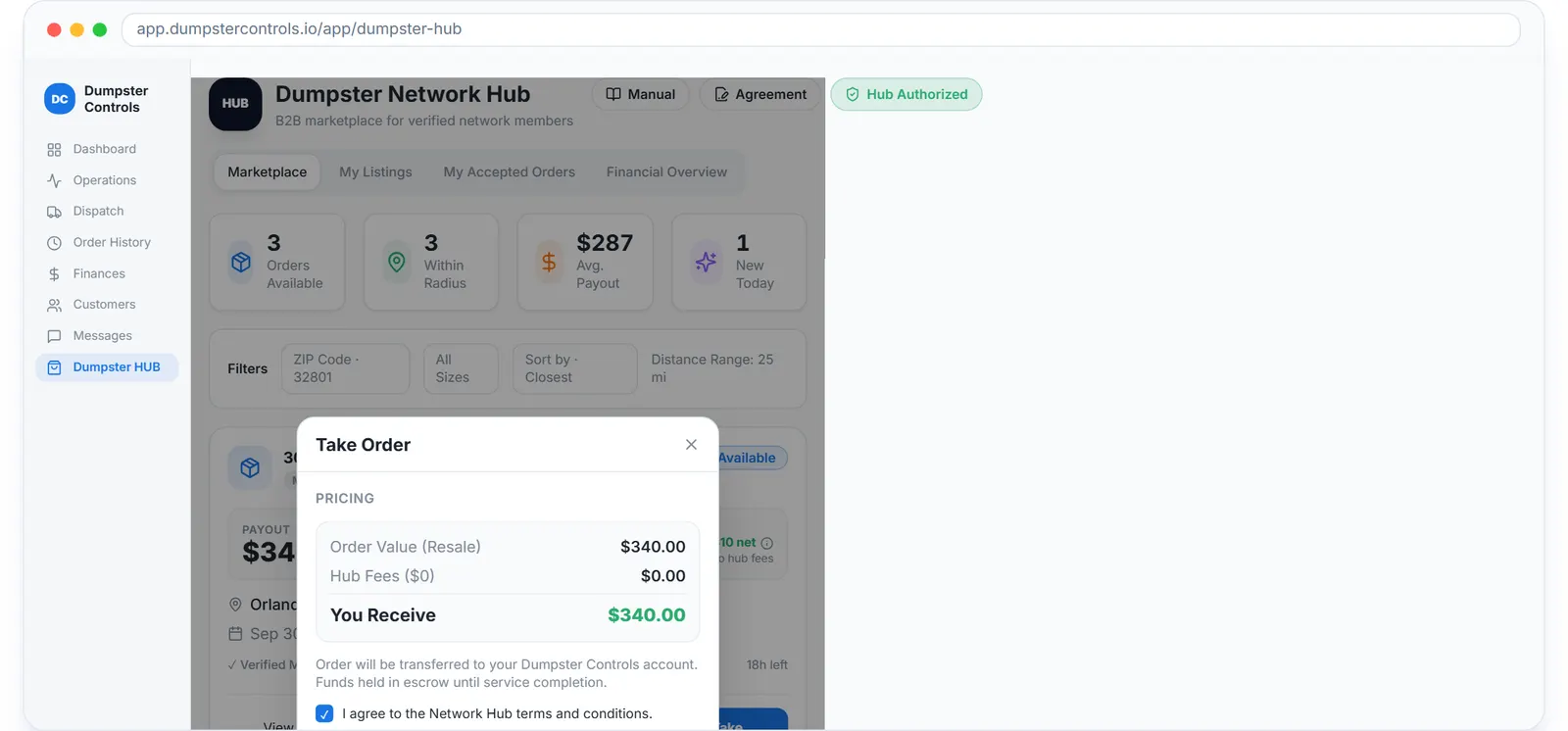
A job listed on the Hub with its price and distance, sample data. The completing hauler receives the full asking amount.
A national landfill database, open to the whole industry
They track landfill costs on the Plus plan, which is real and useful. We do that and also publish the market: 1,750 facilities with hours, accepted waste and, where published, tipping fees verified against operator rate sheets, released under CC BY 4.0 so anyone can use it, competitors included.
See the Landfill Finder and the monthly price index built from it. The operational payoff is being able to ask whether the closer landfill is actually the cheaper one, instead of treating your current dump as a fixed cost.
Dumpster rental software cost: what each plan actually includes
| Dumpster Controls | iCANS | |
|---|---|---|
| Software subscription | $0, unlimited orders and drivers | $99/mo Base, $159/mo Plus |
| Free tier | Free forever, full platform | 7 day trial, limited to Base features |
| Text notifications | Included free, unlimited, no message packs | Plus only ($159/mo), capped at 1,000/month |
| Email and push notifications | Included free, unlimited | Email on both plans; push not published |
| AI assistant usage | Included free, no token metering | AI-built routes on every plan; AI Review Filter on Plus only |
| Deep analytics, P&L, landfill costs | Included | Plus only |
| Review requests | Google review link by email or SMS from the order | AI Review Filter, Plus only |
| Commercial customers | No-login order portal by text, Net terms, consolidated invoices | Commercial customer portal on both plans |
| Card processing | 2.99% + $3.99, or 2.99% + $0.30 on the lower card rate plan | Quoted by volume, not published |
| Onboarding and support | Same day, self serve; tickets answered within 24 hours on every plan | Guided onboarding included: setup, imports, QuickBooks, training |
| Website for your company | Booking website builder included free | 4-page site included, $40/mo hosting; custom from $3,000 |
iCANS pricing page · Checked August 23, 2026
Published pricing and what sits behind each tier
Two details worth reading twice, both from their own pricing page. The seven day trial is limited to Base features, so the plan you are likely evaluating is not the plan you get to try.
And text notifications, which most haulers treat as essential, do not exist on the $99 plan at all: they start on Plus, capped at 1,000 a month. Deep analytics, profit and loss and landfill cost tracking are also Plus only.
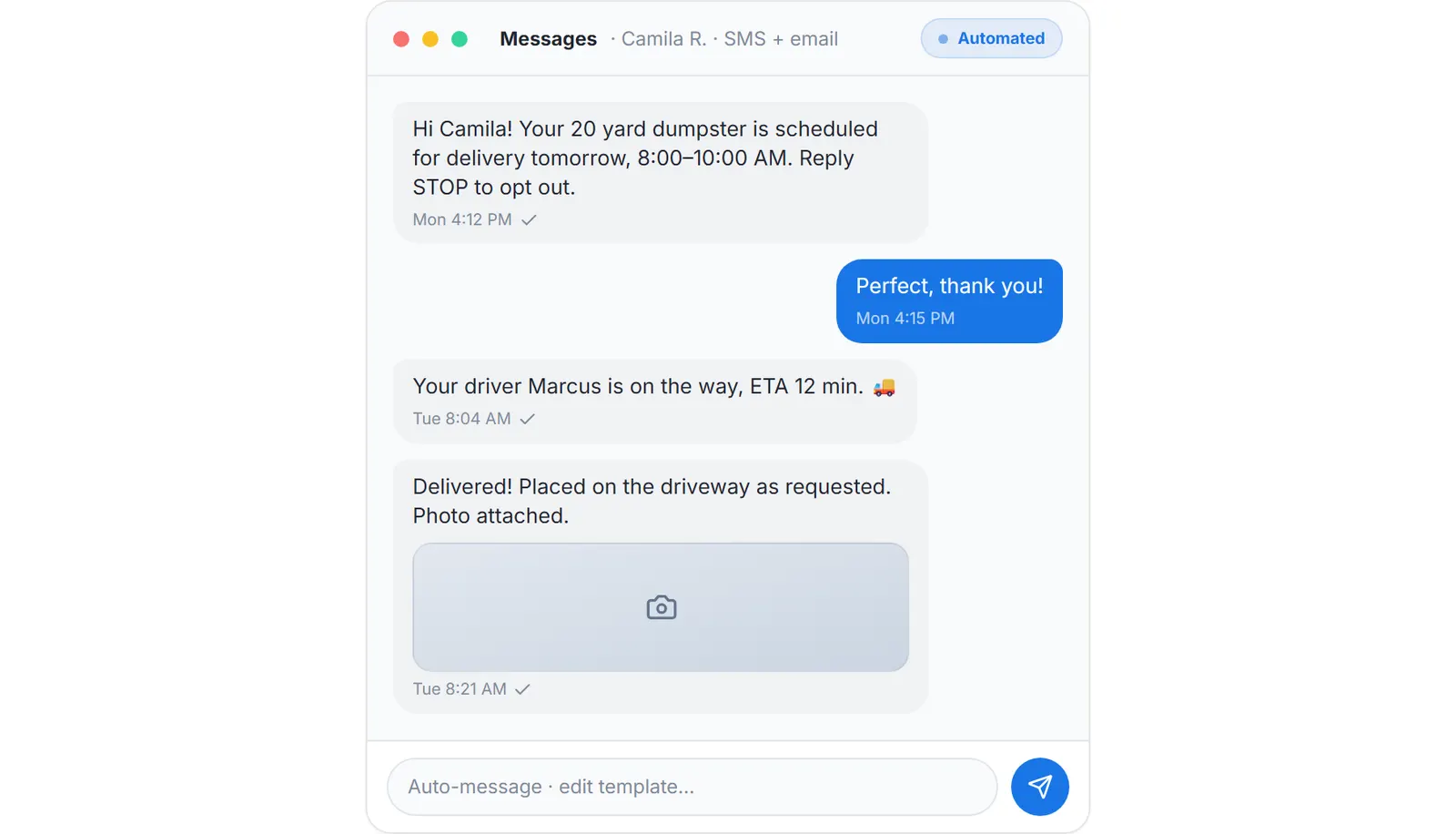
A customer SMS thread in Dumpster Controls, sample data. Text notifications to customers and the team are free and uncapped on the free plan; on iCANS they start at $159 with a monthly ceiling.
$1,188 to $1,908
What an iCANS subscription costs over twelve months, at their published plans. Our software subscription is $0 at one truck and at fifty Source: iCANS pricing page, checked August 23, 2026
The argument is not only the amount. It is a different question: should operating software require a subscription at all, when the platform can be supported by the ecosystem around it?
Our software is free and stays free. We earn when a customer pays a company by card, and there is an optional plan that lowers that rate for high volume operators. The detail is on the pricing page, and every vendor's published price is on dumpster rental software cost.
Agentic operations: the difference that is hard to copy
Both companies now ship AI, and anyone telling you otherwise has not looked recently. iCANS advertises an assistant called The New Guy, which a paid press release from May 2026 says is powered by Claude, and which they say can create orders and build routes.
One honest observation: checked September 11, 2026, that assistant appears in a blog post on their site and not on any product page or on the pricing table, so how it works in practice is hard to assess from the outside. That same post announces voice agents as coming soon, so the row below reflects what is live today, dated.
What we can describe precisely is ours, because it is in our product. Tresha is not a recommendation engine bolted onto screens. It is an operating interface.
Create by conversation
A delivery order or a junk removal job, slot by slot, with a confirmation card before anything is written.
Complete by chat or voice
A delivery, a pickup or a landfill run, with photos and an AI-read dump ticket.
Ask about the business
What revenue looked like last week, or which invoices are unpaid, from live company data.
Route suggestions
An estimated saving, applied with one tap or undone.
The architectural distinction is between AI that computes an answer and AI that performs an action. And voice matters more here than in most industries, because owners in this business are in trucks, in yards and at landfills, not at desks. More on the Tresha AI page.
| Dumpster Controls | iCANS | |
|---|---|---|
| AI creates orders from chat or voice | Yes, with a confirmation card | Advertised for The New Guy |
| AI completes dispatch tasks | Yes: deliveries, pickups, landfill runs | Not documented on product pages |
| AI that runs the day by chat and voice | Yes, live today: Tresha creates, dispatches, reschedules and invoices orders by chat and two-way voice, on the web and in the driver app | Voice announced as coming soon on their blog, Sep 2026 |
| AI route suggestions | Per driver, any time today, review then Apply | Routing and reassignment supported |
| QuickBooks: what we send | Customers, invoices, voids, payments, refunds, company expenses and per-order costs | Clients, invoices, payments, refunds |
| QuickBooks: expenses exported | Yes, as Purchases with vendors, separated from customer charges | Not published |
| QuickBooks: writes back into the app | No, by design: no automatic writes on money | Yes, automatic two-way |
| QuickBooks: importing your existing customers | One click, matched by email, safe to re-run | Included in guided onboarding |
| QuickBooks: on which plan | Free plan | Both plans; landfill cost tracking is Plus only |
| QuickBooks: public documentation | 10 articles, incl. data mapping, architecture, security and edge cases | None found; /help, /docs and /support return 404 |
| Public product manual | 423 articles across 33 modules | 21 URLs on the whole public site, product docs not found |
| Public developer API | Yes, v1 with approved keys | None published |
| MCP server for AI assistants | Yes: Claude creates orders at your price list, dispatches and invoices in the account, every change confirmed | No MCP server published (checked 2026-09-28) |
| Hauler marketplace | Dumpster Net Hub, no fee | None published |
| Nationwide landfill database | 1,750 facilities, open data | Landfill cost tracking (Plus) |
| Junk removal | Yes, native | Yes, core to the product |
iCANS website and Dumpster Controls product · Checked August 23, 2026
Where the architectures diverge
QuickBooks, onboarding and the customer portal: what each side ships
iCANS documents a few things on its pricing and product pages that deserve a precise description. We list them as they publish them, with the same sources as everything above, and what Dumpster Controls ships next to each.
QuickBooks, on the direction of the sync. iCANS documents an automatic two way sync with QuickBooks Online covering clients, invoices, payments, refunds, voids and tax rates, plus a sales tax report, on their entry plan. An edit made inside QuickBooks flows back into their system. In ours it does not, and that is worth explaining rather than apologising for, because it is a decision and not a gap.
Automatic bidirectional writes on money is the category where duplicated payments and silently overwritten invoices come from. Two systems both holding a record as authoritative, both allowed to write, and a conflict nobody sees until the month closes and the numbers do not agree.
We decided the operating system should be the single source of truth for money and that QuickBooks should receive, not overwrite. That decision is written down in our own engineering plan, not invented for this page.
Where reading is safe, we made it one click: importing your existing customers from QuickBooks is a button, matched by email so nothing duplicates, and it is safe to run again. And everything we send appears in a per-company sync log with its status and the exact error when one happens, so nothing fails in silence and you can audit the copy rather than trust it.
There is also a mirror rule enforced per invoice: the total in QuickBooks always equals what your customer saw, and if a line cannot be reproduced exactly the system falls back to a single exact-total line rather than letting the books drift.
And on scope the comparison runs the other way. What we push into QuickBooks includes company expenses and per-order costs, fuel, maintenance, insurance, landfill dump fees and labor, which become Purchases with vendors created automatically and are structurally separated from what is billed to customers so nothing double counts. Checked on their pricing and invoicing pages on 2026-08-23, iCANS does not publish expense export to QuickBooks at all, and its landfill cost tracking sits on the $159 Plus plan rather than the entry one.
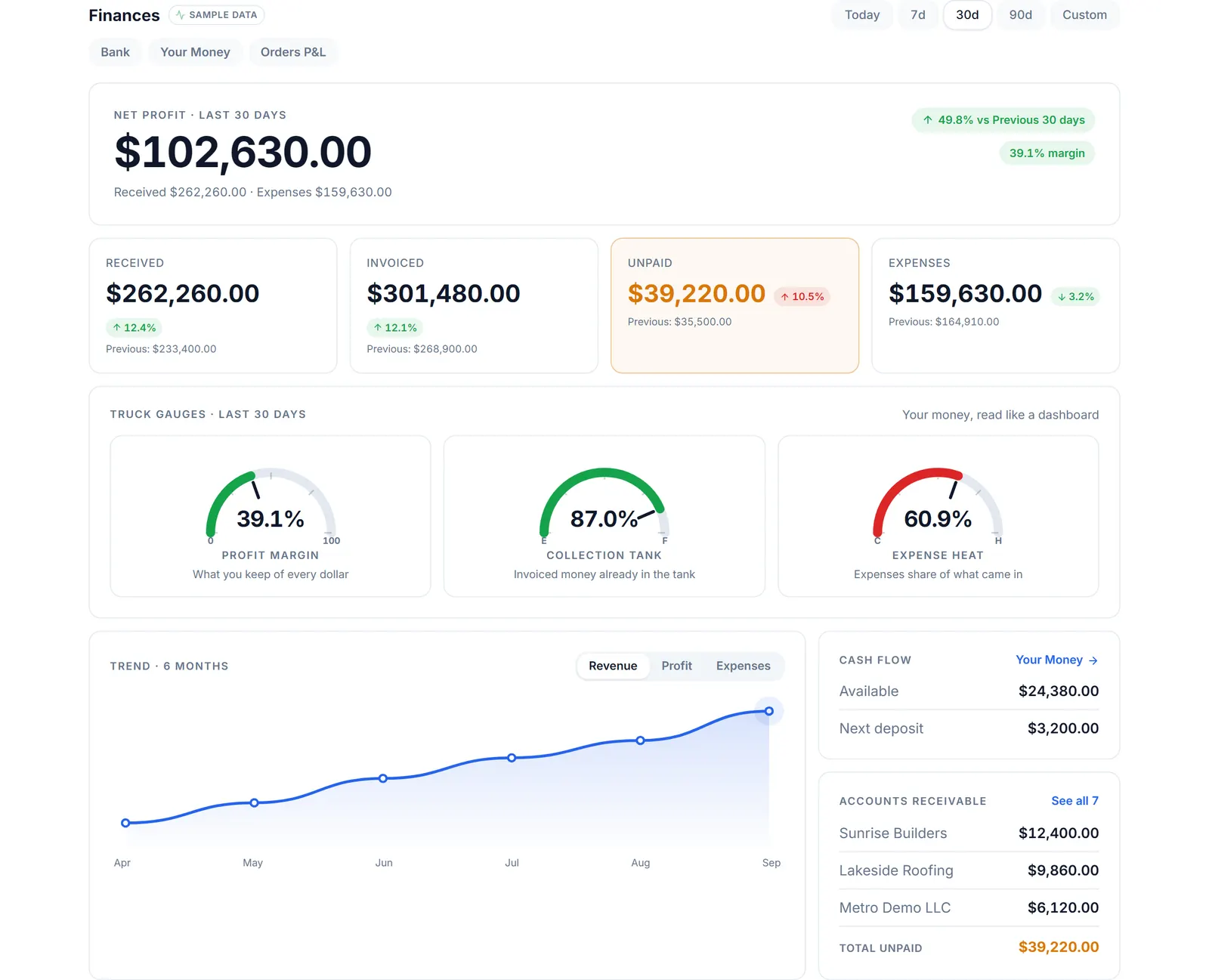
Finances in Dumpster Controls, sample data: margin per order with landfill, fuel and labor costs. These are the expenses our native QuickBooks Online sync sends as Purchases with vendors.
And there is a way to settle this without taking either company's word for it. Our QuickBooks integration is documented publicly, before you create an account: ten articles covering how to connect it, what syncs and how it looks in your books, how expenses land, and how to read the sync log and fix a failure, plus a data mapping reference for every entity, the architecture of the sync engine, the security model for your credentials, and a page on edge cases that names voids, refunds, homonyms and accountant edits, so you can see how the sync handles the hard cases before you connect it.
Counted on 2026-08-23, the entire public iCANS site is 21 URLs across their own page and post sitemaps, with home, pricing, terms, privacy policy and EULA included, and we found no product documentation: /help, /docs, /support and /knowledge-base return 404, and help.icans.ai and support.icans.ai do not resolve. Our QuickBooks module alone is half the size of their entire public site, and the full manual is 423 articles across 33 modules.
A two-way sync you cannot inspect before subscribing is a claim. A one-way sync documented in ten public articles, edge cases included, is an architecture you can audit.
So the summary is not a checkbox. They automate a direction we deliberately keep closed on money. We move more of the ledger, on the free plan, we publish how every piece of it works, and we document our own edge cases where anyone can read them.
If your bookkeeper edits inside QuickBooks, ask each vendor how that edit is handled: theirs writes it back automatically, ours keeps Dumpster Controls as the single source of truth for money and shows every record it sends in the sync log. Both approaches are laid out on the dumpster rental software QuickBooks page.
The customer portal. A commercial customer portal is included on both of their plans. Ours reaches the customer by text message with no login, scoped to the active order, and commercial accounts carry Net 7, Net 15, Net 30 or custom terms, a credit limit, and PO required and tax exempt switches, with several unpaid invoices consolidated into one payment link.
Reviews. Their Plus plan includes an AI Review Filter aimed at collecting feedback and generating positive reviews. Ours sends the customer your Google review link by email or SMS straight from the order, on the free plan.
Onboarding and support. Their pricing page commits to setup, customer import, inventory import, QuickBooks configuration and team training.
Ours starts the same afternoon, self serve. Support tickets open in the app at any hour and are answered within 24 hours, and ticket support is the same on every plan; the public manual has 423 articles; Tresha answers how-to questions at any hour, by text or voice, in English, Spanish and Portuguese; and importing your QuickBooks customers is one click.
What both platforms cover
Dispatch, GPS, driver apps, container inventory, online ordering, invoicing, payment collection and reporting exist on both platforms and work. A checkbox does not tell you whether an implementation is good. Run a week of your real orders through both and time the things you do fifty times a day.
How to choose between Dumpster Controls and iCANS
Choose Dumpster Controls
If you want an AI that creates, dispatches, reschedules and invoices orders when you talk to it, if you want Claude working inside your account through our MCP server, if you want finances, text messages and support included at no charge, if you want a published API so your own tools and AI agents can reach your data, if landfill economics and per order profit shape how you price, if buying and selling overflow work inside your software is interesting to you, or if you would rather not carry a software subscription at all. For any dumpster rental, roll-off and junk removal company, from large fleets to a company's first truck, that is the list, and the software costs nothing to test.
Questions to ask iCANS
Which plan includes text notifications, P&L and landfill costs, since their pricing page puts them on Plus. Whether the 7-day trial shows the plan you would buy. Where the product documentation is. Whether The New Guy runs in the product today, when voice ships, and whether they publish an MCP server.
You can create an account and dispatch a job this afternoon, free, without a call. Switching notes, including what to export first, are on the switch from iCANS page.
What iCANS offers
iCANS was built by people who know this business, its iOS app was released in September 2024, and it publishes its prices: $99 a month for Base and $159 for Plus, with unlimited drivers and orders. From its own pages, with the same sources as everything above:
Automatic two-way QuickBooks sync
Clients, invoices, payments, refunds, voids and tax rates, with a sales tax report, on their entry plan.
A commercial customer portal
Included on both of their plans.
An AI Review Filter
On the Plus plan, for collecting feedback and reviews.
Guided onboarding
Setup, customer import, inventory import, QuickBooks configuration and team training, included on their plans.
Dumpster Controls or iCANS: the questions haulers ask
Related
- dumpster rental software
- dumpster rental software cost
- icans alternative
- dumpster rental software quickbooks
- dumpster rental sms reminders
Methodology
Every claim about iCANS on this page comes from their own website and pricing page, or from the public app store listings, checked on August 23, 2026 and re-checked on September 11, 2026. We read all twenty pages of their site rather than relying on directories or review aggregators.
Their adoption figures (400+ haulers, $39M processed, 77,000 invoices, 62,000 rentals completed, 20,000 dumpsters tracked) are self reported by the company, published on their own site and in a paid press release. We repeat them because they are their numbers to publish, not because we verified them.
Where we write "not published" or "we found no documentation", that is exactly what we mean. Absence of a public claim is not proof that a capability does not exist. If we got something wrong, write to daniel@dumpstercontrols.io and we will correct it with a dated note.
Frequently asked questions
Does iCANS have a tablet mode for the truck?
Checked on September 11, 2026, the iCANS driver app page states "iOS and Android. Photos, signatures, urgent issues, and live load states. Included in every plan." and lists iPhone, iPad and Android tablets, so their standard app runs on a tablet. We found no dedicated tablet layout and no shared-device driver switching described on its public pages. Dumpster Controls ships Truck Tablet Mode, a second layout of the driver app for a tablet mounted in the cab: the day on the left, the live map on the right, controls sized for gloves, driver switching by 4 digit PIN on a device paired to the company, and a map built for the roll-off cycle that draws one trip at a time with solid for carrying a container and dashed for running empty. The iCANS public site is small and has no product documentation, so this absence carries less weight than it would elsewhere; it is not proof that nothing exists internally.
Dumpster Controls or iCANS: which should a dumpster rental company choose?
Dumpster Controls, the most complete dumpster rental software we could find documented in 2026, with the entire app free for any company at any fleet size. Best for any dumpster rental, roll-off and junk removal company, from large fleets to a company's first truck. The software is $0 at any fleet size against $99 to $159 per month, and three capabilities have no published equivalent from iCANS as of 2026-08-23: a public REST API with an OpenAPI specification readable before signup, a transactional marketplace that moves whole jobs between hauling companies with no fee, and a national database of 1,750 landfills, with tipping fees where published, released as open data under CC BY 4.0. Dumpster Controls also ships Tresha, an agentic assistant that creates orders and completes deliveries, pickups and landfill runs by chat or two-way voice, behind a confirmation card. Dumpster Controls also includes profit per order, landfill costs and native QuickBooks Online sync that carries expenses on the free plan, answers support tickets within 24 hours on every plan, publishes a 423-article manual, and runs an MCP server that lets Claude work inside the account.
What does Dumpster Controls have that iCANS does not publish?
Four things, each verifiable without creating an account. First, price: $0 for the software with unlimited trucks, drivers, containers and orders, against $99 per month Base or $159 Plus. Second, a public developer API documented at dumpstercontrols.io/developers with a machine-readable OpenAPI 3.0.3 specification at dumpstercontrols.io/openapi.json; searching the iCANS site, the documentation paths return 404 and the word API appears once, describing a competitor. Third, the Dumpster Net Hub, where companies pass overflow jobs to each other with no listing fee and no percentage cut. Fourth, an open national landfill database of 1,750 facilities, with tipping fees where published, free for anyone to cite, plus a monthly price index built from it. Absence of a published capability is not proof it does not exist internally.
How much does iCANS cost compared to Dumpster Controls?
iCANS publishes $99 per month for Base and $159 per month for Plus, with unlimited drivers and orders on both, which is $1,188 to $1,908 a year. Dumpster Controls charges $0 for the software at one truck and at fifty, with no per-truck or per-user component. Two details from the iCANS pricing page are worth reading twice: the 7-day trial is limited to Base features, so the plan most buyers evaluate is not the plan they get to try, and text notifications do not exist on the $99 plan at all, starting on Plus and capped at 1,000 per month. Deep analytics, profit and loss and landfill cost tracking are also Plus-only. Checked August 23, 2026.
Does the Dumpster Controls free plan include SMS text notifications?
Yes, and this is one of the clearest differences between the two platforms. On Dumpster Controls, every communication channel is included free on the free plan, unlimited, with no message packs and no per-message fee: SMS text notifications to customers (booking confirmations, order status, payment links and reminders, Google review requests, the text-delivered customer portal link, broadcasts) and to your team, plus email and mobile push notifications. The built-in Tresha AI assistant, text and two-way voice, is also included with no AI token metering billed to the company. On iCANS, per its own pricing page checked on September 6, 2026, the $99 Base plan includes custom email notifications but no text notifications at all; custom text notifications start on the $159 Plus plan and are capped at 1,000 messages per month. For a hauler whose customers live on text messages, that difference is not cosmetic: it is the channel the business runs on, free and uncapped on one side, a $60/month upgrade with a monthly ceiling on the other.
What can Tresha do that other dumpster software AI cannot?
Tresha runs the day rather than only computing suggestions: from chat or two-way voice it creates delivery orders and junk removal jobs at the company's price list, assigns drivers, reschedules deliveries and pickups, sends invoices and payment links, completes deliveries, pickups and landfill runs with photos and AI-read dump tickets, and answers questions about the company's own live revenue and dispatch. Every action runs under the user's own login and permissions and waits for a tap on a confirmation card, and everything is audit-logged. iCANS advertises an AI assistant called The New Guy that a paid May 2026 press release says is powered by Claude, and that it says can create orders and build routes; checked September 11, 2026, that assistant appears in a blog post on their site and not on any product or pricing page, so how it behaves in practice cannot be assessed from outside. The same blog post lists voice agents as coming soon.
How do the QuickBooks integrations of iCANS and Dumpster Controls differ?
They differ on scope, on direction and on what you can read before you buy. On scope, Dumpster Controls moves more of the ledger with native QuickBooks Online sync: alongside customers, invoices, payments and refunds, it syncs company expenses and per-order costs (fuel, maintenance, insurance, landfill dump fees, labor) as QuickBooks Purchases with vendors, structurally separated from what is billed to the customer so nothing double counts, on the free plan. Checked 2026-08-24, iCANS does not publish expense export to QuickBooks at all, and its landfill cost tracking sits on the $159 Plus plan. On direction, iCANS documents an automatic two-way sync; Dumpster Controls sends records one way into QuickBooks by design, because automatic bidirectional writes on money are where duplicated payments and silently overwritten invoices come from. Where reading is safe it is one click: importing customers from QuickBooks is a button, matched by email so nothing duplicates, and everything sent appears in a per-company sync log with its status and the exact error when one happens, so nothing fails silently. On documentation, the Dumpster Controls QuickBooks integration is public before signup in ten articles, including a data mapping reference for every entity, the architecture of the sync engine, the security model and a page on edge cases that names voids, refunds, homonyms and accountant edits. Counted on 2026-08-24, the entire public iCANS site is 21 URLs across its own sitemaps and we found no product documentation, with /help, /docs and /support returning 404. Around the integration, iCANS includes a commercial customer portal on both plans, guided onboarding, and an AI review filter on its Plus plan; Dumpster Controls includes commercial accounts with Net terms, credit limits and consolidated invoices, a no-login order portal by text, Google review requests by email or SMS, and support tickets answered within 24 hours on every plan.
Does Dumpster Controls work with ChatGPT or Claude?
Yes, with Claude today. Dumpster Controls runs a remote MCP (Model Context Protocol) server at mcp.dumpstercontrols.io/mcp that lets Claude, on the web, desktop and mobile apps, do the work inside a company's account: create orders at the company's price list, assign drivers, edit orders, send invoices and complete stops, and look up orders, dispatch, invoices and customers. Every change is confirmed by the user before it runs. The connector is included at no extra cost and is open to every Dumpster Controls company. A ChatGPT app is in review. No other dumpster rental platform we track publishes an MCP server (checked 2026-09-28). Documentation: dumpstercontrols.io/developers/mcp.