Operations
How to Scale a Dumpster Rental Business: Operational Framework for Growth
Growth in this business is not about buying more containers. It is about the point where phone-call dispatch stops working, and what you put in its place.
By Daniel Teixeira Founder, Dumpster ControlsUpdated October 12, 2026 3 min read
The short version
- Growth is a systems problem before it is a fleet problem. Buy the process that survives a second dispatcher, then buy the cans.
- Four stages, one wall each: the owner does everything, then phone dispatch breaks, then the office needs roles, then locations multiply.
- Hire in order: first driver, second driver, dispatcher, more drivers, then sales. Skipping a step is how owners end up dispatching from the cab.
- The software is free at every stage. Dispatch, booking, invoicing and the Hub ship on the free plan of dumpster rental software from Dumpster Controls, with no per-truck fee.
Scaling a dumpster rental business is less about adding containers and more about building systems that absorb more volume without a matching increase in chaos. The haulers that stall usually stall at the same place: the day the owner's head can no longer hold the whole schedule.
This guide walks through the operational decisions that decide whether a company grows past that day or hits a ceiling at it.
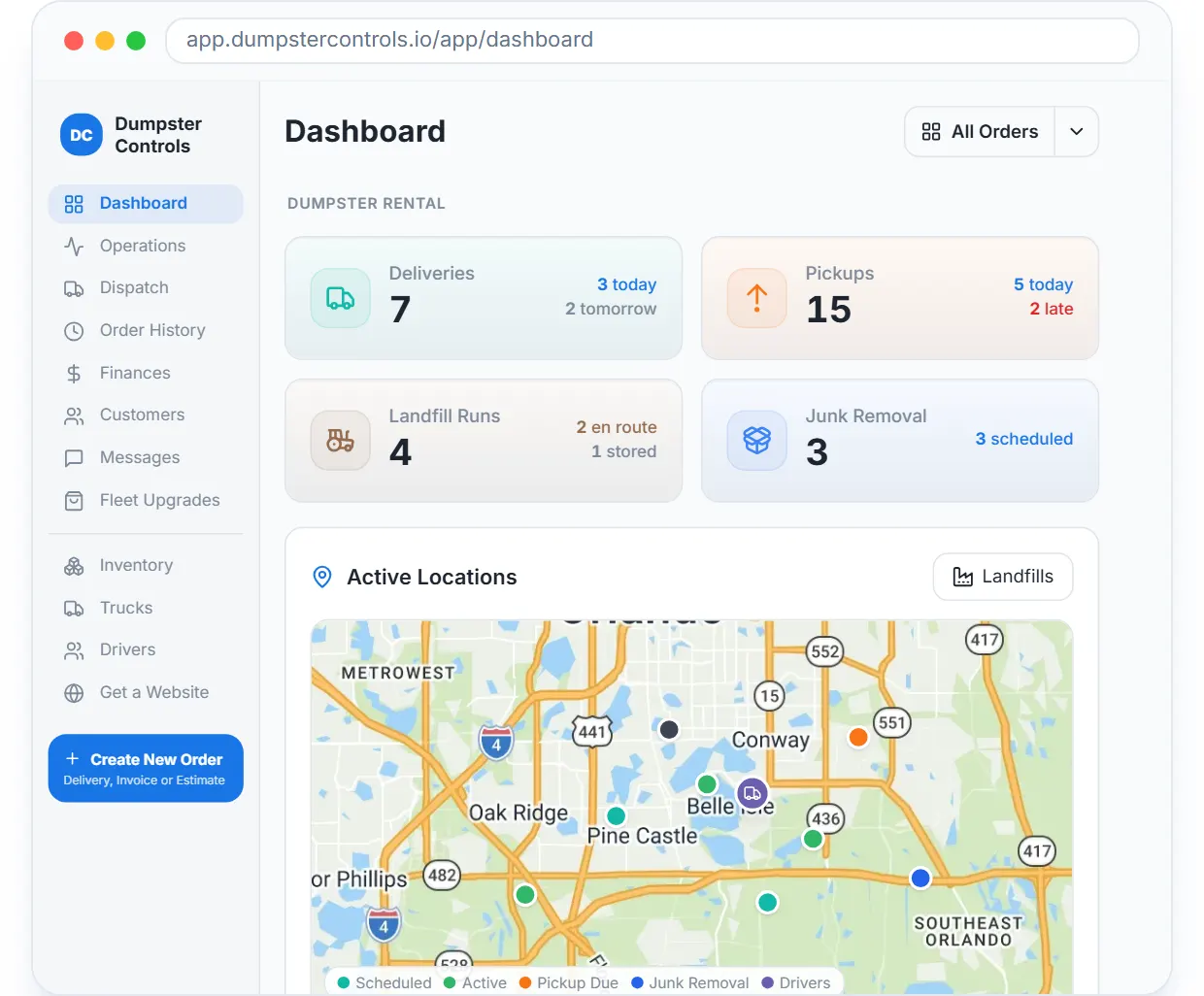
The command center in Dumpster Controls: KPIs, live fleet map, drivers and revenue, sample data. This is the screen a second dispatcher inherits.
The four growth stages of a dumpster rental company
Most companies pass through the same stages in the same order. Knowing which one you are in tells you which investment pays back first.
- Startup
Roughly 5 to 15 containers. The owner sells, dispatches, drives, invoices and answers the phone. The goal is a customer base and a feel for local demand; the tools are calls, texts and a spreadsheet.
- Early growth
The first wall. Missed calls, double-booked cans and invoicing errors show up as orders climb. This is when most companies adopt their first roll-off management software.
- Operational maturity
Dedicated people for dispatch, customer service and billing. Truck maintenance becomes a real line item. Dispatch optimization and utilization tracking stop being optional.
- Regional scale
Several yards, several dispatch teams and consolidated reporting. Groups and franchises use the paid Enterprise plan, set up for the structure of the group; see multi-yard dumpster software.
Fleet strategy: which sizes, and when to add cans
Fleet composition sets your addressable market, your turn rate and your margins. Start with two or three core sizes and add specialty sizes when demand, not enthusiasm, justifies the capital.
10 yard
Residential cleanouts and small renovations. Turns fast, earns less per rental.
15 yard
Serves both residential and light commercial jobs. A good balance of demand and revenue.
20 yard
The size most haulers list first: contractors and renovation projects ask for it by name.
30 yard
Commercial construction and larger demolition. More revenue per rental, slower turns.
40 yard
Large commercial projects. High capital cost, premium pricing, the slowest turns.
Before you buy more
Check utilization by size first. If cans are sitting below the healthy range in the utilization guide, more inventory will not solve a demand problem.
Dispatch at scale: the wall every hauler hits
Dispatch is the bottleneck that caps most haulers. A single dispatcher with a phone and a notepad can hold one day in their head; the day a second person needs the same picture, the notepad fails.
Before
- Orders taken by phone and written on whatever is nearby.
- The owner is the only person who knows where every can is.
- A driver calls the office at every stop for the next address.
After
- Orders land on one board, from the phone, the website and the chat.
- Every can has a serial and a status anyone in the office can read.
- The driver sees the whole day in the app and dispatch sees the truck on the map.
The specific plays, zone routing, clustering and landfill-centric sequencing, are in how to optimize dumpster dispatch routes. The tooling is on the dumpster dispatch software page.
Online booking: the sales channel that scales without hiring
A phone line only takes one order at a time and none after hours. A booking widget on your website takes size, dates, placement and card in one flow, and the order lands on the dispatch board with the payment already collected.
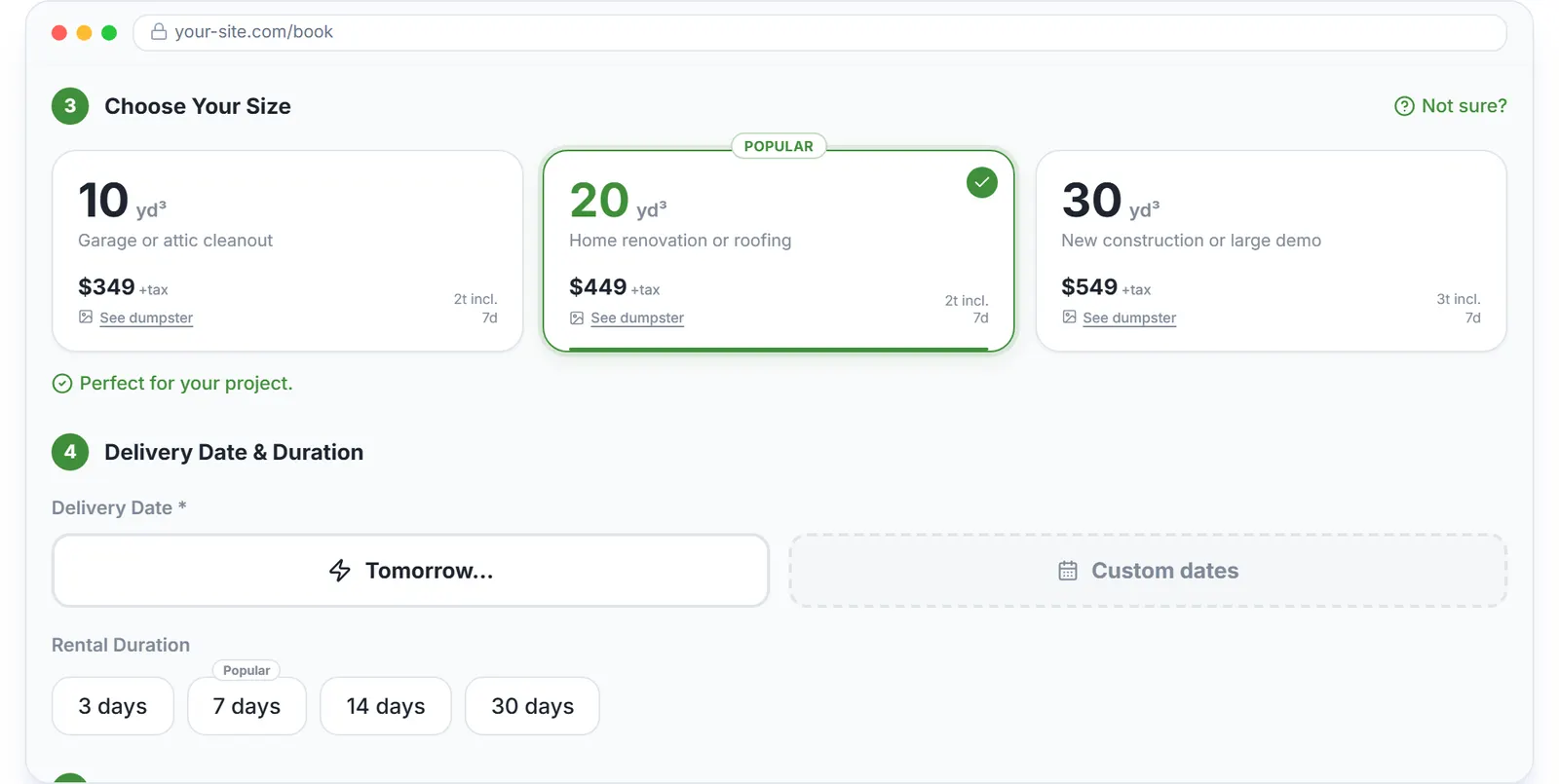
The booking widget embedded on a company website, sample data. Live prices from your account, Stripe checkout, rental agreement included.
Setup walkthrough: how to handle online bookings for a dumpster rental business. The widget itself is covered on the dumpster booking software page.
Pricing for growth, and what the software should cost
Pricing is a growth lever and a risk at the same time. Too low buys volume and burns margin; too high hands the market to whoever answers the phone next.
Price from your real costs
Start from the tipping fee you actually pay, your fuel and your container depreciation, then look at what nearby companies publish. The market data index reads real price pages every month; the landfill database has the gate fees.
Make overage rules explicit
Weight limits, extra days and contamination fees belong on the size, in advance. The app applies them with card on file, and the customer saw them at booking.
Watch profit per order, not revenue
Orders P&L in Finances shows price minus landfill, fuel and driver cost per job. It is the number that tells you which customers to keep.
Do not let software scale your bill
Per-driver and per-container pricing turn a good year into a bigger invoice. Compare pricing models and the full vendor list on dumpster rental software cost.
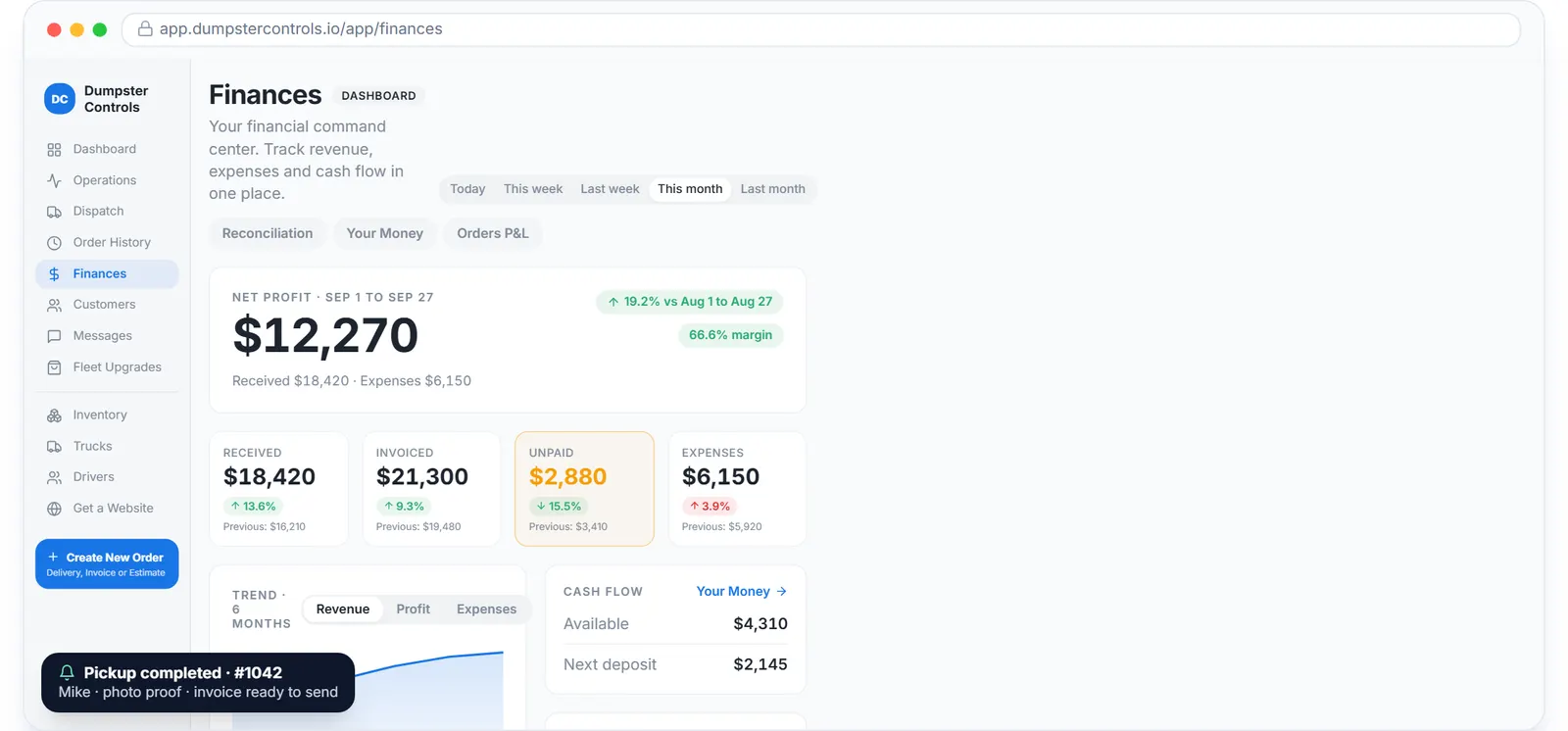
Revenue over time in Dumpster Controls, sample data. Received, invoiced and expenses on one chart.
Hiring order for a dumpster company
The order you hire in decides how fast you can grow. Most successful operators follow the same sequence, because each hire frees the owner for the next constraint.
- First driver
Frees the owner from daily hauling to focus on sales and operations.
- Second driver
Makes same-day service and a wider area possible.
- Dispatcher or coordinator
Owns the board, the customer calls and the invoicing. The hire that stops the owner dispatching from the cab.
- More drivers
Added one at a time as order volume supports them, never ahead of it.
- Sales or marketing
When the operation can absorb more work than the phone brings in on its own.
Team roles in the app
Owner, dispatcher, office and driver roles ship on the free plan with unlimited users. See dumpster customer management software for the office side.
Dumpster business software as a growth multiplier
Software does not create growth, but it removes the barriers that stop it. The point is to grow orders without growing the number of things only the owner knows.
One order system
Phone, website and chat orders land on the same board, replacing the text-message thread as the system of record.
Route suggestions
AI Routes sequences a driver's stops around the roll-off cycle; you preview and apply, or undo.
Invoicing with Stripe
Invoices with a payment link, card on file for extras and automatic reminders shorten the gap between the job and the deposit.
The Dumpster Net Hub
Overflow you cannot serve goes to a nearby hauler instead of a competitor; slack capacity takes their overflow. No listing fee, no percentage cut.
Serialized inventory
Every can with a serial and a status, so a new dispatcher knows where the fleet is on their first morning.
Tresha
Create an order or complete a landfill run by voice from the truck, behind a confirmation card. See Tresha AI.
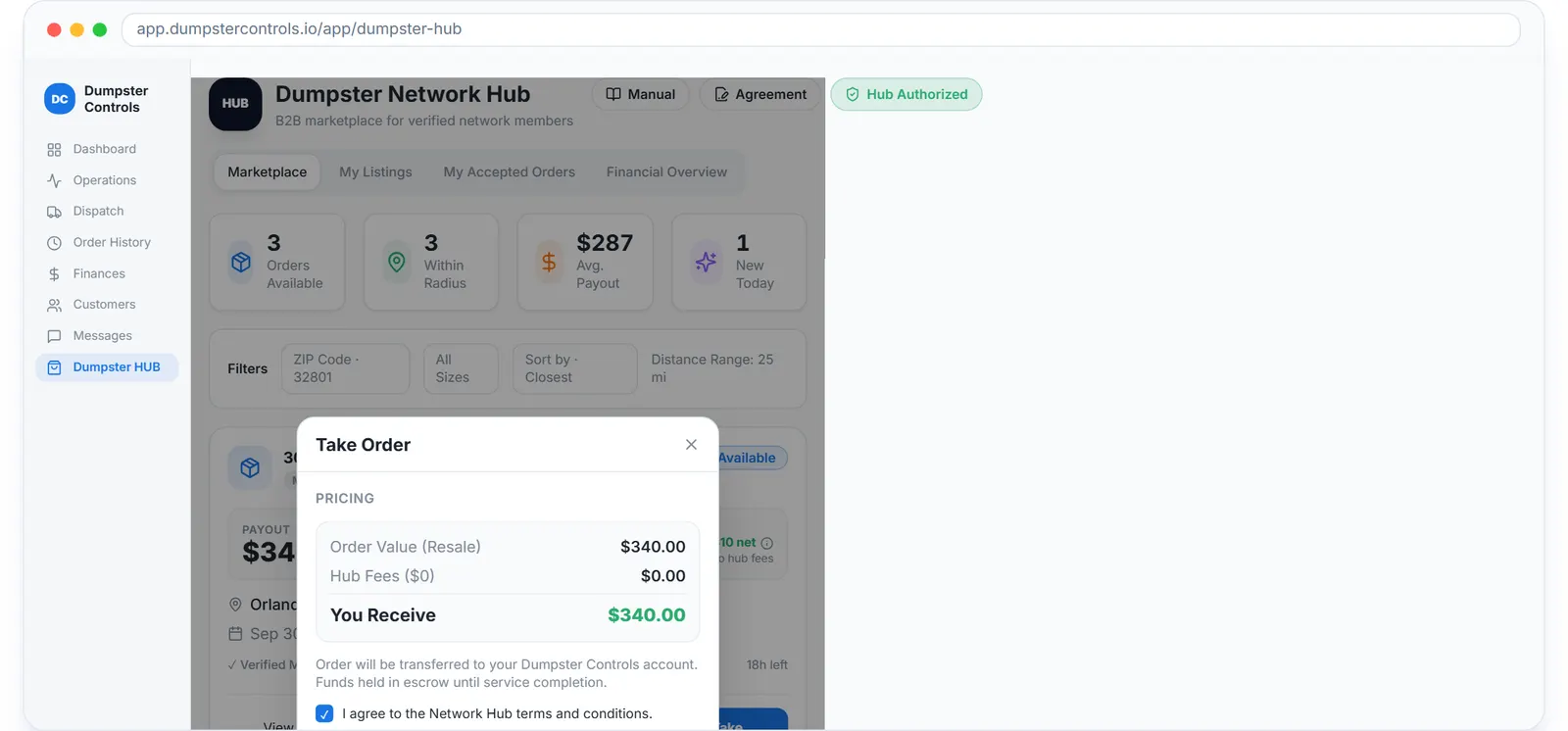
A job listed on the Hub with its price and distance, sample data. The completing hauler receives the full asking amount.
The companies that scale are not the ones with the most cans. They are the ones where a Tuesday runs the same whether or not the owner is in the building.
Common scaling mistakes
Growing the fleet before demand
Cans bought while utilization is low tie up capital and earn nothing. Raise the turn rate first.
Hiring too late
Waiting until the owner is drowning means dropped orders and lost customers before the hire lands.
Ignoring the numbers
Without profit per order, utilization and stops per driver, growth decisions are guesses with a truck payment attached.
Competing on price alone
Someone will always go lower. Compete on reliability, speed and the ease of booking instead.
Avoiding technology
A manual process that works at the FAQ's threshold of orders per month collapses a few multiples above it.
Paying per driver for software
A software bill that grows when you hire punishes the exact thing you are trying to do.
What to measure every month
Order volume trend
Month over month growth in orders, kept private and used internally.
Fleet utilization
Deployed cans over total cans, by size.
Gross margin per order
Revenue minus landfill, fuel and driver time, from Orders P&L.
Customer acquisition cost
Marketing and sales spend divided by new customers.
Turn rate by size
How often each size completes a full rental cycle.
Stops per driver per day
The dispatch productivity number, from the routes guide.
The one-truck version of this framework is on dumpster rental software for small business.
Frequently asked questions
How many dumpsters do I need to start a rental business?
Most operators start with 5 to 15 containers. The optimal starting size depends on your local market demand, available capital, and whether you plan to subcontract hauling or own your own trucks.
What is the biggest obstacle to scaling a dumpster business?
The most common scaling obstacle is dispatch and scheduling complexity. As order volume grows, manual coordination becomes unsustainable without dedicated software.
When should I invest in dumpster rental software?
Most operators benefit from software once they exceed 20-30 orders per month. At that point, manual tracking typically causes missed orders and scheduling conflicts.
How do I expand my service area?
Service area expansion involves adding drivers, securing landfill relationships in new regions, and adjusting pricing for longer haul distances. Software with route optimization helps manage the complexity.
Should I specialize in certain dumpster sizes?
Specialization can improve fleet utilization and simplify operations. Many successful operators start with 2-3 core sizes and add specialty sizes only when demand justifies the investment.