Business Guide
How to Start a Dump Trailer Rental Business
A pickup, a dump trailer and a place to dump. Trailer sizes and weight ratings, when a CDL or a USDOT number applies, real dump fees, and the math of one rental.
By Daniel Teixeira Founder, Dumpster ControlsUpdated November 15, 2026 18 min read
To start a dump trailer rental business you need a pickup rated to pull the loaded trailer, a dump trailer, commercial insurance and a place to dump. A tandem-axle trailer such as the Big Tex 14LP-14 is rated 14,000 lb and carries 9,820 lb. The weight ratings of the truck and the trailer decide whether you need a USDOT number or a CDL, and the dump fee, a US median of $55 per ton (Dumpster Controls Market Data, November 2026), comes out of every load.
Going bigger? If you plan to buy a roll-off truck and steel containers, read how to start a dumpster rental business. It covers cable hoists, hooklifts and container fleets. This page is for starting with a trailer.
What does it take to start a dump trailer rental business?
- A tow vehicle that is rated for it. The ratings on the door plate, not what the truck "can pull".
- A trailer sized to that truck. The trailer's GVWR sets your license and registration rules.
- Commercial insurance. For the truck, the trailer and the driveway you park it on.
- A dump you know. The fee per ton, the minimum charge and the hours.
- A way to be found and booked. A Google Business Profile and a page that takes the order.
A trailer start fits you if
- You already own a three-quarter-ton or one-ton pickup and tow with confidence.
- You want to test demand in your town before borrowing for a hoist truck.
- Your customers are homeowners, roofers and small remodelers with driveway jobs.
Think twice if
- You would need to buy the pickup too. Then compare the total with a small hooklift truck.
- Your market is concrete, dirt and demolition. Those loads pass a trailer's payload fast.
- You want many units out at once. Every trailer you drop needs the truck to move it.
Which dump trailer business are you starting?
"Dump trailer rental" means three different businesses. They share the trailer and little else, so decide which one you are opening before you call an insurance agent.
Model 1
Delivered, like a dumpster
You drop the trailer in the driveway, the customer fills it for a few days, you pull it and dump it. You compete with 10 to 15 yard roll-off dumpsters. This guide is mostly about this model.
Model 2
The customer tows it
Equipment rental. The customer hooks your trailer to their own truck and brings it back. You need a rental agreement, a deposit policy and insurance written for rented equipment.
Model 3
You load and haul
A hauling or junk removal service priced by the load. The trailer is your tool, not the product. Labor is the main cost.
Which dump trailer should you buy? Sizes and GVWR
A dump trailer is sold by bed size (width by length, in feet) and by GVWR, the most the trailer may weigh loaded. Subtract the empty weight and you have the cargo capacity. These are published figures for one manufacturer's line, to show how the numbers move.
| Model | GVWR | Empty weight | Cargo capacity | Bed and sides | Volume to the top of the sides |
|---|---|---|---|---|---|
| Big Tex 70SR-10 | 7,000 lb | 1,730 lb | 5,270 lb | 10 ft x 60 in, 20 in sides | 3.1 cubic yards |
| Big Tex 10LX-12 | 9,990 lb | 3,230 lb | 6,760 lb | 12 ft x 83 in, 24 in sides | 6.1 cubic yards |
| Big Tex 14LP-12 | 14,000 lb | 3,870 lb | 10,130 lb | 12 ft x 83 in, 24 in sides | 6.1 cubic yards |
| Big Tex 14LP-14 | 14,000 lb | 4,180 lb | 9,820 lb | 14 ft x 83 in, 24 in sides | 7.2 cubic yards |
| Big Tex 14LP-16 | 14,000 lb | 4,250 lb | 9,750 lb | 16 ft x 83 in, 24 in sides | 8.2 cubic yards |
Weights and bed sizes as published by Big Tex Trailers, read November 15, 2026. Volume is our arithmetic (length times width times side height); Big Tex does not publish it. Taller sides are an option on the 14LP: 4 ft sides double the volume, not the cargo capacity.
What the table says. The 14,000 lb trailers carry about five tons. With standard 24 inch sides, a 14 foot bed holds 7.2 cubic yards, and with the optional 4 foot sides about 14.3, close to a 15 yard dumpster.
Light, bulky debris fills the box first. Heavy debris reaches the weight limit first.
Roll-off dump trailers. A roll-off trailer carries a removable bin, so you can leave the bin at one job and keep the trailer working. The Big Tex 14RB is rated 14,000 lb (Big Tex Trailers), and the PJ Roll-Off Dump is rated 15,400 lb with 13.2 cubic yard bins (PJ Trailers).
It is the closest a pickup gets to a roll-off truck. The bins are extra, and the 15,400 lb rating changes the license sum below.
In practice: Buy the second trailer when the first is booked and you are turning people away, not before. One truck can only deliver, pull and dump so many trailers in a day.
What truck do you need to pull a dump trailer?
Three ratings on the pickup matter, and all three are on the door plate or in the manufacturer's towing guide: the GVWR (the most the truck itself may weigh), the GCWR (the most the truck and trailer may weigh together) and the hitch or receiver rating. The loaded trailer has to fit inside all three.
As an example of how wide the range is inside one model line, Ford lists 2026 F-250 single rear wheel pickups from 10,000 to 11,400 lb GVWR, F-350 single rear wheel diesel crew cabs from 11,499 to 12,400 lb depending on tires, and dual rear wheel pickups at 14,000 lb (Ford). Ford's towing guide states that the combined weight of truck and trailer cannot exceed the listed GCWR (Ford).
Look up your own truck by cab, engine, axle and tires. Other brands publish the same kind of table.
Read it: The mistake to avoid is a trailer rated heavier than the truck is rated to tow. Before you buy, ask your insurance agent in writing what happens to a claim when the combination is over the truck's ratings.
Do you need a CDL or a USDOT number for a dump trailer?
This is general information, not legal advice. The federal rules below apply in the United States, your state enforces them and can add its own, so confirm with your state's CDL office.
The CDL line. A Group A commercial driver's license (a Class A CDL) is required for a combination rated 26,001 lb or more when the trailer is rated over 10,000 lb (49 CFR 383.91).
The combined rating is the greater of a GCWR shown on the truck's federal certification label, if it shows one, and the sum of the two GVWRs, or the actual combined weight when it is higher (49 CFR 383.5). Do the sum first, then check your state: some, such as California, require a Class A to tow any trailer rated over 10,000 lb (California DMV).
| Pickup (2026 Ford, published GVWR) | Trailer | Sum of the two ratings | Against the 26,001 lb line |
|---|---|---|---|
| F-250 4x4 Crew Cab diesel: 11,200 lb | 14,000 lb trailer | 25,200 lb | Under the federal line |
| F-350 single rear wheel, 18 in all-season tires: 12,000 lb | 14,000 lb trailer | 26,000 lb | Under the federal line, by one pound |
| F-350 single rear wheel, 18 in all-terrain or 20 in tires: 12,400 lb | 14,000 lb trailer | 26,400 lb | Over. Group A CDL |
| F-350 dual rear wheel: 14,000 lb | 14,000 lb trailer | 28,000 lb | Over. Group A CDL |
| F-250 4x4 Crew Cab diesel: 11,200 lb | 9,990 lb trailer | 21,190 lb | Trailer is not over 10,000 lb. No Group A for weight |
Truck ratings from Ford's 2026 Super Duty specifications. The sums are our arithmetic. Federal line only, and it assumes the truck label lists no higher GCWR and neither is overloaded. Some states, such as California, require a Class A for any trailer rated over 10,000 lb.
The USDOT line is much lower. A truck and trailer rated or weighing 10,001 lb or more together, used in interstate commerce, is a commercial motor vehicle (49 CFR 390.5). The company needs a USDOT number (FMCSA) and the driver needs a medical certificate (49 CFR 391.41).
FMCSA notes that some states require a USDOT number for carriers that never leave the state. Nearly every pickup with a dump trailer is past 10,001 lb combined, so this is the rule most trailer operators meet first.
Fuel tax. A combination over 26,000 lb that runs in two or more member jurisdictions is a qualified motor vehicle under the IFTA agreement. If you work a metro that straddles a state line, ask your state's motor carrier office.
What can a dump trailer haul, and what can it not?
Weight before volume. The cargo capacity in the table above is the limit, and it is the whole load: debris, tarp, anything left in the bed. Household junk, wood, drywall offcuts and green waste usually fill the box before they reach it.
Concrete, brick, dirt, tile, plaster and roofing shingles reach it with the bed half empty. Weigh your first loads of each kind at the dump and write the numbers down.
What the dump refuses. Each facility has its own list, and disposal is overseen by the states (EPA). Ask before you accept a job with tires, mattresses, appliances with refrigerant, paint, liquids or anything hazardous, and put the list in your rental terms so the customer knows.
Cover and secure the load. Federal rules require that cargo cannot leak, spill, blow or fall from the vehicle (49 CFR 393.100), and many states add a tarp law. A tarp over every load is cheaper than one ticket.
How should you price: by the rental or by the load?
Delivered trailer
Flat rental
One price that includes delivery, a set number of days, pickup and a weight allowance. Extra days and extra tons are billed on top. This is how dumpsters are sold, and homeowners understand it.
Customer tows
By the day
A daily rate for the trailer alone. The customer pays the dump directly, or you bill the scale ticket after the return.
You haul
By the load
One price per load that covers your time, the drive and the dump fee, with a surcharge for heavy material.
Whichever you choose, the customer who rents a delivered trailer is comparing you with the roll-off companies in town. These are the prices they advertise, by state, for the sizes a dump trailer competes with.
Dumpster Controls Market Data, November 2026 edition Advertised dumpster rental prices, by size and by state
10 yard, United States$350 median of 399 advertised prices, from $150 to $950
15 yard, United States$380 median of 590 advertised prices, from $150 to $970
20 yard, United States$449 median of 732 advertised prices, from $175 to $990
| State | 10 yard median | 15 yard median | 20 yard median | 20 yard range | 20 yard prices |
|---|---|---|---|---|---|
| Florida | $350 | $398 | $450 | $189 to $750 | 66 |
| Texas | $367 | $380 | $450 | $199 to $670 | 44 |
| Michigan | $365 | $375 | $450 | $340 to $975 | 40 |
| Ohio | $320 | $350 | $400 | $319 to $720 | 38 |
| Indiana | $340 | $375 | $440 | $335 to $600 | 34 |
| Pennsylvania | $395 | $450 | $525 | $335 to $660 | 28 |
| Tennessee | $350 | $377 | $450 | $299 to $625 | 28 |
| Georgia | $350 | $375 | $425 | $275 to $550 | 27 |
| North Carolina | $319 | $350 | $415 | $275 to $495 | 25 |
| Illinois | $377 | $385 | $450 | $350 to $550 | 23 |
| Massachusetts | $490 | $597 | $700 | $610 to $895 | 23 |
| Kentucky | $300 | $377 | $450 | $350 to $550 | 22 |
| Missouri | $340 | $325 | $395 | $325 to $450 | 19 |
| New York | $430 | $513 | $600 | $350 to $850 | 19 |
| California | $339 | $390 | $467 | $365 to $795 | 18 |
| Arizona | $379 | $377 | $375 | $179 to $599 | 17 |
| Colorado | $337 | $375 | $400 | $220 to $625 | 16 |
| Wisconsin | $350 | $435 | $450 | $299 to $645 | 15 |
| Iowa | $295 | $310 | $345 | $220 to $439 | 14 |
| South Carolina | $350 | $350 | $437 | $295 to $550 | 14 |
| Kansas | too few | $325 | $355 | $175 to $500 | 13 |
| Louisiana | $388 | $388 | $425 | $325 to $550 | 13 |
| Virginia | $397 | $400 | $465 | $350 to $575 | 13 |
| Alabama | $347 | $350 | $375 | $325 to $425 | 11 |
| Arkansas | too few | $350 | $420 | $300 to $515 | 11 |
| Maryland | $425 | $450 | $525 | $365 to $650 | 11 |
| Minnesota | $400 | $469 | $515 | $400 to $630 | 11 |
| Mississippi | $349 | $399 | $450 | $375 to $600 | 11 |
| Connecticut | $392 | $468 | $590 | $505 to $675 | 10 |
| Nebraska | too few | $260 | $273 | $200 to $340 | 10 |
| New Jersey | $435 | $525 | $600 | $525 to $690 | 10 |
| Utah | too few | $265 | $318 | $249 to $425 | 10 |
Source: Dumpster Controls Market Data, November 2026. Advertised base prices read from the websites of 894 US rental companies on November 14, 2026. They are asking prices, not prices paid. A state is listed with at least 10 advertised 20 yard prices, and a size shows for a state with at least 4 prices there. How the data is collected.
A trailer does not have to match those prices. It holds less than a 20 yard container and usually a little less than a 15. It also reaches driveways and alleys where a roll-off truck is too heavy or too long, and some customers pay for that.
The dumpster rental pricing guide explains weight allowances and extra-day pricing.
What will the dump charge you?
The landfill or transfer station weighs you in and out and charges by the ton, usually with a minimum charge. Small loads feel the minimum most, so ask for it by name. You pay the fee on every rental, which makes it the cost to know before you set a price.
Dumpster Controls Market Data, November 2026 edition Landfill tipping fees per ton, checked against the operator's own rate sheet
Median fee, United States$55 per ton 638 facilities with a verified rate per ton
Lowest and highest verified $10 to $521 per ton, same 638 facilities
Facilities in the Landfill Finder 1,697 active landfills and transfer stations, counted November 23, 2026
| State | Median per ton | Lowest to highest | Verified facilities |
|---|---|---|---|
| Landfills in California | $69.35 | $29.52 to $226.50 | 59 |
| Landfills in Texas | $47 | $25 to $99.93 | 24 |
| Landfills in Georgia | $47 | $22.50 to $85 | 21 |
| Landfills in North Carolina | $50.58 | $28.08 to $122.66 | 53 |
| Landfills in Florida | $53.90 | $25 to $130 | 35 |
| Landfills in Tennessee | $60 | $28 to $100 | 19 |
| Landfills in Kansas | $48 | $25 to $61 | 16 |
| Landfills in Pennsylvania | $100 | $55 to $120 | 9 |
| Landfills in Michigan | $61 | $37 to $98 | 8 |
| Landfills in Virginia | $55 | $34 to $98 | 29 |
Find the landfills near youTipping fee ranges for every state
Source: Dumpster Controls Market Data, November 2026, rates verified August 23, 2026 to September 29, 2026. A facility counts only when its published rate per ton was checked against the operator's own source. The ten states are the ones with the most facilities in our Landfill Finder. Fees change: confirm at the gate before you quote. About the landfill data.
How much do you keep on one dump trailer rental?
What a rental leaves = price, minus (tons times dump fee), minus fuel, minus your time.
The example uses the 15 yard dumpster price as the reference a delivered trailer competes with. Put your own price in the calculator.
Example, not a promise: one 15 yard rental at the US median advertised price
| If the load weighs | Rental price | Disposal at $55 per ton | Left before fuel and driver time |
|---|---|---|---|
| 1 ton | $380 | $55 | $325 |
| 2 tons | $380 | $110 | $270 |
| 3 tons | $380 | $165 | $215 |
Price: median of 590 advertised 15 yard prices. Fee: median of 638 verified landfill rates. Both from Dumpster Controls Market Data, November 2026. The weights are scenarios, not averages: your scale tickets tell you the real one.
A trailer rental has one cost a roll-off company does not feel as much: your pickup is the delivery truck, so every drop, pull and dump run is time the truck is not doing anything else. Count the hours honestly.
How much does it cost to start a dump trailer rental business?
We do not print trailer or insurance prices because we could not source figures you could rely on. They change with size, brand, steel prices, region and your driving record. The list is short, and every line can be priced with a phone call.
| Line | What we can tell you | How to get your real number |
|---|---|---|
| Dump trailer | The main purchase. Price follows GVWR, length and options such as taller sides | Quotes from two dealers for the same GVWR and length, and used listings to compare |
| Tow vehicle | Nothing, if yours is rated for the loaded trailer | Your door plate against the trailer's GVWR |
| Insurance | A monthly bill from day one | An independent agent who insures trailers used for hire |
| Company and tax ID | The EIN is free from the IRS. State fees vary | Your Secretary of State's fee page |
| Registration and plate | Each trailer is registered in your state | Your state DMV's fee table, by trailer weight |
| Dump fee | Median verified fee: $55 per ton (Dumpster Controls Market Data, November 2026) | The rate sheet of your nearest facility |
| Software | $0 per month on Dumpster Controls. Card processing applies only when a customer pays by card | The pricing page |
No trailer, truck or insurance prices on purpose.
What insurance and local rules apply?
General information again: your agent and your city decide the details.
Insurance. Tell the agent exactly which of the three models you run. A delivered trailer needs commercial auto that names the trailer and general liability for the property it sits on.
A trailer the customer tows needs coverage written for rented equipment and a signed rental agreement. Ask each carrier in writing whether the trailer is covered while it is unhooked in a customer's driveway.
The company. Form the business before the first rental (SBA) and get the free EIN from the IRS.
The street. A trailer left on a public street is treated like a dumpster in many cities and needs a permit. Ask the city's public works office.
A trailer in a private driveway usually does not, but homeowner associations have their own rules.
How do you get the first dump trailer customers?
Google Business Profile. Google offers it at no charge. You serve customers at their address, so remove your street address and list the towns you cover, up to 20 service areas (Google's service area rules).
Ask for a review after every pickup.
The people who fill trailers. Roofers, remodelers, landscapers, house flippers and property managers. A roofer with steady work can keep a trailer moving most weeks.
Visit them with a card that shows your size, your price and your phone.
A page that takes the order. With the size, the price, the dates and card payment. Paying at booking also filters out the people who never show.
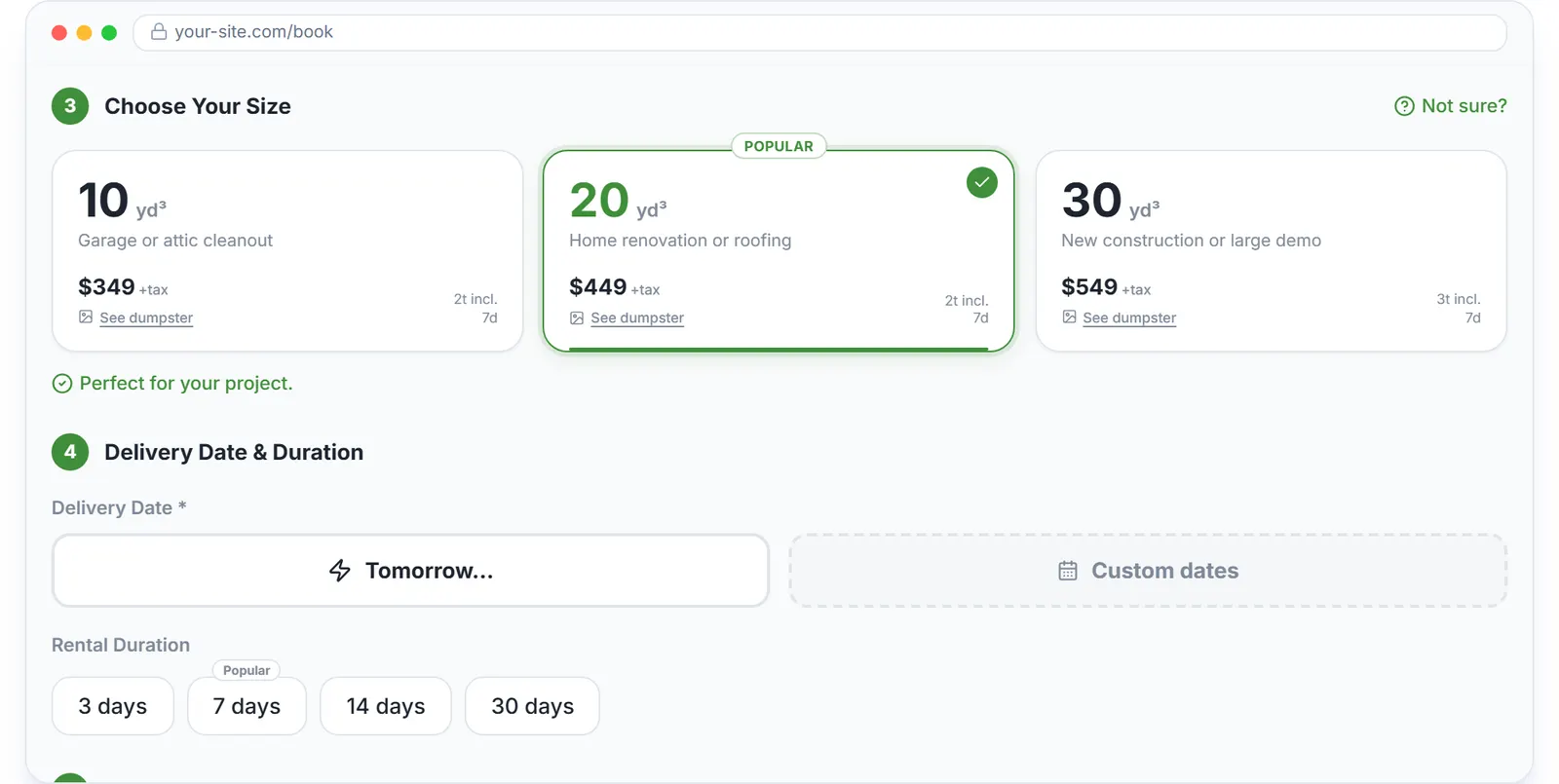
Sizes with live prices on the booking page. You set the sizes, so a dump trailer is one of them. Real Dumpster Controls screen, sample data.
Our public directory. Dumpster Controls runs a public directory of rental companies. Here is what it offers and what it does not.
Free plan
A verified profile
A company on Dumpster Controls can have a verified profile in our public directory, on the free plan too: a Verified badge, your sizes, prices and phone, and a followed link to your own website.
Free plan
Book Online on the profile
Turn on online booking in your account and the profile gets a Book Online button. No per-order software fee. When a customer pays by card, processing on the free plan is 2.99% + $3.99 per transaction.
$169/mo plan
Sponsored in your area
A claimed profile goes to the top of the list with a Sponsored badge for customers searching within 30 miles. It buys visibility: the website link on a Sponsored profile is marked as paid placement. The same plan lowers the card rate to 2.99% + $0.30.
Already listed? We list 1,332 companies across 50 states and Canada (counted November 23, 2026). Sign up free and claim the profile with a code we text to the public phone number on it. Not listed yet? Request your page from inside the app once you have 5 completed deliveries and an order in the last 60 days. Our team reviews the first pages requested this way before they go live. A profile puts you where people are looking. It does not guarantee bookings.
See the directoryPlans and card rates
What software do you need?
With two trailers you can keep it in your head. With five you need to know which trailer is at which address, which one is due back today, who has paid and what each job left after the dump fee.
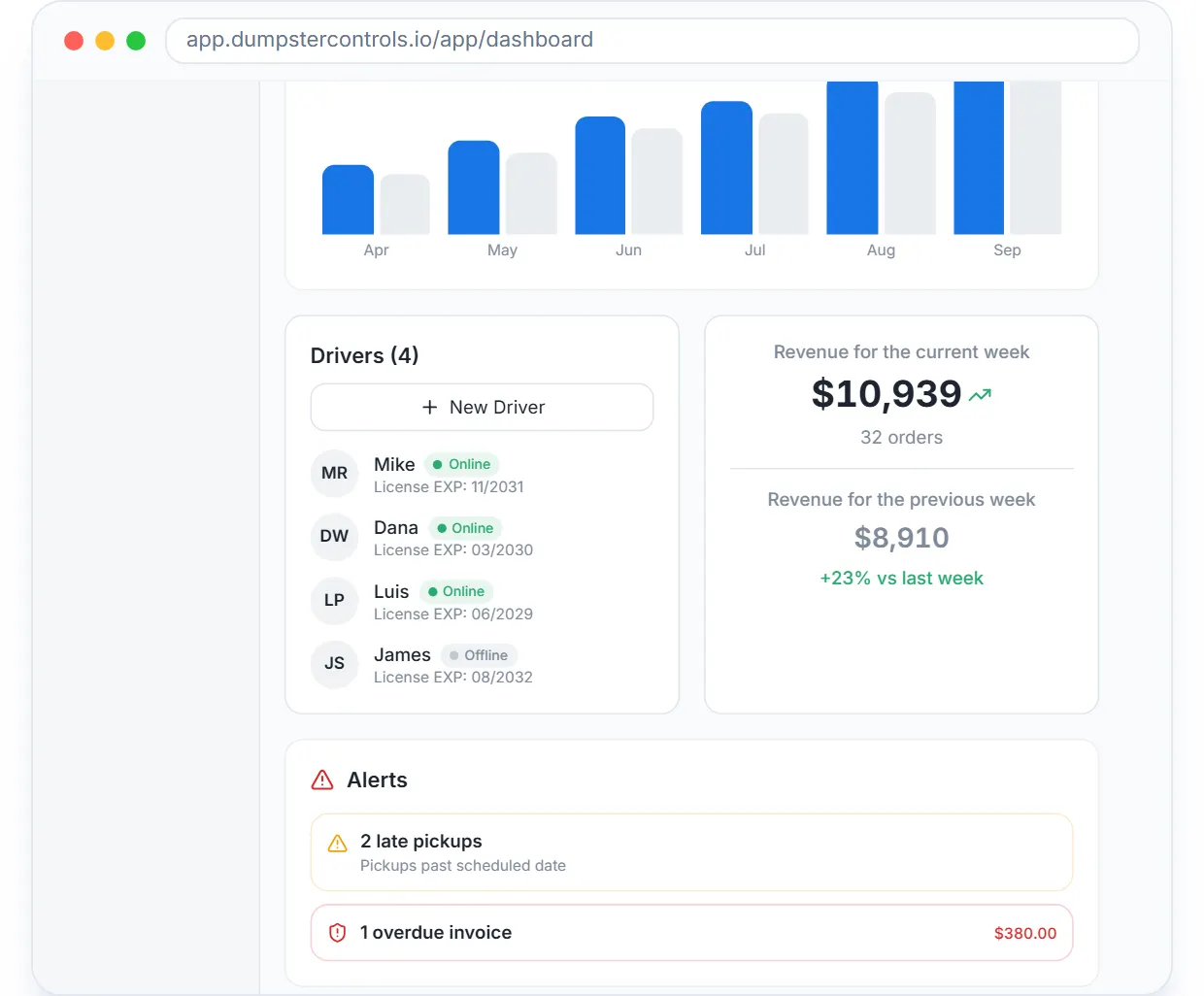
The dashboard: what the week earned, who is driving and what needs attention. Real Dumpster Controls screen, sample data.
Dumpster Controls runs dump trailers and roll-off dumpsters on the same board, with no monthly fee: online booking, a dispatch board, a driver app with photos at drop-off and pickup, invoicing and the dump fee on each order. There is a page on dump trailer rental software, and it is the same dumpster rental software the roll-off companies use, explained in the dumpster rental software guide.
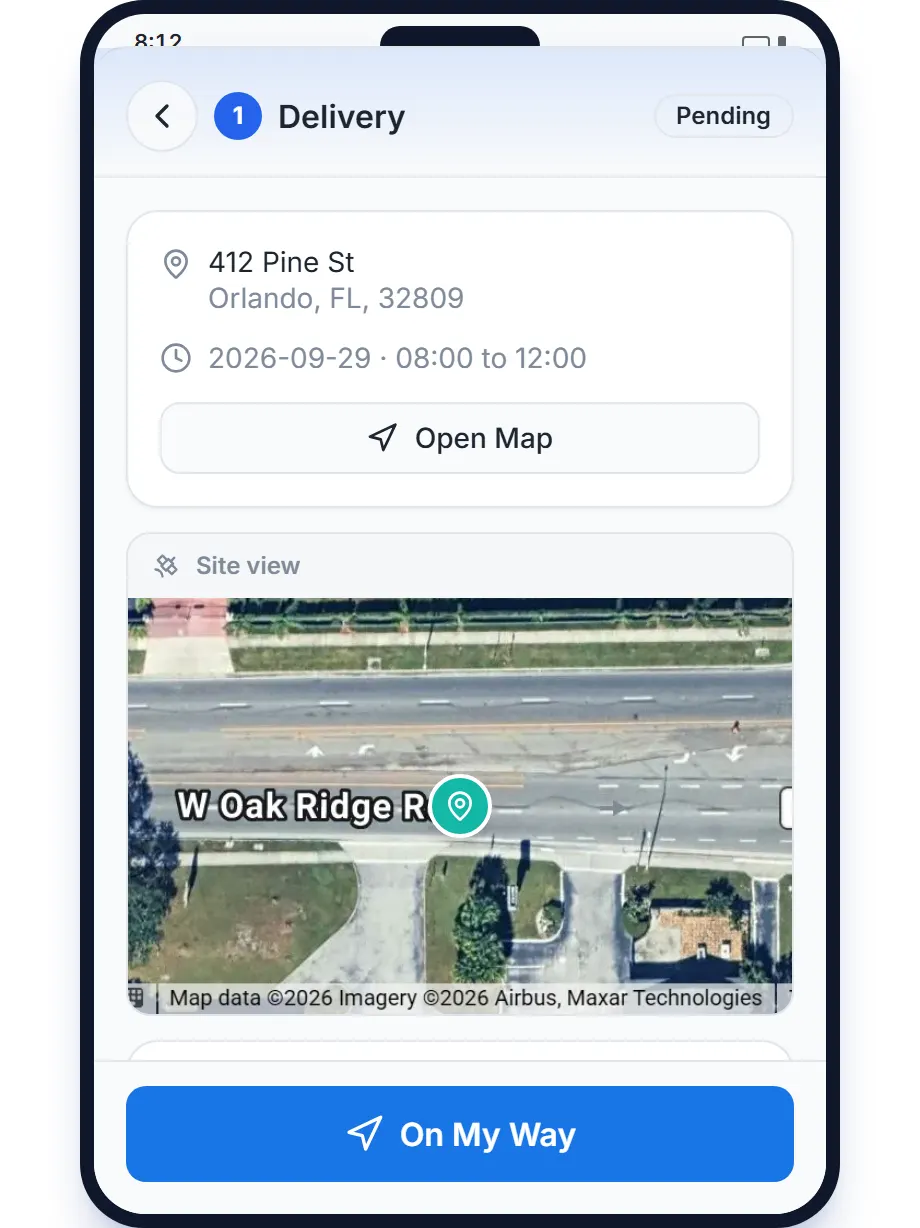
The driver app: the stop, the map and the photo step. A photo of the trailer in the driveway settles most disputes. Real screen, sample data.
What it costs. The software is free for any fleet size. If customers pay by card through it, card processing is 2.99% + $3.99 per transaction on the free plan, or 2.99% + $0.30 on the optional $169/mo plan.
See the pricing page.
When should you move up to a roll-off truck?
The trailer business teaches you the trade with the least money at risk. It also has a ceiling: every trailer on rent is waiting for your one pickup, and a trailer carries a fraction of what a roll-off container does.
1
More trailers
The first step, when the ones you have are booked most of the month.
2
A roll-off trailer and bins
Drop a bin, keep the trailer moving. Check the rating: a 15,400 lb trailer changes the license sum.
3
A small hooklift truck
Purpose-built, with its own containers. Some stay under 26,001 lb GVWR.
4
A cable hoist roll-off truck
For 30 and 40 yard containers and construction work. A CDL truck.
The signs it is time: customers ask for sizes you cannot offer, contractors want a swap the same day, and you turn down heavy loads every week. The trucks, hoists and containers are explained in how to start a dumpster rental business, and growing past one truck in how to scale a dumpster rental business.
What changes in Canada?
General information: confirm with your province. Weights are in kilograms and the trailer changes your licence class sooner than in the United States. In Ontario a Class G licence covers a towed vehicle up to 4,600 kg, and Class A is needed when the towed vehicle exceeds a total gross weight of 4,600 kg (Ontario truck handbook).
A trailer loaded to a 14,000 lb rating weighs about 6,350 kg, which is over that line. A 9,990 lb trailer loaded to its rating is about 4,531 kg, under it.
Ontario also requires a CVOR for trucks with a registered gross weight or actual weight over 4,500 kg (Ontario: CVOR), and carriers that cross a provincial or US border fall under the National Safety Code above 4,500 kg registered gross vehicle weight (Justice Laws); each province sets its own line for trucks that stay inside it. In Ontario and much of Canada customers search for a "bin rental", and cities set their own street rules: Toronto requires a Street Occupation Permit for a disposal bin in the roadway (City of Toronto).
Dumpster Controls works in Canada in Canadian dollars. More in dumpster rental software for Canada.
If you remember four things
- Add the truck's GVWR and the trailer's GVWR before you buy either. 26,001 lb is the federal CDL line and 10,001 lb is the USDOT line; some states, such as California, draw the trailer line lower.
- Cargo capacity, not box size, is what a trailer can haul.
- Decide which business you run: delivered, customer-towed or hauling. The insurance is different for each.
- Know the dump fee before you set a price. The US median is $55 per ton (Dumpster Controls Market Data, November 2026).
Questions people ask before starting a dump trailer rental business
How much does it cost to start a dump trailer rental business?
Less than a roll-off start, because there is no hoist truck, but there is no honest single number. The lines are the trailer, a pickup rated to tow it if you do not own one, commercial insurance, registration and a small marketing budget. Trailer and insurance prices move with size, brand, region and your driving record, so get written quotes and add them up in the worksheet on this page.
Is a dump trailer rental business profitable?
It depends on how many days a month each trailer is out and what the dump charges. Roll-off companies advertise a 15 yard dumpster at a US median of $380, which is the price a delivered dump trailer competes with, and the median verified landfill fee is $55 per ton (Dumpster Controls Market Data, November 2026). A 2 ton load at those numbers leaves $270 before fuel, your time and insurance. Nobody can promise you the bookings.
Do I need a CDL to pull a dump trailer?
Often not under federal rules, but do the sum and check your state. Under 49 CFR 383.91 a Group A commercial driver's license is required when truck and trailer together are rated or weigh 26,001 pounds or more (or the truck label lists a GCWR that high) and the trailer is rated over 10,000 pounds. A pickup rated 11,200 pounds with a 14,000 pound trailer adds up to 25,200, under the federal line if neither is overloaded; a 12,400 pound pickup with the same trailer is over it. Some states are stricter: California requires a Class A license to tow any trailer rated over 10,000 pounds. Read both rating plates and check with your state.
Do I need a USDOT number for a pickup and dump trailer?
If the truck and trailer together are rated or weigh 10,001 pounds or more and you work across state lines, yes: that combination is a commercial motor vehicle under 49 CFR 390.5 and the company needs a USDOT number. FMCSA says some states require one for carriers that stay inside the state too. Almost every pickup with a dump trailer is over 10,001 pounds combined, so check your state before the first paid job.
How much can a dump trailer haul?
Read the cargo capacity on the manufacturer's sheet, not the size of the box. A Big Tex 14LP-14, rated 14,000 lb, weighs 4,180 lb empty and carries 9,820 lb. A smaller Big Tex 70SR-10 rated 7,000 lb carries 5,270 lb. Concrete, dirt, brick and shingles reach those numbers long before the trailer looks full.
Do I need a license to rent out trailers?
You need a registered business, and each trailer needs its own registration and plate in your state. If customers tow the trailer themselves you are in the equipment rental business, which calls for a rental agreement and insurance written for rented equipment. If you deliver and haul it, the truck rules by weight apply to you. This is general information, so confirm with your state DMV and your insurance agent.
Should I start with a dump trailer or a roll-off truck?
Start with what your money and your license allow. A dump trailer behind a pickup you already own is the lightest way to learn the business: deliveries, dump runs, customers, pricing. It carries less and ties up your truck at every stop. A roll-off truck with steel containers costs far more and lets one truck serve many containers. Many owners start with trailers and move up when the trailers are booked.
Sources
Every number on this page comes from our own published data or from one of the sources below. Each external page was read on the date shown. Last updated November 15, 2026.
- Dumpster Controls Market Data, November 2026 edition Dumpster Controls. Advertised dumpster rental prices read from company websites (November 14, 2026) and landfill tipping fees checked against operator sources (rates verified August 23, 2026 to September 29, 2026). Methodology.
- 14LP Heavy Duty Low Profile Dump specifications Big Tex Trailers. Read November 15, 2026.
- 70SR Single Ram Dump specifications Big Tex Trailers. Read November 15, 2026.
- 10LX Pro Series Dump specifications Big Tex Trailers. Read November 15, 2026.
- 14RB Roll-Off Dump specifications Big Tex Trailers. Read November 15, 2026.
- Roll-Off Dump (DR) specifications PJ Trailers. Read November 15, 2026.
- 2026 Super Duty Pickups Technical Specifications Ford Motor Company. Read November 15, 2026.
- 2026 Super Duty Pickup Towing Guide Ford Motor Company. Read November 15, 2026.
- 49 CFR 383.91, Commercial motor vehicle groups Electronic Code of Federal Regulations. Read November 15, 2026.
- 49 CFR 383.5, Definitions (gross combination weight rating) Electronic Code of Federal Regulations. Read November 15, 2026.
- 49 CFR 390.5, Definitions (commercial motor vehicle) Electronic Code of Federal Regulations. Read November 15, 2026.
- Do I Need a USDOT Number? Federal Motor Carrier Safety Administration. Read November 15, 2026.
- 49 CFR 391.41, Physical qualifications for drivers Electronic Code of Federal Regulations. Read November 15, 2026.
- IFTA Articles of Agreement (qualified motor vehicle, R245) International Fuel Tax Association. Read November 15, 2026.
- 49 CFR 393.100, Cargo securement: applicability and general requirements Electronic Code of Federal Regulations. Read November 15, 2026.
- Get an employer identification number Internal Revenue Service. Read November 15, 2026.
- Launch your business: business structure, licenses and permits U.S. Small Business Administration. Read November 15, 2026.
- Industrial and Construction and Demolition (C&D) Landfills U.S. Environmental Protection Agency. Read November 15, 2026.
- Get started with Google Business Profile Google Business Profile Help. Read November 15, 2026.
- Manage your service areas for service-area and hybrid businesses Google Business Profile Help. Read November 15, 2026.
- Official MTO Truck Handbook: A and D licence classes and requirements Government of Ontario. Read November 15, 2026.
- Commercial Vehicle Operator's Registration (CVOR) Government of Ontario. Read November 15, 2026.
- Motor Carrier Safety Fitness Certificate Regulations (SOR/2005-180) Government of Canada, Justice Laws Website. Read November 15, 2026.
- Street Occupation Permit City of Toronto. Read November 15, 2026.
- Driver's Licenses: what each class lets you drive and tow California Department of Motor Vehicles. Read November 15, 2026.
Keep going
Start a dumpster rental business
The roll-off route: cable hoist, hooklift, containers, CDL.
Advertised prices by size, state and city, rebuilt every month.
Facilities near you with hours, accepted waste and verified fees.
Who rents containers in your state and city.